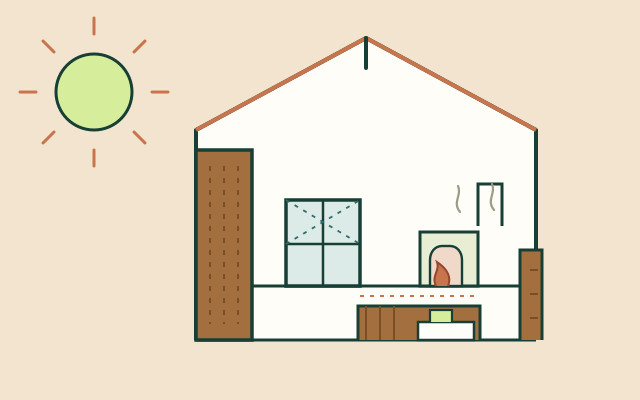
Warmth is not a fuel problem first. It is a building problem, a clothing problem and a behaviour problem. A group that seals its draughts, insulates its roof, stores heat in mass and heats one small room will be warmer on a fraction of the wood of a group that builds a big fire in a leaky hall.
Heat is not the same as warmth
You feel warm when your body loses heat at the right rate. Air temperature is only part of that: radiant heat from a warm surface, cold surfaces sucking heat from your skin, draughts, damp air and the insulation of your clothing all matter. A room at 16 °C with warm walls and no draughts can feel better than a room at 22 °C with cold windows and a wind blowing under the door.
Heat leaves a building by conduction through walls, roof and floor; by convection through gaps and chimneys; and by radiation through cold surfaces. Insulation slows conduction. Air sealing stops convection. Thermal mass stores heat and releases it slowly. Solar gain adds free heat. You need all four working together.
First, stop the leaks
Before you build a bigger fire, find the air leaks. A smoking incense stick, a candle flame or a wet hand on a windy day will show you the gaps around doors, windows, roof junctions, chimneys and floorboards. Seal the big ones with clay, lime mortar, oakum, wool, cloth or fitted boards. A vestibule or double-door entry stops a whole room of heat leaving every time someone comes in.
Insulate the roof first: heat rises, and an uninsulated roof can lose more heat than every wall combined. Use local materials: straw, reed, wool, sawdust, wood shavings, cork, or a clay-straw mix. Keep insulation dry and leave a ventilated cold side. Insulate the floor if it is over cold ground or a crawl space, and insulate the edges of a concrete or stone slab.
Windows are holes in the insulation. Use small windows on the cold sides, fit shutters and heavy curtains, and close them at dusk. A second layer of glazing — even a removable storm window — creates a trapped air layer that roughly halves the heat loss. If glass is unavailable, use translucent cloth, oiled paper or a double layer of clear plastic over a frame; each has trade-offs, but all beat a bare hole.
Store heat in mass
Thermal mass is the ability of a material to absorb and store heat. Stone, brick, earth and water are good; straw, wool and dry wood are not. A masonry stove, an earth bench, a stone floor or a thick internal wall can absorb heat from a short, hot fire and release it for hours after the fire is out.
Put mass inside the insulated envelope, where it can be warmed by the sun and the fire. Insulate the outside of a mass wall, not the inside, or you isolate the mass from the room. A south-facing stone or earth wall behind glazing is a simple solar collector: it absorbs sun during the day and releases heat at night. It needs a clear view of the winter sun and shade in summer, and it must not be covered by furniture or curtains.
Water stores more heat per volume than masonry. A covered barrel or a stone trough near the fire can act as a heat store, but it also raises humidity and needs to be safe around children. Do not use an open container of water as a heater without considering scald risk and evaporation.
Make a small fire hot
A smouldering fire wastes wood and pollutes the air. A small, hot fire with dry fuel, plenty of air and a hot chimney burns cleanly and gives more useful heat. Use split, seasoned wood; burn it in a stove or a well-designed fireplace, not an open hearth that sucks warm room air up the chimney.
A masonry heater is a batch-fired stove with a firebox, a winding flue and a large mass of brick or stone. It burns hot and fast, then radiates heat for many hours. A rocket mass heater uses an insulated J-tube and a horizontal exhaust pipe buried in a thermal-mass bench. Both need careful design, a safe chimney and a carbon-monoxide alarm. Do not improvise a flue through a combustible roof or wall.
A heated platform — the Chinese kang, the Korean ondol, or a simple flue under a raised bed — warms the sleeping surface rather than the whole room. It is an efficient way to keep people warm at night with a small fire, but it must be built so that smoke cannot leak into the sleeping space. If you cannot guarantee a gas-tight flue, use a hot-water bottle, a soapstone slab warmed by the fire, or simply better bedding instead.
A warm-room plan
Choose one room to heat properly and close it off from the rest. Insulate its ceiling, seal its door, add a small stove or a masonry heater, and put the thermal mass where the sun and fire can reach it. Hang a heavy curtain across the doorway. Let the rest of the house be cold but dry, and heat the room you actually use.
Warm the person as well as the room. Wool, layered clothing, hats, dry socks and a warm bed matter more than a few degrees of air temperature. A four-poster bed with curtains, a bed warmer, a hot-water bottle, a shared bed and a raised platform away from a cold floor are all old, effective technologies. Dry clothes and bedding before bed; damp fabric pulls heat from the body.
Ventilate, but do not draught. A stuffy, damp room feels colder and grows mould. Open a high window briefly to change the air, then close it. Keep the kitchen and bathroom ventilated separately. Never block a chimney or a combustion-air vent to “keep the heat in”.
Fuel and the woodlot
Dry wood contains roughly 15–20 MJ/kg; wet wood wastes much of that boiling off water. Season split wood for at least a year, under cover, with air moving through the stack. Coppice hazel, ash, willow and oak on a rotation; use small roundwood for a rocket stove and split logs for a masonry heater. Charcoal is a concentrated fuel for cooking and forging, but it is too valuable to burn for space heating if wood is available.
Insulate the chimney and keep it clean. A cold chimney creosotes and smokes; a dirty chimney catches fire. Burn dry fuel, avoid long smouldering nights, and sweep the flue regularly. If you burn coal or dung, check local rules and use a suitable flue; these fuels produce more pollutants and corrosive deposits.
Troubleshooting
| Problem | Likely cause | Fix |
|---|---|---|
| Room heats slowly, fire roars | Draughts, uninsulated roof, open chimney | Seal gaps, insulate the ceiling, fit a stove or damper |
| Warm near the fire, cold elsewhere | Radiant heat only; no air circulation | Add a small fan or a thermal-mass bench; heat a smaller room |
| Fire smokes into the room | Cold or blocked flue, backdraft, wet wood | Warm the flue, clean it, extend the chimney, use dry wood |
| Condensation on walls and windows | Damp air, poor ventilation, cold surfaces | Ventilate briefly, insulate cold surfaces, dry clothes outside |
| Wood burns away fast, little heat | Too much air, unseasoned wood, open fire | Use a stove, reduce the air, season the wood |
Safety
Carbon monoxide is the silent killer. Any combustion appliance needs a proper flue, a supply of fresh air and a CO alarm where possible. Never sleep in a room with an unvented fire, and never block a flue to keep heat in. Fire. Keep stoves and chimneys clear of combustible material; use a fireproof hearth; sweep the chimney; keep a water bucket and sand nearby. Scalds and burns. Stove surfaces, hot water and steam can burn; use guards around children. Hypothermia. Cold, wet and exhausted people need shelter, dry clothing and gradual warmth — not a hot bath or a huge fire. Seek medical help for confusion, slurred speech or uncontrolled shivering.
Sources and further reading
- Wikipedia: Thermal mass — how mass stores and releases heat.
- Wikipedia: Passive solar building design — orientation, glazing and mass.
- Wikipedia: Masonry heater — batch firing and heat storage.
- Wikipedia: Rocket mass heater — principles and safety considerations.
- Wikipedia: Ondol — heated sleeping platforms.