Water & sanitation · Sanitation
Sanitation is water infrastructure.
A well is only as safe as the nearest latrine, manure heap or greywater puddle. Toilets, handwashing and greywater belong in the water plan from the first day.
Human waste carries pathogens that can reach groundwater, wells, ponds and hands. The goal is not a particular toilet; it is containment, treatment, hand hygiene and a safe end use.
- Contain
- Separate from water
- Wash hands
- Treat before reuse
- Setback
- 30 m+From wells and springs, downhill; local rules may require more.
- Compost
- 1–2 yearsFor a managed twin-vault system, with testing and local advice.
- Hands
- Every timeSoap or ash and water after the toilet and before food.
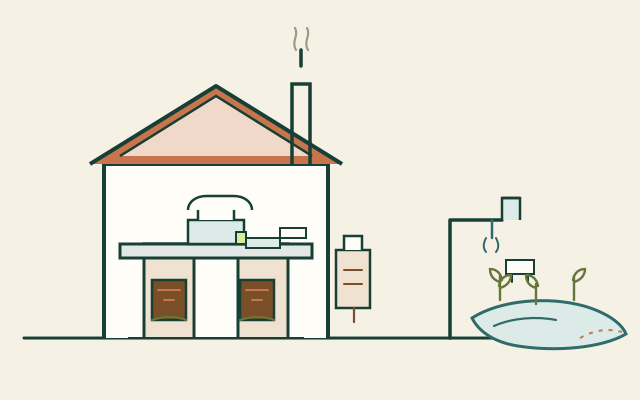
The faecal–oral route
Why sanitation comes first
Pathogens in human waste reach people through water, food, flies, soil and hands. A toilet interrupts some routes; handwashing, safe water and greywater management interrupt the rest.
Diarrhoeal disease is a major killer of young children, and much of it is preventable with safe excreta disposal, handwashing and safe water. A settlement that invests in a well but not in sanitation is building a contamination pathway. The two must be planned together.
Sanitation is also a dignity issue, a privacy issue and a legal issue. A household toilet that is safe, clean and private is more likely to be used than a shared facility that is dark, smelly and far away. Involve the people who will use and maintain it.
Distance and direction
Siting
A latrine uphill of a well is a contamination machine. Put distance and elevation between waste and water.
| Factor | Rule of thumb | Why |
|---|---|---|
| Distance from wells and springs | At least 30 m, more on permeable ground | Pathogens travel in groundwater and surface runoff. |
| Slope | Downhill of water sources and the house | Runoff should move away from water, not into it. |
| Flood risk | Above the flood line | A flooded pit spreads contamination and collapses. |
| Groundwater | Avoid a high water table; check the wet-season level | Waste can enter shallow groundwater. |
| Soil | Deep, well-drained soil; avoid fissured rock and karst | Thin soil and rock cracks carry contamination fast. |
| Access | Private, safe, lit or clearly marked | A toilet people avoid using is a health risk. |
| Legal | Check setbacks, permits and protected areas | Penalties and public-health rules apply. |
30 m is a minimum, not a guarantee. On sandy or fissured ground, or with a high water table, a latrine can contaminate a well much farther away. Get local hydrogeological advice and test the water.
Choose the containment
Toilet options
There is no universal toilet. The right choice depends on water, soil, climate, space, budget, culture and who maintains it.
| Option | How it works | Best / limits |
|---|---|---|
| Simple pit latrine | A lined or unlined pit, slab, cover and a simple shelter | Cheap and fast; flies, odour, groundwater risk, limited life; not for high water tables |
| Ventilated improved pit (VIP) | A pit with a vent pipe and fly screen; the shelter is kept dark | Reduces flies and odour; still a pit; needs a good slab, vent and maintenance |
| Twin-vault composting toilet | Two chambers used alternately; carbon cover; vent; compost after 1–2 years | No water, reuses nutrients; management, space and pathogen care; check local rules |
| Urine-diverting dry toilet | Urine separated at the seat; faeces dried and composted | Less odour and volume; urine use needs dilution and care; user discipline |
| Greywater system | Kitchen, bath and laundry water to a mulch basin or planted bed | Keeps greywater out of water sources; not for toilet waste; needs the right plants and soils |
Whatever you choose, the top of the system matters: a clean slab, a lid, a vent, a handwashing point and a shelter that people want to use. A toilet that is unpleasant will be avoided, and an avoided toilet contaminates the yard.
Pathogens, carbon and time
Composting toilets
Composting is not just “let it rot”. It needs the right carbon, moisture, air, time and management — and a realistic plan for the finished material.
A twin-vault toilet uses one chamber while the other rests. After each use, add a carbon cover — sawdust, dry leaves, straw, shredded paper or fine wood shavings — to absorb moisture, reduce smell and balance the nitrogen. Keep the contents moist but not wet, ventilate the chamber, and turn or move material according to the design. A well-managed chamber rests for at least a year, often two, before it is emptied.
Composting reduces pathogens, but it does not guarantee a sterile product, especially in a small, cool or poorly managed system. Use the finished compost on ornamental plants, trees or non-food crops unless you have testing and local public-health approval for food crops. Wear gloves, keep children away, and never use fresh human waste. Do not add kitchen waste, chemicals or non-compostable material to a toilet chamber.
Urine is rich in nitrogen and can be diluted and used as a fertiliser, but it needs careful handling, dilution, application timing and local advice. Do not apply it directly to leafy or root crops, and do not use it where it can reach a well or pond.
Human waste is a health hazard. Follow local public-health rules for composting, testing and reuse. If you cannot manage the compost safely, use a sealed pit or a municipal service instead of improvising.
The cheapest health intervention
Handwashing
Soap and water after the toilet and before food prevent more disease than most hardware. Make it easy, visible and always available.
A tippy tap — a container with a small hole and a foot-operated string — costs almost nothing and uses very little water. Put one beside the toilet and one near the kitchen. Provide soap or ash; ash is a traditional substitute when soap is unavailable, but soap is better. Wash both hands with running water for at least 20–30 seconds, including between the fingers and under the nails.
Handwashing only works if the water is available and the point is maintained. Refill the container, empty the wastewater to a mulch basin, and keep soap dry. A handwashing station that is empty is worse than none: it gives false confidence.
The other wastewater
Greywater
Greywater is everything except toilet waste: kitchen, bath, laundry and handwashing water. It can irrigate, but it can also pollute.
Greywater carries soap, grease, food particles, hair, lint and sometimes chemicals. It should not be stored for more than a day, sprayed into the air, or allowed to pond. Keep it away from wells, springs, ponds, foundations and places where children play. Avoid bleach, boron, salt, paints, medicines, solvents and strong cleaners; these can damage plants and soil.
A mulch basin is the simplest treatment: a shallow, level basin filled with coarse mulch, planted with thirsty, tolerant plants, and fed below the surface. Alternate between two or more basins so each can rest and dry. A constructed wetland — a gravel-and-sand bed planted with reeds — treats greywater more thoroughly but needs a larger area, a primary settling tank and regular maintenance. Both need a plan for grease, solids and overflow.
Apply greywater to ornamental plants, fruit trees or non-food biomass rather than leafy or root crops. Drip or subsurface application reduces contact. If the system smells, ponds or attracts flies, it is overloaded or anaerobic; stop, fix the cause and do not add more water.
Keep it working
Maintenance and monitoring
A toilet, a vent and a greywater bed are only as good as the weekly check.
- Check the slab, lid, door and vent; repair cracks before water gets in.
- Keep the carbon cover stocked and the toilet dry; empty the urine container before it overflows.
- Clean the handwashing point and refill it; keep soap or ash available.
- Inspect the greywater basin for ponding, smell, flies and blockage; rotate basins.
- Keep a record of chamber filling, emptying, compost dates and any health problems.
- Check the distance and drainage between toilets, greywater and water sources every season.
- Use gloves for emptying; wash hands after; keep children and animals away.
Never enter a pit or chamber to clear it. Pit gases can be dangerous and the space can collapse. Use long-handled tools, a pump or a trained service. Do not smoke or use a flame near a pit.
Scope and safety
Waste is a health hazard, not a garden input by default.
These are general principles, not public-health approval. The safe reuse of human waste depends on containment, treatment, testing and local rules.
Before building or reusing:
- Check setbacks, permits and local sanitation rules.
- Keep toilets and greywater downhill and away from wells, springs and ponds.
- Wear gloves when handling waste or compost; wash hands afterwards.
- Do not use fresh or poorly composted human waste on food crops.
- Never enter a pit or chamber; use trained emptying services.
- Get medical advice for diarrhoea, persistent fever or blood in stool — especially in children. See health and first aid for the household baseline and emergency plan.
Link sanitation to the water system, the well guide and the landscape plan.
Sources and further reading
Where to check the details
Sanitation is local: soil, water table, climate, culture and law all matter. Use public-health guidance and experienced builders.
- Wikipedia: Pit latrine — simple pit design and siting.
- Wikipedia: Ventilated improved pit latrine — venting and fly control.
- Wikipedia: Composting toilet — chambers, carbon and pathogen reduction.
- Wikipedia: Urine-diverting dry toilet — separation and reuse.
- Wikipedia: Greywater — sources, treatment and reuse.
- WHO: Guidelines for drinking-water quality — water safety context.
- CDC: Global water, sanitation and hygiene — public-health guidance.
- CAWST — household water treatment and sanitation resources.
Build the toilet and the handwashing point together.
A toilet without a handwashing station is only half a barrier. Put them in the same project, the same budget and the same maintenance routine.