Rainwater harvesting
Roof, gutter, first-flush diverter, tank and filter. Low-energy and usually clean, but storage is limited by tank size and dry-season length.
Rooted field guides · Water & sanitation · Edition 01
A settlement water system from roof and spring to well, tank, filter, toilet and greywater bed — designed as a chain, not a collection of gadgets.
Water is the easiest thing to collect and the easiest thing to ruin. A clean source can be contaminated by a bucket, a leaking wellhead, a latrine uphill, or a greywater puddle beside the kitchen door. The system matters more than the source.
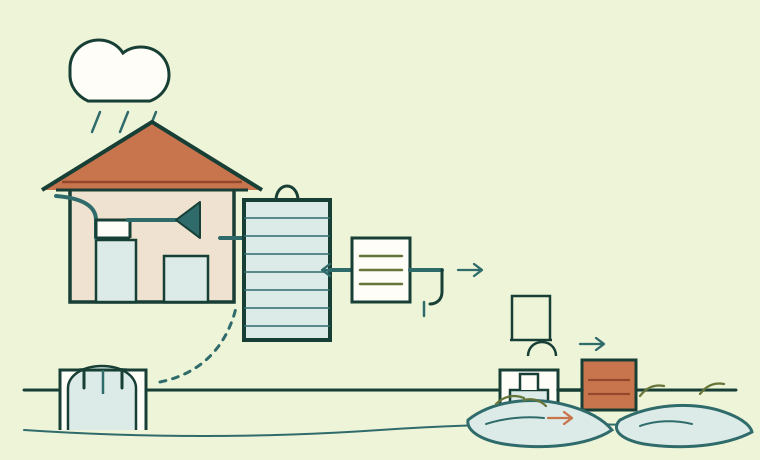
The whole system
Water is clean at the source, clean in the store, clean at the tap and clean at the toilet. Every link has to hold; one neglected link contaminates the rest.
Roof, spring, well or pond. Protect the source from animals, runoff, latrines and chemicals before the water reaches a tank.
A covered tank, underground cistern or reservoir. Store cool, dark and covered; screen the inlet and overflow; keep the outlet above the sediment.
Filter, boil, chlorinate or solar-disinfect. Treatment is a barrier, not an excuse for a dirty source. Test what comes out.
Drinking, cooking, washing, livestock and irrigation. Keep drinking-water containers separate and never dip a dirty cup into a clean store.
Toilet, handwashing and safe containment of human waste. This is the link most likely to contaminate a well or pond.
Greywater to a mulch basin or planted bed; composted human waste to non-food crops after proper treatment; runoff to a rain garden.
Choose the source
Most settlements use more than one source: rain in the wet season, a spring or well in the dry, a pond for fish and irrigation. Design them as backups, not duplicates.
Roof, gutter, first-flush diverter, tank and filter. Low-energy and usually clean, but storage is limited by tank size and dry-season length.
A protected spring can feed a tank and tap by gravity. It is the lowest-energy source if the spring is reliable and the catchment is protected.
A hand-dug shaft or narrow borehole reaches groundwater. Test the water, seal the headworks and never site a latrine or manure store uphill.
Surface water for fish, irrigation and habitat — not drinking water without treatment. Protect the catchment and the spillway.
Defence in depth
No single step makes water safe. Source protection, treatment and clean handling are separate barriers; if one fails, the others still help.
The quiet source
A spring is a natural overflow of groundwater. If it is reliable and protected, it can supply a settlement with no pump and no fuel.
Find the true outlet, not a seep that appears only after rain. Dig back carefully to the source, build a spring box of stone, brick or concrete with a removable lid, and collect the water from a clean outlet. Seal the box against surface water, fence it from animals, and pipe it to a covered tank or standpipe with a continuous fall. A spring box is a capture structure, not a filter: test the water and protect the catchment.
Gravity systems need a reliable fall, a pipe that can be drained and cleaned, and an overflow that does not erode the slope. Keep a spare length of pipe and fittings. If the spring is low in summer, plan a second source or storage before the dry season.
Do not dig out a spring without advice. A spring can be a legally protected water source, and uncontrolled excavation can collapse the outlet or contaminate it. Check water rights and get local guidance.
The other half of the system
A well is only as safe as the nearest latrine, manure heap or greywater puddle. Sanitation belongs in the water plan from the first day.
Human waste contains pathogens that can reach a well through groundwater, a flooded pit, flies or contaminated hands. A toilet is not enough: it needs a safe containment, a vent, a cover, handwashing and a plan for the compost or sludge. Greywater carries soap, grease, food particles and sometimes chemicals; it needs a planted basin or wetland, not a puddle beside the door.
A first system
You do not need every source. Build one reliable source, one store, one treatment barrier, one toilet and one greywater bed — then improve.
Keep the system honest
A water system fails quietly. Measure the things that would tell you before the household does.
| Measure | A good sign | Start with |
|---|---|---|
| Source yield | The source still produces at the end of the dry season. | Well recovery test or spring flow measurement. |
| Storage days | At least the length of the longest dry spell or supply interruption you expect. | Tank size and daily use record. |
| Water quality | No bacterial contamination; no unusual colour, smell or taste. | Local lab or test kit; retest after floods and repairs. |
| Sanitation separation | Latrines, manure and greywater are downhill and well away from water sources. | Site map with 30 m separation and drainage arrows. |
| Maintenance | Gutters, screens, filters and covers are intact; spares are in store. | Monthly walk-around and a written repair log. |
Scope and safety
These pages describe general principles and small-scale methods. They are not a substitute for local water testing, engineering, public-health advice or water law.
Before you build or change a water system:
Use the well guide for source construction, the landscape guide for slope and planting, and the site atlas for local ground and water context.
Protect one spring, fit a first-flush diverter to one roof, cover one tank, or build one toilet with a handwashing point. Then measure what changed.