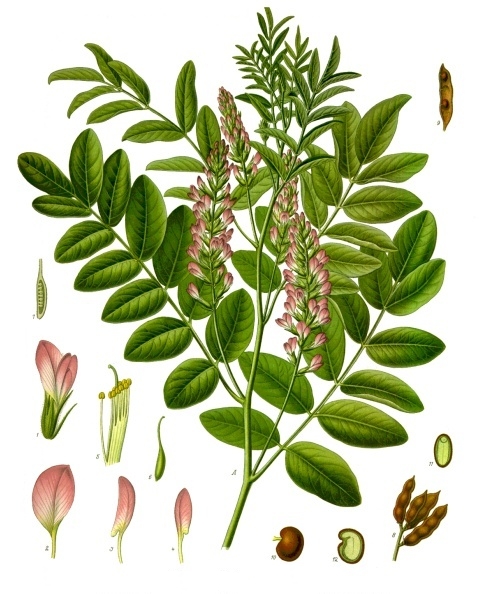
Traditionally used for dry, irritating cough; hoarseness and voice strain; a harmonizing herb in formulas.
Traditional uses
- For dry, irritating cough—coats and soothes throat
- For hoarseness and voice strain
- As a harmonizing herb in formulas (TCM uses it to balance other ingredients)
- For gastric irritation accompanying respiratory illness
Conditions it is used for
Respiratory System
Fever & Infection
Circulatory System
Oral & Dental Health
In the old texts
Licorice appears in virtually every major pharmacopoeia. It is one of the most frequently used herbs in TCM formulas. Ibn Sina documented it extensively for respiratory complaints. Ayurveda considers it a premier remedy for Vata and Pitta coughs. Its demulcent and anti-inflammatory properties make it a cornerstone of respiratory treatment.
What does the work
- Glycyrrhizin
- Triterpene saponin from licorice root, 50× sweeter than sucrose.
Cautions
- Drug interactions Serious
Herbs can alter drug metabolism via CYP450 induction (St. John’s wort induces CYP3A4 1) or inhibition (piperine inhibits CYP3A4 and P-glycoprotein), causing subtherapeutic or toxic drug levels. - Heart conditions Serious
Cardiac glycoside-containing plants (foxglove, lily of the valley) inhibit Na+/K+-ATPase; sympathomimetics (ephedra) increase cardiac workload; both carry arrhythmia risk in pre-existing cardiac disease. - Kidney conditions Serious
Herbs containing oxalates (rhubarb, sorrel), aristolochic acid, or high-dose tannins can cause tubular damage, interstitial nephritis, or aggravate existing renal impairment by increasing filtration burden. - Liver conditions Serious
Hepatotoxic constituents including pyrrolizidine alkaloids, pulegone (pennyroyal), and kava lactones can cause veno-occlusive disease, centrilobular necrosis, or cholestatic injury in susceptible individuals 2. - Pregnancy Serious
Many herbs cross the placental barrier and may stimulate uterine contractions (emmenagogue/oxytocic effects) or disrupt fetal development. Alkaloids, volatile oils, and anthraquinone laxatives carry particular risk 3. - Blood pressure Take care
Herbs with ACE-inhibiting, calcium-channel-blocking, or vasodilatory activity may cause additive hypotension when combined with antihypertensive drugs, particularly in salt-depleted individuals.
These are the cautions recorded for this plant, not a complete list. Doses, preparations and interactions vary; ask a pharmacist or qualified practitioner before combining a herb with medication.
Research references
- Moore LB et al.. St. John’s wort induces hepatic drug metabolism through activation of the pregnane X receptor. Proc Natl Acad Sci USA, 2000.
- Teschke R et al.. Herbal hepatotoxicity: a tabular compilation of reported cases. Liver Int, 2012.
- Ernst E. Herbal medicinal products during pregnancy: are they safe?. BJOG, 2002.