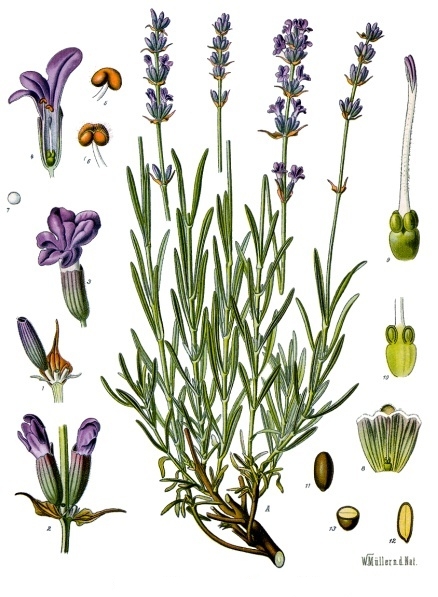
Traditionally used for tension headache with stress or anxiety component; migraine; headache with insomnia.
Traditional uses
- For tension headache with stress or anxiety component
- For migraine (inhalation at onset)
- For headache with insomnia
Conditions it is used for
Pain & Inflammation
Wounds, Skin & External Conditions
Nervous System & Mental State
In the old texts
The use of lavender oil for burns is attributed to French chemist René-Maurice Gattefossé, who reportedly burned his hand in a laboratory accident in 1910 and plunged it into lavender oil, experiencing rapid healing with minimal scarring. This story helped launch modern aromatherapy. Whether apocryphal or not, lavender’s soothing and healing properties for minor burns are traditional. For Burns: Diluted oil: Lavender essential oil diluted in carrier oil (2-3% dilution) applied to minor burns Neat application: Some use undiluted lavender (one of the few essential oils considered safe undiluted) on small burns—use caution and test sensitivity first Lavender-infused oil:* Gentler than essential oil
What does the work
- Linalool
- Monoterpene alcohol found in lavender, coriander, basil, and many aromatic plants.
- Volatile oils
- Complex mixtures of terpenes, terpenoids, and phenylpropanoids responsible for plant aromas and many therapeutic effects.
Combines well with
Chamomile European
Gentle calming tea safe for children and sensitive people
How: Apigenin (chamomile) binds GABA-A benzodiazepine receptors with anxiolytic effect; rosmarinic acid (lemon balm) inhibits GABA-transaminase; linalool (lavender) modulates glutamate binding at NMDA receptors—triple anxiolytic via three distinct molecular targets
Lemon Balm European
Gentle calming tea safe for children and sensitive people
How: Apigenin (chamomile) binds GABA-A benzodiazepine receptors with anxiolytic effect; rosmarinic acid (lemon balm) inhibits GABA-transaminase; linalool (lavender) modulates glutamate binding at NMDA receptors—triple anxiolytic via three distinct molecular targets
Cautions
- Drug interactions Serious
Herbs can alter drug metabolism via CYP450 induction (St. John’s wort induces CYP3A4 1) or inhibition (piperine inhibits CYP3A4 and P-glycoprotein), causing subtherapeutic or toxic drug levels. - Cooling / Cold conditions Worth knowing
Cooling herbs (peppermint, chamomile) activate TRPM8 receptors and have peripheral vasodilatory effects that may worsen cold-pattern presentations in traditional diagnostic frameworks. - Sedation Worth knowing
GABAergic herbs (valerian, kava, passionflower) potentiate GABA-A receptor activity, producing additive sedation when combined with benzodiazepines, barbiturates, or alcohol 2.
These are the cautions recorded for this plant, not a complete list. Doses, preparations and interactions vary; ask a pharmacist or qualified practitioner before combining a herb with medication.
Research references
- Moore LB et al.. St. John’s wort induces hepatic drug metabolism through activation of the pregnane X receptor. Proc Natl Acad Sci USA, 2000.
- Khom S et al.. Valerenic acid potentiates and inhibits GABA(A) receptors: molecular mechanism and subunit specificity. Neuropharmacology, 2007.