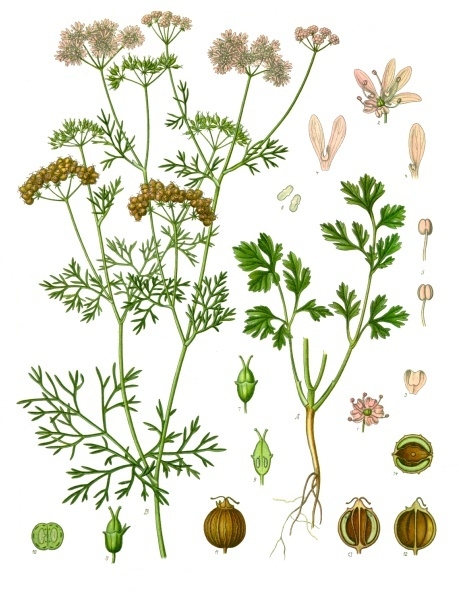
Traditionally used for acid indigestion, heartburn, burning sensations; digestive issues in summer or hot climates; urinary burning and heat conditions generally.
Traditional uses
- For acid indigestion, heartburn, burning sensations
- For digestive issues in summer or hot climates
- To balance formulas containing warming herbs
- For urinary burning and heat conditions generally
Conditions it is used for
Digestive System
In the old texts
Coriander seeds appear in Charaka Samhita, Ibn Sina’s works, and Dioscorides. It is notable for its cooling nature—where ginger and cumin are warming, coriander brings balance, making it suitable for “hot” digestive conditions.
What does the work
- Linalool
- Monoterpene alcohol found in lavender, coriander, basil, and many aromatic plants.
- Volatile oils
- Complex mixtures of terpenes, terpenoids, and phenylpropanoids responsible for plant aromas and many therapeutic effects.
Combines well with
Cumin Ayurveda
Balanced digestive support—cumin stimulates, coriander cools, fennel soothes
How: Cuminaldehyde stimulates digestive enzyme secretion; linalool (coriander) is antispasmodic on GI smooth muscle; anethole (fennel) relaxes intestinal musculature via calcium channel modulation
Fennel Ayurveda
Balanced digestive support—cumin stimulates, coriander cools, fennel soothes
How: Cuminaldehyde stimulates digestive enzyme secretion; linalool (coriander) is antispasmodic on GI smooth muscle; anethole (fennel) relaxes intestinal musculature via calcium channel modulation
Cautions
- Blood pressure Take care
Herbs with ACE-inhibiting, calcium-channel-blocking, or vasodilatory activity may cause additive hypotension when combined with antihypertensive drugs, particularly in salt-depleted individuals.
These are the cautions recorded for this plant, not a complete list. Doses, preparations and interactions vary; ask a pharmacist or qualified practitioner before combining a herb with medication.