Crop 041 / Brassica rapa subsp. rapa

A quick root, with greens to spare.

Grow turnips in a cool, evenly moist window for tender white-fleshed roots and peppery leaves. Sow a short row, thin before seedlings crowd, and cover the bed with fine mesh where brassica pests fly.

Root and leaf harvests
Fast and dual-purpose Pick young greens, then lift the root while still tender.
Typical crop window
35–70 days Baby roots can be earlier; maincrop roots usually need longer.
Season
Cool and evenly moist Heat, drought and crowding favour poor roots and premature flowering.
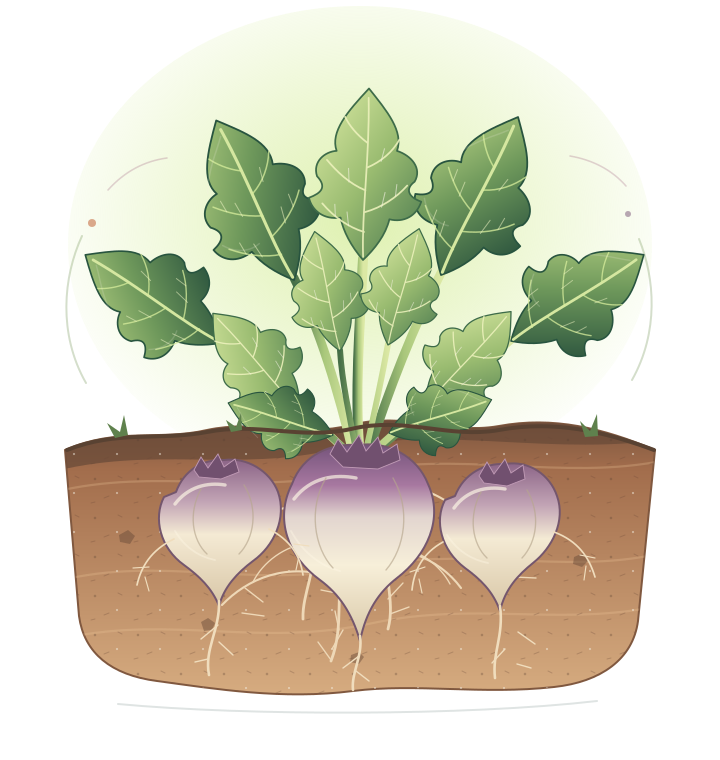
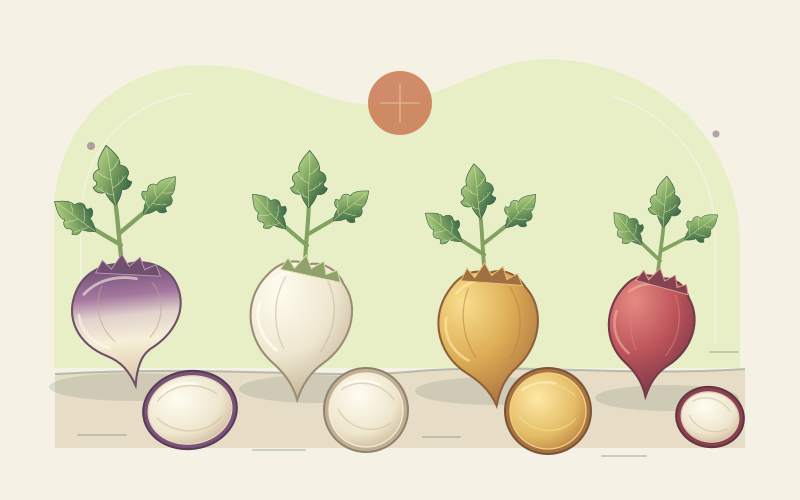
Turnip plants with broad green leaves, pale green stems and round white roots with violet-purple shoulders above fine branching roots.
A garden turnip forms a swollen root with a coloured shoulder where it meets the light; its young leaves are edible too.

Crop profile

Turnip, from quick row to cool store

A biennial brassica normally grown as an annual for its swollen root and leaves. Fast early types suit fresh harvests; later maincrops can be kept for several weeks when harvested sound and stored cool.

Botanical name
Brassica rapa subsp. rapa, the cultivated turnip
Family
Brassicaceae
Origin
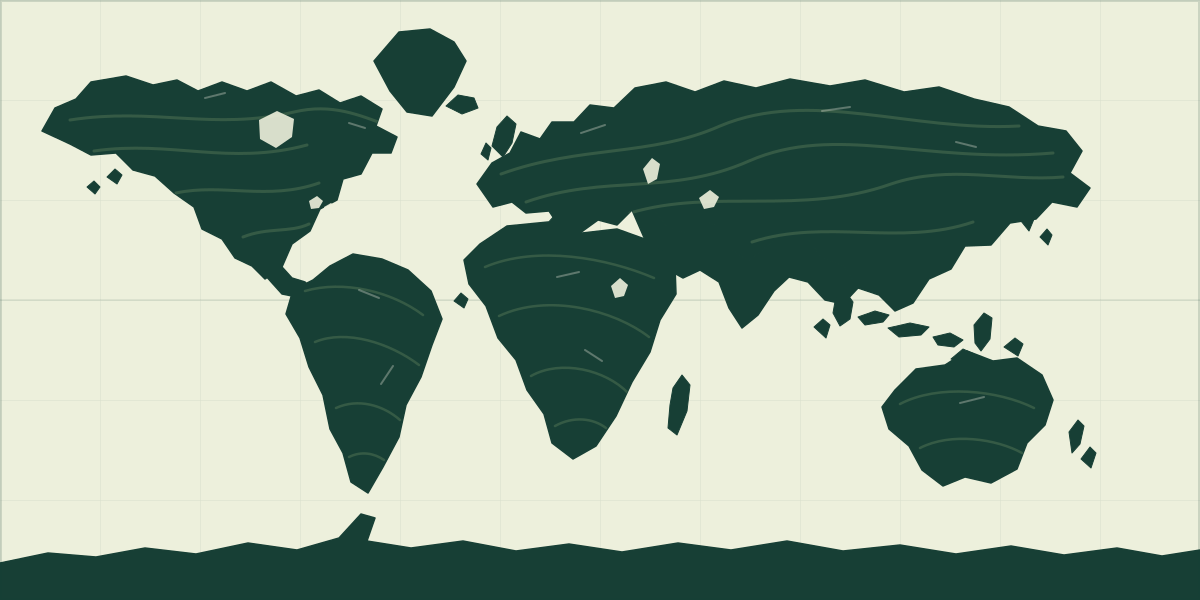
Cultivated across Europe and Asia; the precise origin is uncertain
Growth
35–70 days From direct sowing to a first usable root. Quick early cultivars can produce baby roots in about five to six weeks; maincrop roots commonly need about ten weeks. Young leaves may be picked earlier. Cultivar, temperature, spacing and water supply all affect timing.

Nutrition / cooked turnip roots

Moderate nutrient density · editorial rank 2

“Moderate” is Rooted’s qualitative editorial category, based on protein, fibre, folate, iron and potassium density in cooked foods. It is not an official nutrient score or a promise of a health outcome.

Approximate values per 100 g cooked turnip roots, boiled and drained without salt.
Nutrient Amount
Protein0.71 g
Fibre2 g
Folate9 µg
Iron0.18 mg
Potassium177 mg

Basis: Approximate values per 100 g turnips, cooked, boiled, drained, without salt (USDA FoodData Central SR Legacy 170058). View the USDA reference.

Roots are not leafy tops. These values are for turnip roots only; cooked turnip greens have a distinct leafy-green profile. The same root record supplies 11.6 mg vitamin C per 100 g. Boiling and draining can reduce water-soluble nutrients.

Values are not interchangeable with raw, roasted, canned or frozen turnips. Preparation, added ingredients and serving size change nutrient intake.

At the table

Build a varied meal around turnips

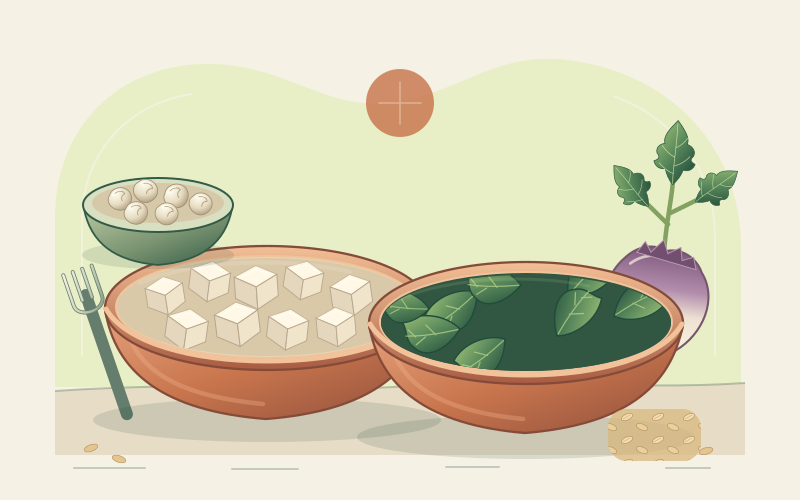
  • Beans, lentils or chickpeas — protein and fibre variety: Turnip roots contain little protein, so legumes can make a root-based meal more varied and filling while adding fibre, folate and minerals. Add diced turnip and its cooked greens to a lentil stew, or serve roasted roots with chickpeas.
  • Peppers, tomatoes or citrus — vitamin C and non-heme iron: When a meal includes beans or another plant source of non-heme iron, vitamin-C-rich vegetables or fruit can support iron absorption. The response depends on the whole meal and the person. Serve a turnip and bean bowl with tomatoes and peppers, or finish it with lemon.
  • Grains, eggs, fish, yogurt or tofu — a varied plate: Grains add energy and texture, while eggs, fish, yogurt or tofu can add protein and different nutrients. Choose according to dietary preferences rather than a required pairing rule. Try turnip roots and greens with barley and tofu, or with rice and fish.

The essentials

From a shallow drill to the storage tray

Six practical stages. Adapt timing and cultivar to your temperatures, soil, pests and intended harvest.

  1. Choose a cool growing window

    Prepare fertile, loose and well-drained but moisture-retentive soil in sun. Sow in spring or late summer where summers are hot, or during the locally mild season elsewhere. Avoid waterlogged ground and hot, dry periods that slow germination and make roots strong or woody.

  2. Direct sow small batches

    Make shallow drills about 1 cm deep, water them if dry, and sow thinly. Leave roughly 23–30 cm between rows and follow the packet where it differs. Direct sowing avoids root disturbance. Short successive rows give a steadier harvest than one large sowing.

  3. Thin before the roots compete

    As soon as seedlings are large enough to handle, thin without leaving crowded clusters. About 10 cm apart suits baby roots or leaf harvests; allow around 15 cm for early types and up to 23 cm for maincrops, following the packet. Sound young thinnings are edible.

  4. Mesh the bed and water evenly

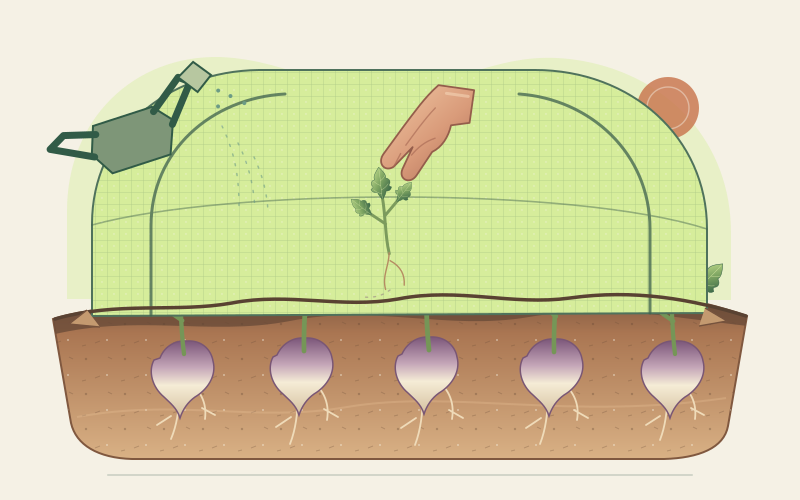
    Where cabbage root fly or flea beetles are expected, install fine insect mesh immediately after sowing. Support it above the foliage, allow growing room and seal every edge with soil or weights. Inspect beneath it regularly. Water thoroughly in dry spells without waterlogging; drought followed by heavy watering can split roots.

  5. Pick greens and lift tender roots

    Take a few sound young leaves at a time, leaving enough foliage if you also want roots. Lift baby turnips at golf-ball size or cooking roots around tennis-ball size, adjusting for the cultivar. Do not wait for the largest root: age, heat and drought increase fibrous texture.

  6. Store sound roots before hard frost

    Turnip roots are not completely hardy. Lift mature, undamaged maincrop roots before severe frost or prolonged saturation. Twist off tops rather than cutting into the crown, and store roots cool, humid and frost-free in slightly damp sand or coir. Use greens soon and inspect stored roots often.

Growing notes by place

Read your region, then read your weather

Compare broad growing conditions, then adjust for your own frost dates, altitude, rainfall and soil.

Cool, temperate and often maritime, with colder springs inland and in upland districts.

Northwestern Europe

Turnips suit spring and late-summer sowing in Britain, Ireland and nearby areas. Early crops need cool but workable soil; hot, dry spells can check growth.

Indicative planting
Sow early cultivars from March–June, or in February under cloches where local conditions allow. Sow maincrops from July to mid-August, in small batches for fresh roots.
Indicative harvest
Pick young leaves from spring onward. Lift early roots from May–September and maincrops from October onward, before severe frost damages roots left outdoors.
Soil and moisture
Fertile, moisture-retentive but well-drained soil in sun; keep a fine seedbed and water during dry spells to limit woody or split roots.

Field note: Fit fine insect mesh immediately after sowing where cabbage root fly or flea beetles are expected; seal the edges and leave room for growth.
Dates are indicative. Local frost forecasts, soil temperature and recent weather—not the calendar alone—should guide sowing and harvest.

Cool-temperate Northern Hemisphere · example

Two cool-season rhythms

A compact planning guide, not a fixed schedule. Shift it with latitude, altitude, cultivar and local conditions.

  1. February–April

    Prepare a fertile, fine seedbed. Start early cultivars under cloches in February where suitable, or direct-sow from March into workable soil; cover against flying pests.

  2. March–June

    Sow short rows every few weeks. Thin promptly for baby or full-size roots, weed by hand, and water evenly before heat or drought checks growth.

  3. July–mid-August

    Sow maincrop turnips for autumn. Keep the seedbed moist through establishment and maintain mesh with space for the developing canopy.

  4. May–November

    Pick young leaves and lift early roots while small; harvest maincrops from October. Before severe frost, move sound keeping roots into a cool, frost-free store.

Leaves can be ready before roots. Hot, dry conditions favour bolting and woody roots, while crowded seedlings stay small. Let plant condition and local weather refine the calendar.

From the field journal

Sow, select and cook your turnips

Practical reading for a fast root crop, a choice of root forms and seasons, and separate kitchens for root and green nutrition.

Your next harvest begins here

Start with one short, covered row.

A small sowing is enough to learn how turnips respond to your soil and weather. Thin early, keep the mesh closed and moisture steady, and use both root and leaf while tender.

Open the growing guide