
Crop 056 / Salvia officinalis

Silver leaves, sharp drainage, patient picking.

Grow common sage as a sun-loving Mediterranean subshrub. Let young plants root before a light harvest, prune leafy growth rather than old bare wood, and dry sound sprigs fully before sealing the jar.

Perennial herb
A short-lived subshrub Productive for several years; propagate replacements before the centre becomes bare and woody.
First leaf harvest
About 75 days–1 year Roughly 75 days from a well-rooted young plant; at least a year from seed.
Essential site
Sun and free drainage Persistent wet around the roots is more damaging than modest soil fertility.
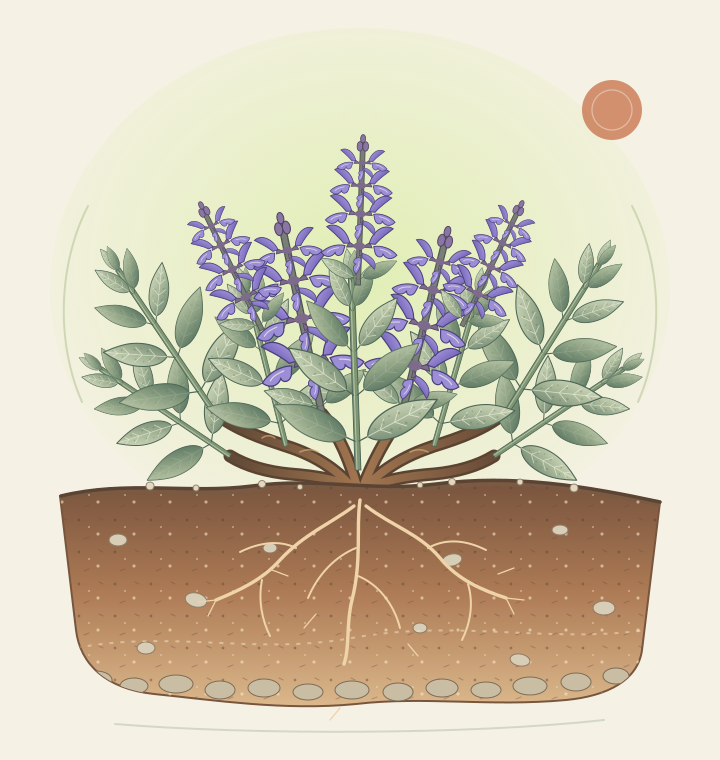
Common sage with opposite textured grey-green leaves, square young stems, woody lower branches and whorls of two-lipped violet-blue flowers above a sharply drained soil cutaway.
Common sage carries simple, opposite, softly textured leaves. Young stems mature into wood; useful new shoots are the place for harvest and careful pruning.

Crop profile

Common sage, from leafy shoot to seasoning jar

A perennial Mediterranean herb harvested for aromatic leaves. It is not an annual to clear-cut: establishment, drainage and restrained cutting determine whether the plant remains useful in later years.

Botanical name
Salvia officinalis, common or garden sage; not every plant called “sage” is this culinary species
Family
Lamiaceae
Origin
Northern Mediterranean region
Growth
75 days–1 year From a young nursery plant to a light first leaf harvest, often about 75 days once established; from seed, allow at least a year to reach harvesting size. Sage remains a perennial, and the first picking must leave most of the plant intact.

Nutrition / uncooked dried ground sage

High nutrient density · editorial rank 3

High This is Rooted’s qualitative category for protein, fibre, folate, iron and potassium in its crop comparison. It is not an official nutrient score, a universal ranking of herbs or a reason to eat 100 g of a strong seasoning.

Approximate values per 100 g dried ground sage, uncooked as sold.
NutrientAmount
Protein10.6 g
Fibre40.3 g
Folate274 µg
Iron28.1 mg
Potassium1070 mg

Basis: Approximate values per 100 g spices, sage, ground, dried and uncooked as sold (USDA FoodData Central SR Legacy 170935). View the USDA reference. This is not a fresh-leaf or cooked-food entry.

Drying concentrates by weight. The reference contains 7.96 g water per 100 g. A teaspoon of ground sage weighs roughly 0.7 g, so a normal seasoning portion supplies only a tiny fraction of these figures. The values do not describe absorption or a health effect.

Do not transfer this profile to fresh sage, fried leaves, tea, extracts or essential oil. Culinary use does not establish medicinal efficacy or make concentrated preparations interchangeable with leaves.

At the table

Use sage as a flavouring, not the whole meal

  • Beans and lentils — substance and savoury depth: Sage adds aroma; pulses add protein, fibre, folate and minerals. Try a little chopped sage with white beans, onion and leafy greens. No special nutrient-combining rule is needed.
  • Squash, cabbage, onions or mushrooms — vegetable variety: These ingredients provide most of the food volume while sage supplies a strong, earthy note. Add chopped leaves near the end of cooking mushrooms and cabbage, or season roasted squash.
  • Grains, eggs, fish or tofu — flexible meals: Use sage sparingly in grain-and-bean stuffing, with tofu or eggs, or in other dishes suited to your preferences. These are culinary choices, not therapeutic pairings.

Kitchen boundary: Do not ingest sage essential oil or treat a recipe as a dose. Sage naturally contains thujone and other aromatic compounds in variable amounts; leaves, extracts and essential oil are not equivalent. Seek qualified advice before using concentrated products, especially alongside medicines or during pregnancy or breastfeeding.

The essentials

Six stages for a plant that stays for years

Adapt timing to local frost, rain and plant condition. The aim is a well-rooted, airy subshrub—not the largest first-year bunch of leaves.

  1. Choose common sage and a dry, sunny site

    Buy or sow Salvia officinalis labelled for culinary use; pineapple sage and Russian sage are different plants. Give sage full sun and soil that never stays saturated. On heavy ground use a raised bed or a pot at least 30 cm wide and deep with open drainage holes and a gritty, peat-free mix.

  2. Start with a plant, seed or cutting

    A nursery plant offers the quickest route to a modest harvest. Sow common-sage seed indoors in spring, cover thinly and grow on in bright conditions, but allow at least a year before substantial picking. Named foliage cultivars are usually propagated by softwood cuttings or layering because they do not come true from seed.

  3. Plant at the same depth and establish roots

    Harden off indoor-raised plants, then set them out in a locally mild window with the root system only lightly covered, not buried deeper than before. Allow roughly 45–60 cm between full-size plants or follow the cultivar label. Water new plants during dry spells in the first year; established garden sage usually needs little extra water where rainfall is adequate.

  4. Prune leafy growth, never old bare wood

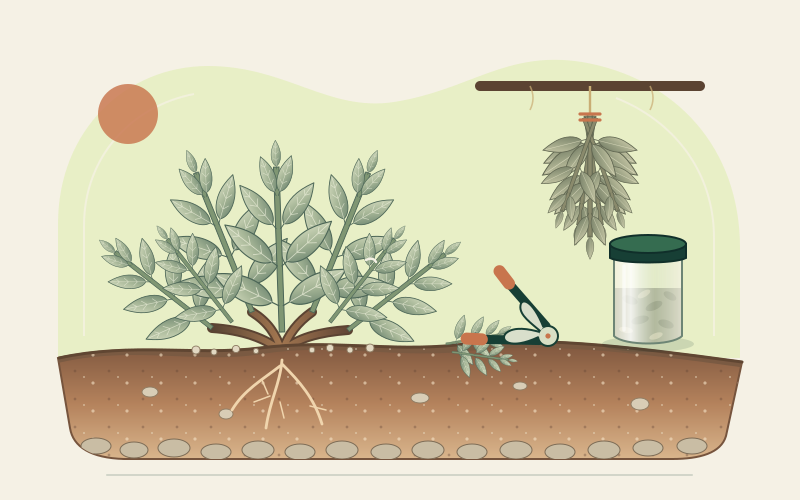
    In mid- to late spring, shorten some young stems lightly to encourage branching and retain a compact shape. Regular small harvests also help. Old leafless wood may not reshoot, so do not shear the whole plant into brown sticks. Remove spent flower stems in late summer and take cuttings before an ageing plant becomes straggly.

  5. Harvest lightly in year one

    A well-rooted young plant may allow a few leaves after about 75 days of active growth; seed-raised plants generally need at least a year. Pick individual leaves or short young shoots before flowering for a main harvest, leaving most foliage and never removing more than a small share of a new plant. Established sage can be picked repeatedly without clearing a whole branch.

  6. Dry completely and store clean

    Harvest sound, dry sprigs after surface moisture has gone. Rinse only if needed under clean running water and dry thoroughly. Hang small bundles or spread sprigs in a warm, dark, clean and well-ventilated place until leaves crumble readily and no cool dampness remains. Strip and pack into a clean, dry airtight jar, label it, check for condensation and discard anything mouldy.

Growing notes by place

Read your region, then read root-zone moisture

Broad regional windows are only a start. Local frost, altitude, rainfall, drainage and cultivar hardiness decide when to plant, prune and pick.

Cool, temperate and often maritime, with milder western coasts, colder inland winters and frequent winter wet.

Northwestern Europe

Representative of Britain, Ireland, the Low Countries and nearby districts. Common sage can persist in a sunny, sheltered, sharply drained site; winter wet and exposed cold are greater concerns than a single calendar date.

Indicative planting
Plant container-grown common sage from April–June after hard frost, once soil is warming. Start seed indoors in spring for a plant to harvest the following year; harden off nursery or home-raised plants before planting out.
Indicative harvest
Pick only a few leaves from an established young plant after roughly 75 days of active growth; allow seed-raised plants at least a year. Established plants yield best from spring to autumn, with light evergreen picking in mild winter weather.
Soil and moisture
Full sun and light, free-draining soil are essential. Use a raised bed or a pot with open drainage holes on heavy ground; avoid a rich, damp bed and water new plants only as needed during establishment.

Field note: Prune lightly in mid- to late spring into stems that still carry leaves, never hard into old bare wood. Shelter pots from prolonged winter rain and replace woody, straggly plants with rooted cuttings.
Dates are indicative. Plant condition, local forecasts and actual drainage—not the calendar alone—should guide planting, pruning and harvest.

Cool-temperate Northern Hemisphere · example

A perennial rhythm, not a one-season row

This example begins with an established plant and a spring-planted nursery specimen. Shift it for your own winters and rainfall.

  1. March–April

    Sow common-sage seed indoors for following-year harvests. Harden off young plants. As established sage begins growing, assess winter damage and improve drainage without burying the crown.

  2. April–June

    Plant out after hard frost into a sunny, drained bed or pot. Prune established plants lightly in mid- to late spring, keeping leafy wood. Water new transplants during dry establishment periods.

  3. June–September

    Pick young leaves or short shoots before flowering and through the growing season. A transplanted young plant may offer a very light first harvest after roughly 75 days of strong growth; leave seed-raised plants to establish.

  4. September–November

    Take final modest harvests early enough for plants to retain sound growth. Dry sprigs under clean cover and pack only when fully brittle. Remove spent flower stems, take replacement cuttings and shelter pots from persistent winter wet.

Sage is evergreen where conditions suit it, but winter leaves may be sparse or weather-damaged. Do not force growth with heavy feeding or prune hard just before cold weather.

From the field journal

Grow, select and season with sage

Practical reading for keeping a perennial plant productive, choosing a true common-sage cultivar and putting concentrated nutrient figures into a cook’s context.

Your next harvest begins here

Start with one plant and one dry, sunny corner.

Let the roots establish, take only a few leaves at first, and prune while the stems still carry growth. A small bunch dried thoroughly is a more useful result than a large harvest from a weakened plant.

Open the growing guide