
Crop 025 / Pyrus communis

Choose the tree before you wait for the pear.

Match grafted European pear to local chill, soil and fireblight pressure. Pair compatible blossom, build a well-spaced framework, then pick mature firm fruit and finish ripening off the tree.

Perennial establishment
Scion and rootstock together The grafted combination determines mature size, anchorage, adaptation and the path to bearing.
First useful crop
2–4 years From planting a young grafted tree under suitable conditions, not an annual seed-to-harvest window or a guarantee.
Pollination and ripening
Compatible blossom; mature firm harvest Most pears crop best with cross-pollination, and European pears develop eating quality after picking.
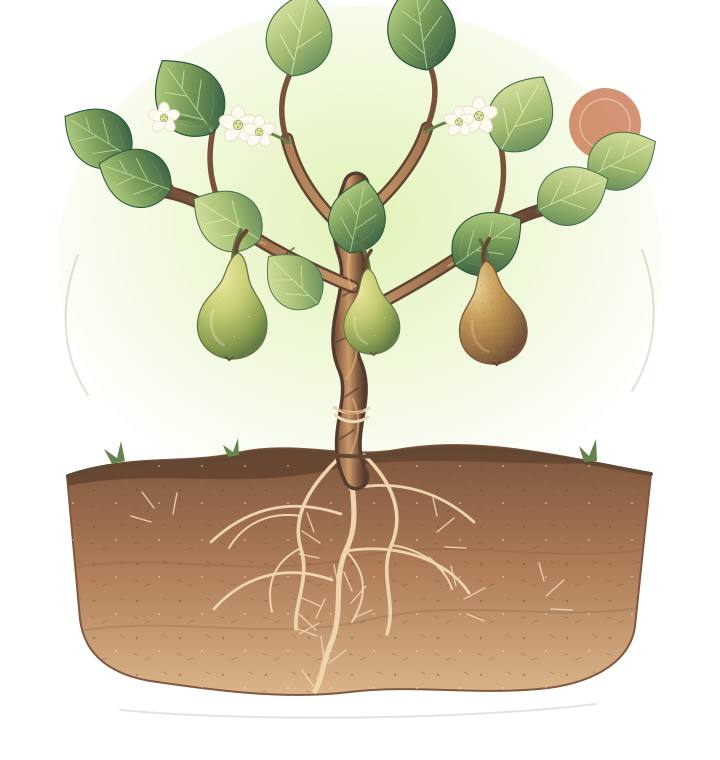
European pear tree with a grafted trunk, white blossom, green and russet pears, oval leaves, and branching perennial roots.
A pear is a long-lived deciduous tree: graft union, root system, scaffold branches and compatible blossom all precede a dependable crop.

Know the crop

Crop profile

A long-lived deciduous tree grown for dessert and culinary fruit. This entry concerns European pear, Pyrus communis; Asian pears and local hybrids are different crops with different texture, harvest and climate behaviour. Scion, rootstock, compatible pollination, winter chill and fireblight pressure determine local success. The first useful crop commonly follows two to four years of establishment, not an annual growing cycle.

Crop essentials

Botanical name
Pyrus communis
Growth
2–4 years From planting a young grafted tree to a first useful crop under suitable conditions. Precocious dwarfing rootstocks and a well-established nursery tree can crop sooner, while vigorous seedling stock, poor pollination, frost, drought, winter injury or fireblight can delay bearing. Full production takes longer; do not remove every flower from a weak tree without also correcting its growing conditions.
Family
Rosaceae
Origin
Europe and western Asia
Habit
Long-lived deciduous perennial tree, commonly grafted on a size-controlling rootstock

Nutrition / raw fresh pear

Nutrition, in context

Moderate Editorial nutrient-density rank 2. This is Rooted’s qualitative category for protein, fibre, folate, iron and potassium in the site’s food comparison, with highlights adding context. It is not an official nutritional score or a promise of a health outcome.

Approximate values per 100 g raw pears, edible portion.
Nutrient Amount
Protein0.36 g
Fibre3.1 g
Folate7 µg
Iron0.18 mg
Potassium116 mg
  • Provides dietary fibre (3.1 g) alongside modest amounts of potassium, folate and very little protein in the raw reference.
  • Contains vitamin C (4.3 mg) and vitamin K (4.4 µg) per 100 g in the same raw entry; neither amount supports a medicinal claim.
  • These are explicitly raw pear values and are not directly interchangeable with cooked vegetables, dried pears, juice, nectar or fruit canned in syrup.

Basis: Approximate values per 100 g raw pears, edible portion (USDA FoodData Central SR Legacy 169118); this is not an Asian-pear, juice, canned or cooked reference. View the USDA reference.

Use sound ripe fruit, wash it under clean running water before cutting, and refrigerate cut pear promptly. Whole fresh pears need cultivar-appropriate cooling and ripening rather than an assumed storage life. Drying or canning requires a tested preservation method; drying concentrates sugar and calories per 100 g by removing water. Listed content does not measure absorption or individual dietary needs.

At the table

Enjoy fresh pears in ordinary meals

  • Yogurt, cheese, nuts or seeds — A varied snack or breakfast: These foods add protein, fat and different nutrients alongside fresh pear. Choose according to dietary preferences and needs rather than treating pear as a required health ingredient. Serve sliced ripe pear with plain yogurt and walnuts, or with cheese and whole-grain bread.
  • Oats or other whole grains — Fibre and practical texture: Pear adds moisture, sweetness and its intact fruit fibre to a grain-based meal, while grains and other ingredients make the meal more substantial. Juice is not nutritionally interchangeable with whole pieces. Dice a ripe pear into oatmeal with seeds, or bake plain pear slices beside an unsweetened grain dish.
  • Beans, lentils, eggs, fish, tofu or meat — A complete savoury meal: Protein-containing foods and vegetables balance a meal in which pear supplies a sweet, juicy component. There is no required nutritional formula or therapeutic pairing. Add sliced pear to a lentil and leafy-vegetable salad, or serve it beside roasted vegetables and a preferred protein food.

The essentials

From grafted tree to ripe pear

Six practical stages for Pyrus communis. Adapt the scion–rootstock combination, pollination, pruning and harvest to local conditions and advice.

  1. Match scion, rootstock and chill

    Choose full sun, moving air, shelter from destructive wind and a site above frost-collecting hollows. Buy a healthy grafted tree with both cultivar and rootstock identified. Rootstock controls mature size, support needs, soil adaptation and sometimes precocity; it does not make every scion fireblight-proof. Confirm that local winter temperatures satisfy the cultivar’s chill requirement without assuming one universal hour count. In marginal climates, use locally trialled cultivars and consider other Pyrus species only as a separate crop choice.

  2. Provide compatible cross-pollination

    Most European pears crop best with pollen from a different compatible cultivar that flowers at the same time. Check pollination-group tables and known incompatibilities rather than buying any two pear names; some cultivars produce poor or no usable pollen. A nearby partner, bee activity and suitable bloom weather all matter. Partly self-fertile cultivars often still crop better with a partner. Plan both trees’ mature spacing and avoid a site where early flowers repeatedly meet frost.

  3. Plant and train a durable framework

    Plant dormant stock when soil is workable, spread roots without bending them into a small hole and keep the graft union above final soil level. Water to settle soil, stake or permanently support stock that needs it, and keep mulch clear of the trunk. Select wide-angled scaffold branches within a locally taught central-leader or other named system. Avoid severe annual heading and excessive pruning that stimulate soft upright shoots; trained cordons and espaliers need their own seasonal pruning routine.

  4. Water, mulch and feed with restraint

    Test soil before correcting pH or nutrients, maintain a weed-free rooting zone and irrigate young trees deeply enough to support establishment without saturation. Containers and dwarfing rootstocks need closer monitoring. Established trees may still need water during prolonged drought while fruit swells. Use compost or mulch appropriately, but avoid high nitrogen and other practices that force lush growth, which can increase susceptibility to fireblight and reduce safe access for picking.

  5. Select and manage for fireblight

    Where fireblight occurs, resistant cultivars and rootstocks reduce risk but do not confer immunity. Inspect blossom, shoots and woody branches for blackened, wilted growth and characteristic bent shoot tips; confirm symptoms with local expertise before treatment. Follow regional rules for pruning infected wood, tool sanitation and disposal, and avoid pruning in wet infection-friendly weather. Do not rely on routine antibiotic or other sprays: use only locally legal, recommended measures matched to a diagnosis and label.

  6. Pick mature firm fruit, then ripen

    European pears usually develop poor texture if left to soften fully on the tree. Learn the cultivar’s normal harvest window; look for a subtle skin-colour change, brown seeds where applicable, and easy separation when the fruit is lifted and gently twisted. Pick while still firm and handle without bruising. Cool sound fruit promptly, giving late cultivars their required cold period; then ripen at room temperature until the neck near the stem yields slightly. Refrigerate ripe or cut fruit, inspect stored fruit often and use tested methods for drying or canning.

Growing notes by place

Read your region, then read your winter

Compare broad growing conditions, then adjust for actual chilling, winter minimums, frost dates, altitude, rainfall, bloom weather and soil.

Cool, temperate and often maritime, with milder western sites, late frosts, variable summer warmth and humid disease-friendly periods.

Northwestern Europe

European pear is well established in suitable districts, but early blossom, cool pollinating weather, fireblight where present and late cultivars needing a long season all require local choices.

Indicative planting
Plant a healthy grafted tree during dormancy from late autumn to early spring when soil is neither frozen nor waterlogged. Choose a locally suitable quince or Pyrus rootstock, stake or support as required, and plan a compatible pollination partner.
Indicative harvest
After establishment, pick mature but still firm fruit roughly late summer–autumn according to cultivar and season. Early types need prompt ripening and use; later types may need cool storage before room-temperature ripening.
Soil and moisture
Deep, fertile but free-draining soil in full sun and shelter; avoid frost pockets and waterlogging. Use soil testing and moderate feeding rather than nitrogen-heavy growth that is vulnerable to fireblight.

Field note: Select an early, locally proven cultivar where summers are short, check the pollination group and fireblight response, and learn regional rules for inspecting and reporting this regulated disease.
Dates are indicative. Local chill, frost forecasts, winter minimums, bloom weather, rainfall and recent weather—not the calendar alone—should guide planting, pruning and harvest.

Cool-temperate Northern Hemisphere · example

A perennial tree’s rhythm

A compact planning guide, not a fixed schedule. Shift it with latitude, altitude, cultivar, rootstock, training system and local conditions.

  1. December–February

    Inspect support, guards and graft union. Order or plant dormant stock when soil is workable, and prune within the locally recommended dry, dormant window using the chosen training system.

  2. March–April

    Watch bud development and local frost forecasts. Confirm that compatible partners overlap in bloom, protect pollinators and inspect blossom and new shoots for fireblight symptoms without unnecessary wet-weather pruning.

  3. May–August

    Train the framework, water during dry establishment and thin an excessive fruit set using local spacing guidance. Retain healthy foliage, avoid nitrogen-driven soft growth and monitor for regional pests and disease.

  4. August–October

    Harvest each cultivar mature but firm, cool sound fruit promptly and apply any required cold conditioning. Ripen small batches at room temperature, check the neck, refrigerate ripe fruit and inspect stored fruit regularly.

The 2–4 year window runs from planting a young grafted tree to its first useful crop, not from annual sowing. Full production takes longer; rootstock, pollination, frost, winter injury, pruning and fireblight can delay or prevent cropping.

From the field journal

Select, grow and ripen your pears

Practical reading for perennial establishment, fireblight-aware cultivar choices, and the useful distinction between harvest maturity and eating ripeness.

Your next harvest begins here

Start with a compatible pair and a patient plan.

Choose locally proven scion–rootstock combinations, give them a sunny site and build strong frameworks before expecting abundance. A firm, well-timed harvest is the beginning of a ripe pear, not the end of the work.

Open the growing guide