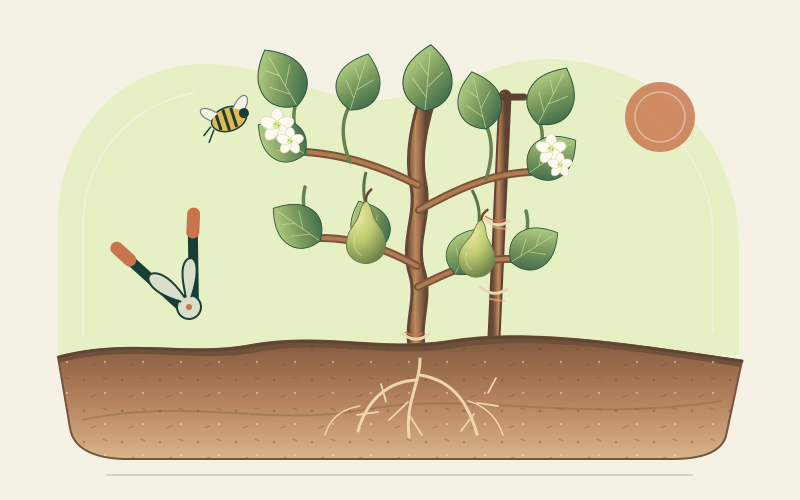
Plan for a perennial, not a quick annual
This guide centres on European pear, Pyrus communis, a long-lived deciduous tree in the rose family. Dessert fruit can be soft and juicy after ripening; culinary types may remain firmer for cooking. Asian pears, often P. pyrifolia or other Pyrus species, have different flesh and harvest behaviour and should not inherit this guide’s instructions automatically.
Under suitable conditions, a first useful crop commonly arrives about two to four years after planting a young grafted tree. That is an establishment range, not a guarantee or the time to full production. Rootstock precocity, nursery-tree age, pruning, pollination, frost, water and disease all shift it. A vigorous seedling-rooted tree can take longer than a dwarfing combination. Prioritise roots and wide-angled scaffold branches rather than measuring success only by the first blossom.
Keep records of cultivar, rootstock, planting date, flowering overlap and each year’s crop. Those notes distinguish a pollination problem from winter injury or a tree that is simply still establishing.
Choose rootstock, scion and chill as one decision
Most garden pears are grafted. The scion determines the fruiting cultivar; the rootstock supplies the root system and influences mature size, anchorage, soil adaptation and how soon bearing begins. Quince A is a common semi-vigorous choice in Britain, while Quince C and Quince Eline are more dwarfing and suit smaller trained trees with appropriate support. In other regions, OHxF selections and Pyrus seedling or clonal stocks may be preferred. Names are not interchangeable across climates or soils.
Ask a specialist nursery for the exact combination, expected mature dimensions and support requirement. Dwarfing does not mean neglect: smaller root systems can need more reliable water, weed control and permanent staking. Check graft compatibility and local performance rather than choosing the smallest available tree by default.
European pears also need winter dormancy followed by enough chilling for regular bud break. There is no single chill number for all pears: cultivars differ, and chill-hour, chill-unit and dynamic models calculate winter exposure differently. Warm winters can produce delayed, sparse or uneven flowering; selecting a low-chill cultivar in a frosty site can instead encourage vulnerable early bloom. Compare locally gathered temperatures and flowering records with regional advice.
Give blossom a safe site and a compatible partner
Choose full sun, free drainage and good air movement, with shelter from destructive wind. Avoid low pockets where cold air settles. Pear blossom appears early and is vulnerable to spring frost; cold, wet or windy weather can also limit bee visits even when two suitable cultivars flower together. A gentle slope with unobstructed cold-air drainage can help, but exposed trees still need sound support.
Most European pears crop best with cross-pollination. Plant or identify a different compatible cultivar with overlapping bloom, within practical bee-flight distance. “Two pears” is not sufficient information: some pairings are incompatible, some cultivars have sterile pollen, and a triploid or pollen-sterile tree cannot serve as the only partner for another tree. Use an up-to-date regional pollination table and check both directions of pollen supply.
Partly self-fertile cultivars may set alone but often yield better with a partner. Protect wild and managed pollinators by avoiding insecticide during bloom and by following the label for any legally permitted product used at other times. Do not plant ornamental Pyrus calleryana as an assumed pollen source without verified compatibility, and check local invasive-plant restrictions.
Plant carefully and train a durable framework
Plant healthy bare-root or container stock in the locally recommended dormant window, when soil is workable and not frozen or saturated. Protect roots from drying while preparing a hole wide enough to spread them naturally. Set the tree at its nursery depth with the graft union above final soil level, backfill with native soil, firm gently and water to remove air pockets. Do not bury the union or add a concentrated fertiliser plug to the planting hole.
Install the stake, trellis or permanent support at planting so roots are not damaged later. Use a flexible tie with room for trunk growth and inspect it each season. Keep a weed-free zone and spread suitable mulch over the rooting area, leaving a clear gap around the trunk. Remove rootstock suckers, which do not produce the named scion’s fruit.
Form a central leader, modified central leader or other locally taught structure with wide branch angles and enough space for light, inspection and harvest. Narrow, crowded forks can split under fruit load. Winter pruning suits many free-standing trees; trained cordons, fans and espaliers often require summer pruning within their own system. Avoid severe yearly heading that fills the crown with vigorous upright shoots.
Water for establishment, feed moderately and thin excess fruit
Deep, well-drained soil supports a longer-lived tree. Test before correcting pH or applying phosphorus, potassium or lime. Young trees need thorough root-zone watering during dry periods, with frequency set by soil texture, rainfall and temperature rather than a fixed daily routine. Avoid constantly saturated soil. Established trees can tolerate some dryness but still need water during prolonged drought while fruit swells; containers and dwarfing stock need the closest attention.
Moderate growth is desirable. Excess nitrogen and hard pruning promote succulent shoots that are especially vulnerable to fireblight. Mulch and compost can support soil function, but more feed is not a cure for poor cropping caused by frost, missing pollen or inadequate light. Diagnose before correcting.
A young or heavily setting tree can carry more fruit than its branches and reserves support. After natural fruit drop, thin crowded clusters to locally recommended spacing if crop load is excessive. This can improve fruit size, reduce broken limbs and limit alternate bearing. Support heavily laden branches only as a temporary supplement to sound training, not as a substitute.
Make fireblight a selection and management issue
Fireblight is a bacterial disease affecting pear and other members of the rose family. Infected blossom and shoots can wilt and blacken, sometimes leaving a bent “shepherd’s crook” tip; cankers can extend into woody branches. Warm, humid or rainy bloom weather and vigorous young growth can favour infection, but risk and regulations differ by region.
Start with cultivars and rootstocks documented as resistant in local trials where the disease occurs. Resistance reduces risk; it is not immunity. Bartlett, Bosc and D’Anjou are rated low for resistance in Oklahoma State’s regional table, while Harrow Delight, Magness, Moonglow, Seckel and Warren are among examples rated highly there. Those ratings are selection evidence, not a universal performance ranking.
Inspect regularly, obtain a diagnosis and follow regional instructions for removing infections, including how far below visible symptoms to cut, when weather permits pruning, how to sanitise tools and how to dispose of wood. Do not copy a cutting distance or chemical programme without local context. Avoid routine antibiotic use; any intervention must be legally permitted, justified and labelled for pear and the target problem.
Separate harvest maturity from eating ripeness
Most European pears do not ripen to good quality while softening on the tree. They ripen from the core outward, so fruit that already feels soft at the outside may be mealy or breaking down inside. Pick at mature but firm harvest stage. Learn the cultivar’s normal season and combine subtle background-colour change, brown seeds where applicable, sweetness in early types and ease of separation when fruit is lifted and gently twisted. Bosc may not separate as easily as other cultivars.
Handle fruit gently, keep stems intact where possible and do not store bruised, insect-damaged or diseased pears. Cool sound fruit promptly without washing it into storage. Oregon State gives approximate storage at 30–32°F (−1–0°C) of 30–45 days for Bartlett, 50–70 for Bosc and 120–140 for D’Anjou, with shorter life at warmer temperatures. These are cultivar references, not promises for every home refrigerator or harvest.
Cold conditioning also differs. Oregon State lists no required pre-ripening cold period for Bartlett and Bosc, about one month for Comice and about two months for Green Anjou. After the appropriate storage period, ripen at 60–70°F (16–21°C) for roughly three to ten days. Apply gentle thumb pressure at the neck near the stem: a slight yield indicates eating ripeness. Refrigerate a ripe pear to slow further softening, and refrigerate cut fruit promptly in a clean covered container.
For drying or canning, use sound fruit and a current tested recipe from a food-preservation authority. A dried pear is not made safe merely by a leathery surface, and a sealed jar is not evidence of correct processing. Follow preparation, time, temperature, acidity and storage instructions exactly.
Sources and further guidance
- Royal Horticultural Society: How to grow pears
- Oklahoma State University Extension: Growing and Producing Pears in Oklahoma
- Oregon State University Extension: Picking and storing apples and pears
- University of Tennessee Extension: Selecting Apples and Pears for Residential Production
- USDA National Center for Home Food Preservation