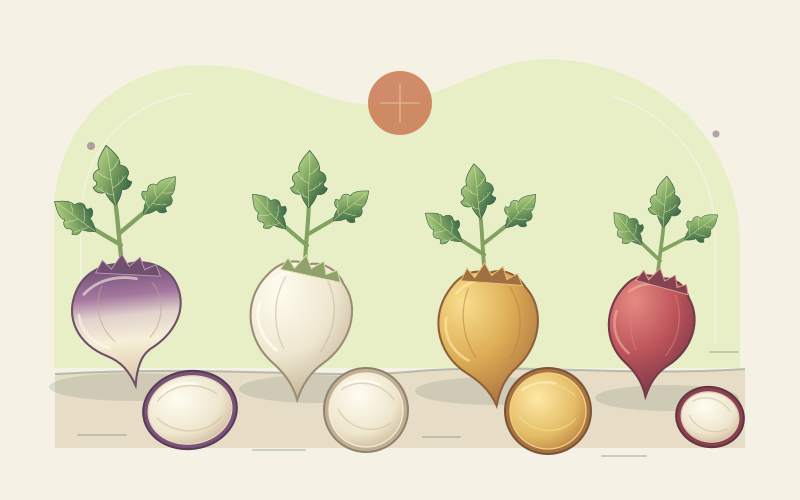
One crop, several useful selections
Cultivated turnips are Brassica rapa subsp. rapa. Breeders and growers have selected them for early tender roots, later storage roots, particular skin or flesh colours, and leafy tops. The descriptive groups below are practical rather than strict botanical divisions. Named cultivars within a group can differ in days to harvest, shape, flavour and keeping quality.
Most garden turnips offer a first usable root roughly 35–70 days after sowing, but that range is not a promise. Baby roots can be earlier, greens earlier still, and maincrops later. Weather, site and spacing shift every date. Read the packet for the intended sowing window and final size rather than choosing by colour alone.
“Turnip” is also used loosely for other root crops in some places. Check the botanical name when buying seed: a swede or rutabaga is not simply a large yellow turnip. Local trials and a short comparison row are more useful than a universal “best variety” list.
Four useful root forms and colours
Purple-top white: the familiar two-tone root
These turnips have a violet-purple shoulder and a white lower root, usually with white flesh. The coloured shoulder develops where the root is exposed to light; it is a normal feature, not disease. Roots may be globe-shaped or flattened. Purple Top Milan is a familiar early, flatter type, while Purple Top White Globe is a well-known round maincrop type. Their seasons and intended sizes are not interchangeable.
Use early types young and tender, and choose a maincrop selection for an autumn harvest or storage. A purple top does not guarantee storage ability, and a cultivar sold under a similar name can perform differently by supplier. Follow the packet for spacing and harvest size.
White salad: quick, small, and mild when young
White-skinned, white-fleshed salad turnips include Hakurei and Tokyo Cross types. Many are bred for fast production of smooth, round roots eaten raw or lightly cooked while small. Their young leaves are also useful. “Salad” describes a common use, not a rule that they must be eaten raw; roast or simmer them if preferred.
Harvest promptly at the supplier’s recommended size. Even a tender salad cultivar can lose quality after heat, drought or overmaturity. Their speed makes them useful for short rows and succession sowing, but does not eliminate the need for thinning, water and pest mesh.
Golden or yellow-fleshed: colour without a species change
Golden Ball and other yellow-fleshed turnips have yellow to golden skin or flesh, depending on the cultivar. They remain turnips within Brassica rapa. Yellow flesh alone does not make a root a swede, and colour does not predict sweetness, nutrient content or storage life. Growing conditions and harvest stage remain decisive.
Lift a sample at the recommended size rather than waiting for a deeper colour. Use yellow roots in much the same range of cooked dishes as white turnips, allowing for cultivar texture and maturity.
Red-skinned: a bright exterior with pale flesh
Temari Red and similar selections produce small scarlet to crimson roots, often with white flesh and sometimes a coloured blush. The skin colour is culinary and visual; it is not evidence of a special health property. Many red types are intended for an early, small harvest rather than long storage.
Skin brightness varies with temperature, light and root condition. Judge harvest by size and firmness, not by pursuing maximum colour. If you want to retain contrasting slices, prepare and cook them gently rather than assuming every method will preserve the same appearance.
| Type | Example names | Useful feature | Keep in mind |
|---|---|---|---|
| Early purple-top | Purple Top Milan | Fast, often flattened fresh roots | Not the same season as a maincrop |
| Maincrop purple-top | Purple Top White Globe | Round roots for autumn and keeping | Needs longer spacing and season |
| White salad | Hakurei, Tokyo Cross types | Quick, smooth, pale roots and greens | Harvest young; speed is not immunity to stress |
| Yellow-fleshed | Golden Ball types | Golden colour for cooked dishes | Still a turnip, not a swede |
| Red-skinned | Temari Red types | Scarlet exterior, usually pale flesh | Typically chosen for small fresh roots |
Choose the season before the colour
Early turnips are intended for spring and early-summer sowing and a fast fresh harvest. They are often best small and are not automatically good keepers. In very early cold conditions, use only a cultivar recommended for that window and provide cloche protection where appropriate. Heat and drought can still cause bolting or woody roots.
Maincrop turnips are generally sown later for autumn harvest. Give them the packet’s wider spacing and full growing window. Select a cultivar described for storage if that is your aim, and harvest only sound mature roots before severe frost. Sowing an early salad type late does not turn it into a storage maincrop.
Leaf-focused selections, including Seven Top types, are grown primarily for repeated greens rather than a choice swollen root. Many root cultivars also have tasty tops, but heavy repeated picking reduces the leaf area available to fill the root. Choose a greens type for abundant foliage, or a dual-purpose cultivar for both, rather than expecting one plant to maximise both harvests.
Do not confuse turnip with swede or rutabaga
The turnip is Brassica rapa subsp. rapa. The swede, called rutabaga in North America, is Brassica napus (Napobrassica Group). Swedes commonly have larger, denser roots, often yellow flesh and purple-toned skin, and usually require a longer growing season. The two are related but are not interchangeable cultivar choices.
Regional naming adds confusion: “turnip” can mean swede in parts of the UK, while “rutabaga” is the usual North American term for swede. Look for the botanical name, days to maturity and intended use on the seed packet. This guide’s fast 35–70 day timing and tender-root harvest advice are for turnips, not an assumption that a swede will mature on the same schedule.
Also distinguish garden turnips from wild Brassica rapa and from other root vegetables with white or purple skin. Buy named seed for the plant part and season you want, and keep labels so your own observations remain useful next year.
Make a small, useful comparison
Start with your cool sowing window, then select root size, storage and leaf use. Check days to harvest, final spacing and any locally verified disease resistance. Colour comes after those practical limits. Buy fresh seed from a reputable supplier and store it as the packet directs.
Sow two short rows rather than committing the whole bed: perhaps an early purple-top beside a white salad type, or a maincrop beside a yellow-fleshed selection. Keep the same sowing and care where their requirements match. Record emergence, date of first usable root, texture, leaf quality and storage performance. A notebook and two cultivars teach more than a long unverified list. Our seed-to-storage guide covers the shared growing method.