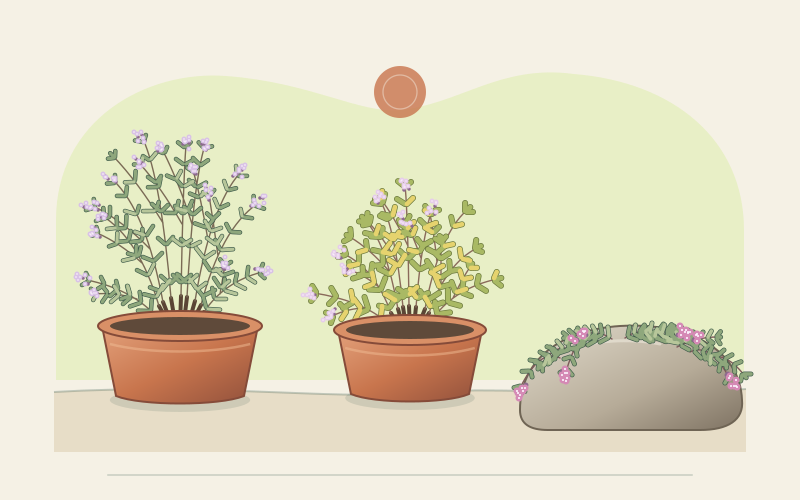
Begin with botanical identity
The genus Thymus contains many species and cultivated plants. This crop profile concerns common thyme, Thymus vulgaris, a small upright or mounded subshrub with narrow aromatic leaves. Nursery labels also use “thyme” for citrus-scented plants, mat-forming species and ornamental foliage. All may be legitimate garden plants, but they are not interchangeable evidence that a named selection of T. vulgaris will grow or taste the same way.
A cultivar is a cultivated selection maintained for particular characteristics. A horticultural name such as English or French thyme describes a recognised garden type rather than a country-wide guarantee of quality, and common names vary between suppliers. Look for the fullest available name, including genus, species and cultivar in single quotation marks. Ask the nursery when the label gives only a colour, scent or marketing name.
English and French are useful kitchen descriptions
English thyme usually refers to a relatively broad-leaved common thyme with a familiar robust savoury aroma. French thyme is commonly described as narrower-leaved and finer in habit or flavour. These are horticultural groupings, not separate scientific species. Leaf width, vigour and scent can vary among clones and growing conditions, so a pot labelled simply “French” is not a standardised cultivar.
For cooking, crush or smell a leaf and choose an aroma you enjoy. Upright, mounded common thymes are generally easier to cut for the kitchen than very low creeping types. Consider winter survival, mature width and whether you want fresh sprigs, a drying harvest or both. No English or French label makes a plant tolerant of shade or waterlogging.
Named foliage cultivars need clonal propagation
Thymus vulgaris ‘Argenteus’ is listed by NC State for green-and-cream variegated foliage. ‘Silver Posie’ is another widely sold white-edged, pink-flowering selection, although RHS currently treats it as Thymus ‘Silver Posie’ and lists both T. vulgaris and T. citriodorus names as synonyms. That taxonomic uncertainty is a useful reminder to read the actual supplier label rather than forcing every plant into one simple category.
Variegation, compact habit and a particular scent are best preserved by cuttings or layering. Seed collected from a named plant may produce variable offspring, including seedlings without the parent’s leaf pattern. Buy a healthy vegetatively propagated plant when the exact character matters, and retain a young replacement as older plants become woody.
| Plant name | Useful distinction | Selection caution |
|---|---|---|
| English or French common thyme | Horticultural culinary types of T. vulgaris | Not standardised cultivars or separate species |
| ‘Argenteus’ or ‘Silver Posie’ | Named variegated selections | Propagate clonally; check ‘Silver Posie’ taxonomy |
| Lemon thyme | Citrus aroma, often T. citriodorus | A different identity, not just scented common thyme |
| Creeping or wild thyme | Low ground-cover habit, often T. serpyllum | Different form and flavour from upright culinary thyme |
Citrus aroma does not make every plant common thyme
Lemon thyme is commonly labelled Thymus citriodorus or Thymus × citriodorus. Espace pour la vie notes that it was long considered a hybrid involving common thyme. Its lemon scent suits vegetables, fish, tofu, grains and other foods where that aroma is wanted, but it should be chosen as a distinct plant rather than assumed to be ordinary thyme with a marketing adjective. Orange- and lime-scented selections likewise require their own labels and local hardiness checks.
Common thyme itself can have varied aromatic nuance. “Sweet”, “lemony” or “spicy” are sensory descriptions, not precise chemical specifications or promises of an essential-oil profile. For this culinary guide, smell the living foliage and use small amounts in food; do not infer a medicinal dose or essential-oil use from a cultivar name.
Creeping thymes solve a different garden problem
Wild or creeping thyme, often Thymus serpyllum, forms a low mat rather than the small upright shrub typical of common thyme. It can be valuable as a sunny ground cover, path-edge plant or pollinator flower source. Woolly thyme and other very low selections are primarily useful where carpet-like foliage is wanted. Their leaves may be edible, but identity, flavour and harvest convenience differ.
Do not choose a creeping plant for a large easy culinary harvest merely because its label includes “thyme”. Equally, do not expect an upright common thyme to make a dense walkable lawn. Compare mature height, spread, tolerance of foot traffic and local persistence. Every type still needs suitable drainage, and even drought-adapted ground covers need water while rooting.
Let flowers and local performance shape the final choice
Flower colour ranges through white, pale pink and lilac depending on plant. The small blossoms attract bees, butterflies and other pollinators; leaving some stems to flower is compatible with harvesting others for the kitchen. Flower colour alone does not prove species identity, hardiness or flavour. A compact plant with all blooms sheared off offers fewer foraging opportunities than one allowed a flowering period.
Start with one or two healthy plants that match your actual sun, winter minimums, rainfall and drainage. Ask local gardeners or extension which selections persist rather than simply survive a single mild season. Record aroma, flowering, winter condition and ease of cutting. Propagate the plants that perform best, and see the growing guide for pruning and renewal.