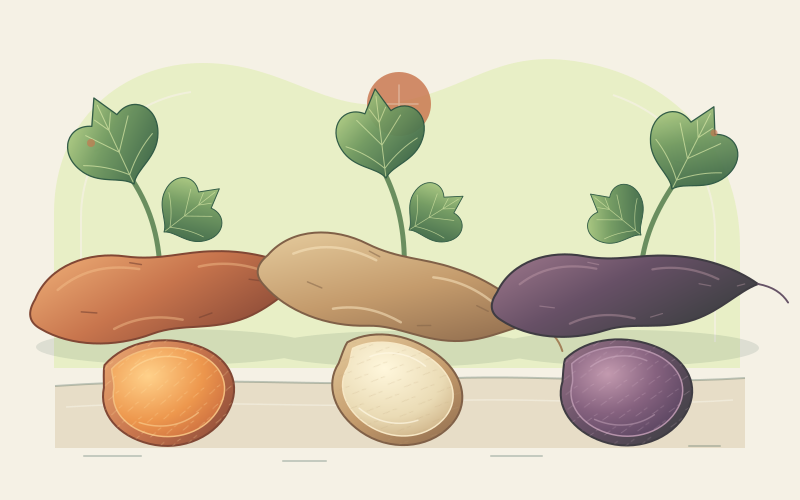
One species, many different roots
Cultivated sweet potatoes are forms of Ipomoea batatas, a member of the Convolvulaceae, or morning-glory, family. The plant produces edible enlarged storage roots and trailing vines. Ordinary potatoes are Solanum tuberosum tubers in the nightshade family; sweet potatoes are not a coloured version of that crop. Their slips, care, and storage needs differ accordingly.
Within I. batatas, breeders and growers have selected many combinations of skin colour, flesh colour, root shape, vine habit, maturity, and cooking quality. Skin may be cream, tan, copper, red, or purple; flesh may be white, cream, yellow, orange, or purple. These visible traits do not form a strict ladder of quality. They help you choose an ingredient and a cultivar suited to your garden.
Rooted gives the crop a broad 90–150 day harvest window from planting slips. Individual cultivars and regional trials can fall differently, and cool conditions slow development. A variety name is therefore only the start: ask a local supplier about its expected maturity, vine vigour, and performance where you grow.
Read flesh colour as a culinary and nutritional clue
| Flesh | Typical kitchen character | Useful context |
|---|---|---|
| Orange | Often moist and sweet when baked, though not always | Usually contains beta-carotene; depth of orange is a clue, not a laboratory measurement |
| White or cream | Often drier, firmer, or more mildly flavoured | A useful roasting, boiling, and mashing root; not interchangeable with orange-flesh vitamin A values |
| Purple | Often dense and relatively dry, with striking cooked colour | Anthocyanin pigments contribute colour; this does not establish a treatment or health promise |
Orange flesh is familiar in moist baking types. Beta-carotene is one of the pigments responsible for the colour, and the body can convert it to vitamin A. Pale orange roots should not be assumed to match a deep orange reference sample. Use our cooked nutrition guide to see why one USDA entry cannot describe every colour.
White and cream flesh can be chestnut-like, crumbly, or pleasantly firm rather than watery. These roots are useful where a less sweet or drier ingredient is wanted, but flavour still depends on cultivar and curing. Purple flesh holds dramatic colour in many preparations; some types become drier than expected, so a recipe may need added moisture. Pigment chemistry is not a reason to call either group a cure or to rank one colour as universally best.
Separate texture from colour, then check the cultivar
Suppliers often describe cooked sweet potatoes as moist-fleshed or dry-fleshed. Moist types feel soft and smooth after baking; dry types are more floury or firm. Colour and texture frequently travel together, but they are not synonyms. Maturity, curing, storage, and cooking method also change the result. A freshly lifted uncured root may taste less sweet and cook differently from the same cultivar after curing.
| Cultivar or market type | Common flesh and texture | Selection note |
|---|---|---|
| Beauregard | Orange; usually moist | Widely grown; check local maturity and disease guidance |
| Covington | Orange; moist | A storage and baking type where the season is long enough |
| Jewel | Orange; moist | Familiar general-purpose orange-fleshed cultivar |
| O’Henry | Cream to pale yellow; comparatively dry | A pale-fleshed alternative for roasting and mashing |
| Japanese or Murasaki types | Pale flesh, often dry; purple to red skin | Market labels cover more than one cultivar; verify the actual name |
| Okinawan or Stokes Purple types | Purple; often dense or dry | Check local availability and cooking descriptions rather than assuming interchangeability |
Choose first for your frost-free season and available heat. In a short temperate summer, a locally proven earlier cultivar is more useful than a famous late one. Next consider space: vigorous vines can sprawl well beyond the root bed, and a container needs enough depth, drainage, and watering attention. Finally, grow a small kitchen trial. Keep notes on yield, texture, sweetness after curing, and storage rather than relying on colour alone.
Harvest leaves only from a known food plant
Young leaves and tender shoot tips of cultivated I. batatas are edible and can be cooked much like other greens. Some cultivars are selected for leaf production, while others are managed mainly for roots. Choose a locally recommended leafy cultivar for repeated harvest, or take only light pickings from a root crop so enough canopy remains to feed it.
Do not identify food by “morning-glory-like” leaves alone. Other Ipomoea species and unrelated vines are not automatically edible. Start with planting material from a reliable food-crop supplier, retain its label, and confirm the species as Ipomoea batatas. Never forage an unknown vine for sweet-potato greens. Ornamental sweet-potato vines may belong to the same species, but do not eat them unless their identity is certain and they have been grown and handled as food, without unsuitable pesticide exposure.
Pick clean, young leaves and short tender tips, leaving damaged, diseased, or contaminated growth behind. Wash thoroughly under running water and cook until tender; discard anything doubtful. Do not assume that leaves or other parts of true yams are interchangeable with sweet-potato greens, because those plants belong to a different genus and require species-specific food knowledge.
A sweet potato is not a true yam
True yams are tubers of several Dioscorea species in the Dioscoreaceae family. They are botanically distinct from I. batatas, with their own cultivation, cooking, and food-safety requirements. In some markets, especially the United States, “yam” is used as a marketing name for moist orange-fleshed sweet potatoes. The food may still be a sweet potato despite the large sign.
Check the ingredient label, botanical name, or supplier rather than relying on colour or root shape. Ube, for example, usually refers to purple yam, Dioscorea alata, not simply a purple sweet potato. A recipe developed for a moist orange sweet potato may need adjustment for a dry purple cultivar and even more for a true yam. Clear naming prevents both gardening and kitchen surprises.
Sources and variety references
- University of Maryland Extension: Growing Sweet Potatoes in a Home Garden
- Royal Horticultural Society: Sweet potato cultivation and cultivars
- University of Hawai‘i: Vegetable Sweet Potato—forms, food uses, and leaves
- Penn State PlantVillage: True yams and their distinction from sweet potato
- International Potato Center: Sweet potato diversity and crop resources