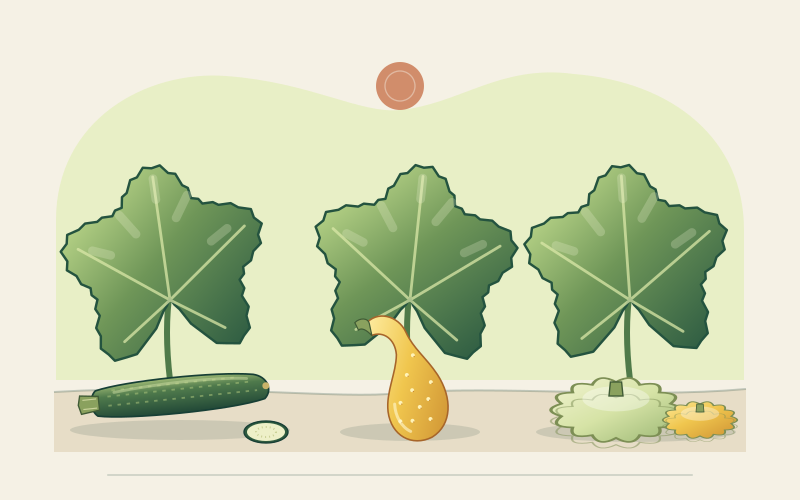
Kitchen forms and cultivars are not separate species
“Summer squash” describes fruit harvested immature with tender skin, not a botanical species or a guarantee that every plant is compact. Zucchini and courgette are names for the same general type: “courgette” is common in British and French usage, while “zucchini” is common in North American and Italian-derived usage. Yellow straightneck, crookneck and scalloped pattypan are other garden forms.
These types are all Cucurbita pepo, a species that also includes mature acorn squash, many pumpkins, ornamental gourds and marrows. Planting a dark-green courgette beside a yellow pattypan therefore does not isolate their seed. Their current fruit keeps its own appearance, but insect-carried pollen can produce variable offspring in saved seed.
Rooted uses an indicative 45–65 days from sowing to first tender harvest. Actual timing depends on cultivar, transplanting, warmth, water and pollination. Fruit colour, ribbing, shape, plant spread and disease resistance vary within each form. Treat a named cultivar and local trial results as more useful than a universal “best” type.
Three useful forms for garden and kitchen
Zucchini or courgette: elongated fruit in many colours
Zucchini may be dark or pale green, striped, grey-green or yellow, with cylindrical or slightly tapered fruit. Costata romanesco-type cultivars add pronounced ribs; round zucchini are selections for a different shape rather than a separate species. Skin gloss and fruit length are useful picking cues, but a yellow zucchini is not the same thing as a yellow crookneck simply because both are elongated.
Many modern zucchini have a bushy habit, although the mature leaf canopy can still approach a metre across. Other cultivars trail. Compact plants suit large containers only when rooting volume, water and nutrition are adequate. Pick elongated fruit young—often around 15–20 cm for standard zucchini, and sooner for baby fruit—while the rind is easily marked. Larger fruit remain usable promptly if sound, but do not acquire winter-squash keeping quality.
Yellow straightneck and crookneck: colour with distinct necks
These yellow summer squashes may be smooth or lightly warty depending on cultivar and maturity. Straightneck fruit has a comparatively direct profile; crookneck fruit curves near the stem end. Their flesh and tender skin are suited to slicing, sautéing, roasting or adding to mixed dishes. Wartiness and shape do not by themselves establish a cultivar, and yellow skin is not a measure of maturity in the way full rind colour is for winter squash.
Harvest while the skin remains tender and seeds soft, before the neck hardens or the fruit becomes swollen and seedy. Plant habit varies, so read the seed packet rather than assuming all yellow types stay compact. Their colour makes them easy to spot beneath leaves, but regular inspection is still essential in warm weather.
Pattypan or scallop: flattened fruit with a scalloped edge
Pattypan squash have a flattened, rounded form with a lobed or scalloped margin. Depending on cultivar, they may be white, cream, yellow, green or striped. Small fruit can be cooked whole; larger young fruit can be sliced or hollowed for stuffing. “Scallop” refers to the outline, not to seafood or to a particular flavour.
Pick at the cultivar’s recommended tender stage, often while still small enough to hold in the hand. A giant pattypan is not a storage squash: its skin and seeds become firmer and its best use shifts to immediate cooking. Many plants are bushy but broad, and they need the same warmth, water and pollinator access as other summer squash.
| Type | Useful feature | Tender-harvest cue | Keep in mind |
|---|---|---|---|
| Zucchini / courgette | Elongated slices; green, yellow or ribbed forms | Glossy tender rind; often 15–20 cm for standard types | Bush plants can still spread widely |
| Straightneck / crookneck | Yellow fruit with straight or curved necks | Tender skin and soft seeds before swelling | Surface texture varies with cultivar and age |
| Pattypan / scallop | Small whole fruit or scalloped slices | Small, glossy fruit with a tender margin | Oversized fruit is for prompt use, not curing |
Choose for the actual plot and kitchen
Start with adult plant size and your warm, frost-free season. Check days to first harvest, local performance and any independently supported powdery-mildew resistance. “Resistant” does not mean immune, so water, airflow and inspection still matter. In containers, select a cultivar explicitly described as compact and provide an appropriately large, drained pot rather than relying on restricted roots to dwarf a vigorous plant.
Consider how you will use frequent harvests. Standard zucchini are efficient for long slices; round fruit suit stuffing; pattypans offer small whole portions; yellow types bring visual variety. A mixed planting broadens choice but can produce a large simultaneous surplus. One healthy plant may be more useful than several crowded ones. Record first flower, first fruit, harvest frequency, mildew onset and flavour to guide next year’s choice. Our seed-to-harvest guide covers the shared method.
Save mature seed with species and breeding in mind
Summer squash flowers are insect-pollinated, and cultivars of C. pepo can cross even when their fruit shapes and harvest stages differ. Pollen carried between a courgette and an acorn squash does not change that season’s courgette flesh, but seeds from a deliberately matured fruit can produce mixed offspring. Different Cucurbita species generally cross less readily, yet species difference alone is not a rigorous isolation plan.
Distinguish open-pollinated cultivars from F1 hybrids. Properly isolated and selected open-pollinated seed can remain reasonably consistent; seed from an F1 normally segregates and should not be expected to reproduce the parent. Follow a specialist guide for isolation distances or hand-pollination, population size and selection rather than saving casually from one fruit.
A seed crop must remain on the plant to full fruit maturity, which is later than the tender kitchen harvest. Follow the recommended after-ripening period where applicable, extract seed from sound fruit, clean it and dry it thoroughly before cool, dry, labelled storage. Do not sow seed from mouldy or decayed fruit. If food quality is the priority, pick tender fruit and buy reliable seed rather than sacrificing production to uncertain seed saving.
Sources and variety references
- Royal Horticultural Society: Squash types and cultivation
- University of Minnesota Extension: Summer squash and zucchini
- Cornell University: Vegetable Varieties for Gardeners, squash listings
- Seed Savers Exchange: Squash species and hand-pollination
- Clemson Cooperative Extension: Types and uses of summer squash