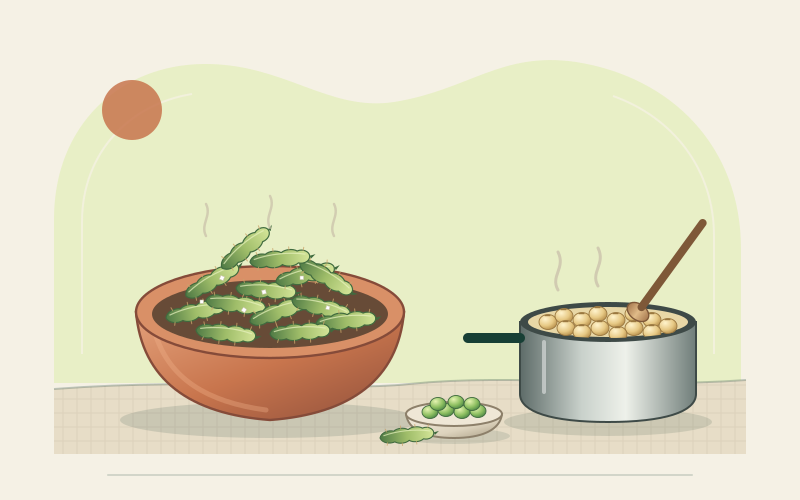
Start with mature cooked beans, not raw seed
Soybeans, Glycine max, reach the kitchen as green edamame, mature boiled beans, tofu, tempeh, miso, soy drink, flour and many other foods. Those products have different water content and processing, so their values per 100 g are not interchangeable. Even the same whole bean changes concentration when it absorbs cooking water.
Rooted gives soybeans nutrient category rank 4, “Very high”. This is a qualitative editorial comparison among crops on this site, not an official USDA score or a claim that soybeans prevent or treat any condition. It draws attention to protein, fibre, folate, iron and potassium together; it does not measure an individual’s total diet, absorption or requirements.
The reference is deliberately narrow: 100 g of mature soybeans, cooked by boiling without salt. The exact USDA FoodData Central title is “Soybeans, mature cooked, boiled, without salt”, SR Legacy 174271, corresponding to NDB 16109. It is not raw mature seed (a separate USDA record), green edamame, a roasted snack or a prepared soy product.
| Nutrient | Amount per 100 g | Meal context |
|---|---|---|
| Protein | 18.21 g | Total intake and other protein-containing foods still matter |
| Dietary fibre | 6 g | Other pulses, grains, vegetables, fruits, nuts and seeds also contribute |
| Folate | 54 µg | A content value, not an absorbed or supplemental dose |
| Iron | 5.14 mg | Plant-food non-heme iron; absorption varies |
| Potassium | 515 mg | One mineral contribution within the wider diet |
For comparison, the same record provides 172 kcal, 8.97 g fat and 8.36 g carbohydrate per 100 g. These extra figures clarify the food’s identity but do not turn the table into a dietary prescription. Cultivar, crop year, cooking time, water uptake and measurement methods introduce variation, and a cup is not automatically a 100 g portion.
“Complete protein” describes the amino-acid profile
Protein is built from amino acids. Nine—histidine, isoleucine, leucine, lysine, methionine, phenylalanine, threonine, tryptophan and valine—are described as essential because they must be supplied by the diet. Penn State Extension describes soy as a complete plant protein because it contains all of these essential amino acids. That statement concerns their presence and pattern in soy protein.
“Complete” does not mean that a few beans supply enough total protein, that every soy product has the same composition, or that soybeans are nutritionally equivalent to every other protein food. Portion size, total energy, processing and the rest of the day’s meals remain relevant. Highly refined products can have different protein and fibre contents from whole cooked soybeans.
Because soy already contains all nine essential amino acids, rice or another grain is not required to “complete” it. Grains remain useful meal companions for flavour, energy and their own nutrient contributions. Nor is there a same-mouthful rule for plant proteins generally: varied foods across the day can meet amino-acid needs. No single pairing guarantees adequacy.
Read fibre and minerals without health promises
Protein and fibre belong to the whole meal
The cooked reference contains more protein per 100 g than Rooted’s cooked chickpea and lentil references. That comparison does not make those other pulses unnecessary or establish a universal ranking. Mature soybeans also contain fibre, while green edamame and processed soy foods have their own profiles. A varied pattern can include several pulses rather than relying on one.
Iron is non-heme iron
The 5.14 mg iron value is a measure of content, not absorption. Soybean iron is non-heme iron, the form found in plant foods. Eating a vitamin-C-rich vegetable or fruit at the same meal can support non-heme iron absorption; tomatoes, sweet peppers, cabbage, broccoli and citrus are flexible options. This is meal context, not a promise to prevent or correct deficiency.
Folate and potassium are content values
The reference supplies 54 µg folate and 515 mg potassium per 100 g. The folate amount is not equivalent to a folic-acid supplement dose, and potassium content does not predict an individual requirement. People with prescribed dietary restrictions or specific clinical needs should use qualified individual advice rather than changing a diet or medicine on the basis of this table.
Cook green and dry soybeans thoroughly
Do not eat raw home-grown soybeans. Raw soybeans contain heat-sensitive compounds including trypsin inhibitors, and adequate heat processing is part of preparing them as food. Soaking, drying and blanching are not interchangeable with final cooking. Use food-grade harvests, clean water and a reliable recipe; planting seed can be treated or otherwise unsuitable for the kitchen.
Sort, rinse and keep food lots clean
For dry beans, remove stones and debris and discard mouldy, insect-damaged or doubtful seed. Rinse sound beans in clean water. For edamame, wash the fresh green pods and refrigerate promptly after harvest. Do not keep fresh pods or cooked beans for extended periods at room temperature.
Soak dry beans only as part of a cooking method
Soaking can hydrate mature dry beans and shorten later cooking, but it does not make them ready to eat. Follow the chosen reliable recipe for soaking duration and cool, clean conditions; refrigerate if the kitchen is warm. Drain, discard soaking water and rinse before cooking in fresh water. Unsoaked methods, including suitable pressure-cooker methods, require their own tested timing.
Boil or simmer mature beans until tender throughout
Cover with fresh water and cook until the centres are completely tender, following the recipe’s boiling or simmering directions. Seed age, size, storage, soaking and equipment affect time, so no single universal minute count is responsible here. If using a pressure cooker, follow the manufacturer’s fill limits, timing and safe-opening instructions. Never serve crunchy, undercooked dry soybeans.
Cook edamame before serving or after freezer blanching
Utah State University Extension describes boiling fresh whole edamame pods for about 5 minutes; use a sound recipe and check the beans are cooked before serving. Squeeze the beans from the pod to eat them; the fibrous pod is not the edible portion. For freezing, its method blanches washed green pods for 3 minutes, then cools, dries and packs them. Cook those frozen pods thoroughly later—about 4–5 minutes in that guidance—rather than treating blanching as the final preparation.
Cool and refrigerate leftovers promptly
Serve cooked beans hot or cool them for a dish without an extended room-temperature wait. Refrigerate leftovers promptly in clean covered containers and follow local food-safety guidance for storage time. Freeze only with suitable packaging and labelling. Reheat or use leftovers according to sound food-safety practice.
Choose the matching food reference and build ordinary meals
| Food | Use which reference? | Preparation note |
|---|---|---|
| Raw mature dry seed | USDA SR Legacy 174270, not the cooked table above | Do not eat raw; store dry and cook properly |
| Mature boiled beans | USDA SR Legacy 174271, the table above | Values are per cooked 100 g without salt |
| Green edamame | A green-soybean record matching its cooked or raw state | Chill fresh pods and cook before eating |
| Tofu, miso, tempeh or soy drink | The specific product reference or package label | Ingredients and processing change composition |
Serve fully cooked mature soybeans with rice and a tomato-and-pepper stew, add cooked edamame to noodles with greens and mushrooms, or combine cooled cooked edamame with cabbage and citrus. These are flexible examples rather than nutritional prescriptions. Salt, oils, sauces and other ingredients change the finished dish.
The complete amino-acid profile means grains are optional companions, not an obligatory chemical finishing step. Vitamin-C-rich produce is useful beside plant sources of non-heme iron. Beyond those composition facts, choose a varied meal that fits preferences, energy needs and any individual dietary guidance.
Sources and specialist references
- USDA FoodData Central: Soybeans, mature cooked, boiled, without salt (174271; NDB 16109)
- USDA FoodData Central: Soybeans, mature seeds, raw (174270)
- Penn State Extension: Soy Protein and Soy Isoflavones—complete essential-amino-acid profile
- Utah State University Extension: Edamame cooking and freezing
- FAO: Soybean processing and heat treatment
- NIH Office of Dietary Supplements: Iron fact sheet for consumers