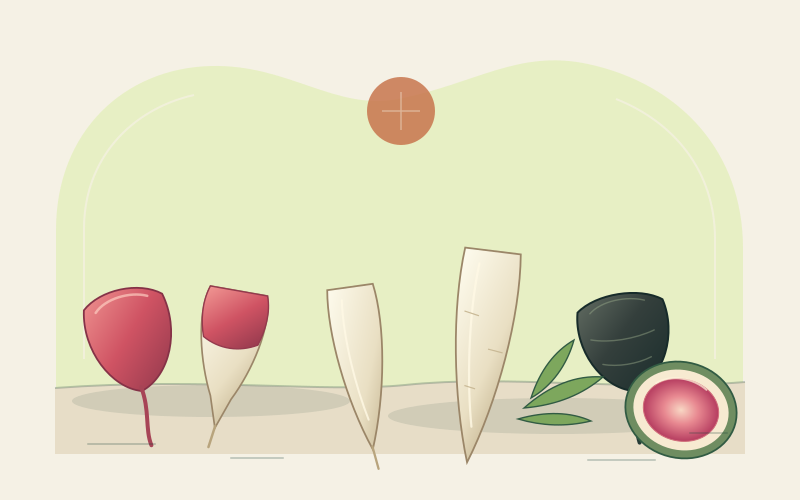
Many forms, one cultivated radish
Round red, elongated breakfast, white icicle, large oriental, black-skinned winter and edible-podded radishes are selections of Raphanus sativus. Horticultural names may add a variety or group, but a colour or shape alone does not define maturity, flavour or nutrient content.
Rooted’s indicative 25–45 days from direct sowing applies to fast salad roots under favourable conditions. It is not a promise for every packet. Large oriental and winter types commonly need at least eight weeks, while edible-podded plants need enough time to flower and set tender pods. Cold, heat and dry soil can change every schedule.
Begin with four questions: Which mild growing window do you have? How deep is the loose soil? Do you want fresh roots, storage roots or pods? How much can you eat at once? Only then use colour and novelty to narrow the list.
Salad radishes: quick roots in several shapes
Round red and bright-skinned types
Small globe radishes are the familiar fast crop. ‘Cherry Belle’ is a classic round red example; other cultivars offer pink, purple, yellow or white skin and sometimes differently coloured flesh. Choose a named cultivar with an early maturity and season suited to your site. Skin colour is a culinary and visual choice, not evidence of superior nutrition.
Elongated breakfast types
‘French Breakfast’ is the familiar oblong form, usually red above with a white tip. It needs a little more unobstructed depth than a globe type and should still be harvested young. “Breakfast” is a traditional type name, not a requirement to eat it at a particular meal or a guarantee of mildness.
White icicle types
‘White Icicle’ and similar cultivars form slender, tapering white roots. Their shape requires deeper loose soil than a round salad radish, but they still belong to the fast fresh-harvest group rather than the long-season daikon group. Pull at the packet’s diameter and length before age makes the texture fibrous.
Short salad types suit containers with adequate depth and drainage. Mixed colour packets can make a small sowing visually varied, but component cultivars may mature at different rates. Sow separate rows when uniform harvest or record-keeping matters.
Oriental and winter radishes need a different plan
Daikon, mooli and other oriental forms
Oriental radishes include long white daikon or mooli types as well as round and dark-skinned selections. ‘Minowase’ is a familiar long white example. Many can exceed 30 cm, so root form and soil depth matter. These are slower crops, often harvested in late summer or autumn; follow local sowing guidance because inappropriate timing can trigger flowering before the root fills.
‘Watermelon’ radish is generally a larger, later type with a pale exterior and pink to red interior, not a small red salad radish with a misleading name. Its colour develops as a cultivar trait, but the exact raw-radish nutrient reference on this site does not analyse every coloured form.
Black Spanish and winter keepers
Winter radishes are larger, hardy selections commonly sown in mid to late summer for autumn and winter harvest. ‘Black Spanish’ has rough dark skin and white flesh and is traditionally used as a keeping type. Sowing too early can cause bolting; sowing too late may leave too little mild growing time. Use the packet and regional advice.
Winter types are generally better candidates for storage than fast salad radishes, but “winter” does not mean immortal or immune to rot. Harvest sound mature roots before damaging ground frost or waterlogging, remove tops and store cool, humid and frost-free. Inspect regularly and use damaged roots promptly only if the remaining tissue is sound.
Grow pods deliberately; treat leaves as a bonus
Edible-podded radishes such as ‘Rat’s Tail’ are selected for abundant, elongated immature pods rather than a storage root. Plants produce flowering stems and can crop over many weeks, including in weather too warm for good salad roots. Pick pods while young and crisp; mature pods become fibrous. The plants still need enough space, water and access for pollinating insects.
Any ordinary radish that bolts may form edible young pods, but that does not make it equivalent to a pod cultivar. If the aim is pods, sow the appropriate type from the outset. If the aim is salad roots, bolting signals a disappointing root crop and a reason to adjust the next sowing.
Radish leaves are edible, particularly when young, and winter types can have substantial tops. No special “leaf radish” is required for a few garden greens, but repeated heavy stripping will reduce root growth. Use sound foliage from known cultivated plants, wash it well and avoid leaves exposed to unsuitable pesticides. Leaves and pods have separate nutrient profiles from raw roots.
Compare the practical growing job
| Type | Main harvest | Timing and space | Best planning cue |
|---|---|---|---|
| Round salad | Small crisp root | Fast; shallow relative to long types | Short successions in mild weather |
| Breakfast or icicle | Elongated fresh root | Fast; more loose depth | Harvest young before fibrous |
| Oriental or daikon | Large root, raw or cooked | Slower; often deep soil | Match cultivar to local sowing season |
| Winter | Mature root for use or storage | Longer, later crop; wider spacing | Allow time before damaging cold |
| Edible-podded | Immature seed pods | Flowering plants; room for stems | Pick regularly before pods turn stringy |
Catalogue days are useful comparisons, not guarantees. Check sowing depth, final spacing, intended season and root dimensions together. Bolt resistance or heat tolerance applies only to the stated cultivar and conditions; neither makes an unsuitable midsummer sowing universally reliable.
Let a small local trial make the final choice
Ask nearby growers, extension services or trial gardens which types perform in your actual season. A fast cultivar that excels in a northern spring may fail in a hot lowland summer. Likewise, an oriental cultivar labelled for autumn should not be squeezed into an arbitrary spring date.
Sow two contrasting salad cultivars in neighbouring short rows under the same conditions. Record sowing, emergence, first useful root, texture, pepperiness and bolting. For winter types, also record root size and storage losses; for pod types, record first flowering, pod tenderness and picking duration. Repeat the comparison before declaring a universal winner.
Open-pollinated and hybrid cultivars can both have useful traits. Neither label automatically predicts flavour, adaptation or nutritional value. Buy fresh seed from a reputable supplier, store it cool and dry as directed, and use the growing guide to give each selection even moisture and enough room.