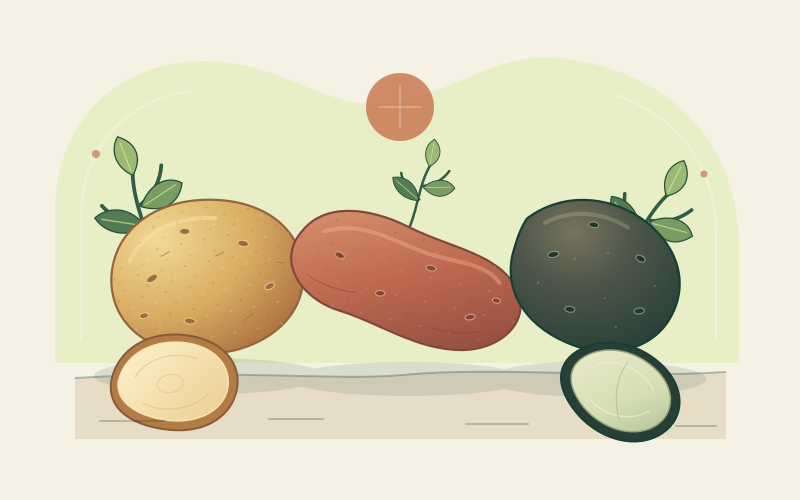
Two labels, two different questions
A potato’s crop group tells you roughly when it can be harvested. Its texture tells you how it is likely to behave in the kitchen. These labels answer different questions: a first early is not automatically waxy, and a maincrop is not always floury. Variety descriptions are useful tendencies, not guarantees. Maturity, soil, moisture, storage, and cooking method all influence the result.
All are forms of the cultivated potato, Solanum tuberosum. The familiar groups are gardener-friendly shorthand rather than rigid botanical categories. Suppliers sometimes place the same cultivar in different slots, particularly across countries, so use the descriptions below to ask better questions—not to overrule local knowledge.
First early, second early, or maincrop?
All three are commonly planted during the local potato-planting season. “Early” refers to the interval to a useful harvest, not necessarily to planting weeks ahead of every other group. Weather, tuber condition, and site temperature make calendar dates approximate.
First early: the quickest fresh crop
First earlies occupy the ground for the shortest time and are lifted young as small, thin-skinned “new” potatoes. They are useful where space is limited, the growing season is short, or an early crop can be followed by another vegetable. Their fresh flavour is the point; most are not intended for months of storage. An early harvest may also finish before late blight becomes severe in some seasons, but earliness is not disease resistance.
Second early: a little later, still fresh
Second earlies bridge the gap between the first new potatoes and the mature keeping crop. They often provide tender salad and boiling potatoes, with a somewhat later harvest and larger tubers than first earlies. They can be a practical middle choice for gardeners who want a fresh crop without the full time commitment of maincrop varieties.
Maincrop: time for size and storage
Maincrops grow for longer, generally producing a larger harvest with thicker skins. Once mature, properly cured, and stored, sound tubers can supply the kitchen beyond the growing season. They need enough frost-free time and water to finish, and more garden space for longer. Late lifting also means greater exposure to whatever pests and diseases are active locally.
| Group | Harvest character | Best fit | Storage expectation |
|---|---|---|---|
| First early | Young, small, thin-skinned | Quick new potatoes | Usually short |
| Second early | Young but more developed | Salads and fresh boiling | Generally limited |
| Maincrop | Mature, larger, firmer-skinned | Bulk harvest and versatile cooking | Best potential after curing |
Waxy, floury, and everything between
Waxy potatoes hold together. Their cooked flesh tends to stay moist, dense, and smooth, with cells that retain their structure. Choose them when distinct slices or pieces matter: potato salad, gratins, boiling, and some stews. Waxy does not mean unpleasantly sticky or gluey; overworking any cooked potato can spoil its texture.
Floury potatoes break down more readily. Their drier, more open cooked texture suits fluffy mash, crisp roast potatoes, chips, and baking. They can absorb butter, milk, oil, or cooking juices readily. The trade-off is that vigorous boiling may cause the pieces to split.
All-rounders sit between the poles. They can give a respectable mash while remaining intact enough for many everyday dishes. Starch content helps explain these differences, but it is not the whole story: dry matter and cell structure matter too. Even within one cultivar, a freshly lifted early tuber may cook differently from a mature one after storage. Start with the packet description, then adjust your method—gentle simmering for a firm salad potato, thorough draining and steaming dry for a fluffy mash.
Familiar varieties as starting points
The following cultivars illustrate the range, not a universal recommendation. Crop slot and cooking descriptions can differ among suppliers; availability and legal seed-certification systems differ among regions.
| Cultivar | Common crop slot | Texture tendency | Often chosen for |
|---|---|---|---|
| Pentland Javelin | First early | Firm to general purpose | Early boiling and salads |
| Charlotte | Second early | Waxy and firm | Salads and boiling |
| Nicola | Second early | Waxy | Salads and buttery boiled potatoes |
| Yukon Gold | Early to mid-season | Medium, versatile | Boiling, mashing, and roasting |
| Maris Piper | Maincrop | Floury all-rounder | Chips, roasting, and mashing |
| King Edward | Maincrop | Floury | Roast potatoes and fluffy mash |
| Desiree | Maincrop | Medium, fairly firm | General-purpose cooking |
| Russet Burbank | Maincrop or late-season | Floury and dry | Baking and frying |
A practical way to choose
Begin with your season and space
Count the likely frost-free growing period and consider heat, rainfall, irrigation, and daylight. Short-season gardens may favour earlies; a longer, mild season opens more maincrop options. Containers can make early harvesting easy, but they require attentive watering. Do not assume a variety that excels in a trial in one country will behave the same in another.
Match resistance to local pressure
Ask nearby growers, extension services, or seed suppliers which problems recur. Independent variety databases can help compare resistance to concerns such as late blight, common scab, or potato cyst nematodes. Resistance is not immunity, ratings may refer to foliage or tubers separately, and local pathogen populations can change. Continue crop hygiene and monitoring whatever the label says.
Choose for the kitchen, then grow a trial
If salads are the goal, a firm second early is a logical start. For a winter stash of roast and mash potatoes, look for a locally successful maincrop with good cooking and storage qualities. A mixed planting of an early and a maincrop spreads harvest and risk. Where space permits, grow a small quantity of two candidates, keep notes on emergence, yield, damage, and flavour, and let your own plot inform the next order.
Whatever you select, buy healthy certified seed suited to your region. Our seed-to-storage guide covers the next steps.