Begin with species, not skin colour
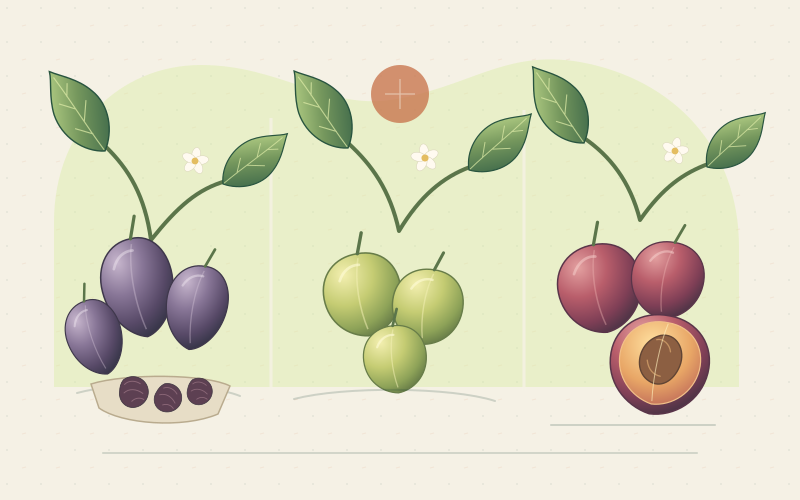
The European plum, Prunus domestica, includes dessert plums, culinary plums, gages and prune types. Fruits can be round or oval, with purple, blue, red, yellow or green skin and a wide range of sweetness and acidity. Trees often have an upright or vase-shaped habit. The Japanese plum, Prunus salicina, is commonly grown for large, juicy fresh fruit, often with red, yellow or dark skin and yellow or red flesh; its tree is often more rounded and spreading.
These are useful generalisations, not identification keys. Many modern cultivars are interspecific hybrids, including Japanese-American plums and plum-apricot crosses sold under names such as plumcot, Pluot or Aprium. Their fruit may look plum-like, but chill, hardiness, pollen compatibility and ripening can reflect mixed parentage. Read the complete nursery description and do not classify an unknown hybrid by colour.
Other species, including American plum P. americana, damsons and cherry plums, are locally valuable but are not silently interchangeable with this entry. A regional nursery may recommend them for severe cold or particular soils. Treat that as a separate, fully identified choice with its own pruning and pollination guidance.
Choose fresh, culinary, prune or dual-purpose fruit
Dessert plums are selected for pleasant fresh eating when fully ripe. Juiciness, aroma, skin astringency, flesh texture and the balance of sugar and acid all matter. Culinary plums may be too sharp or firm for some tastes raw but cook into sauces, jams and desserts with useful structure and flavour. Dual-purpose cultivars can do both; they are practical where space permits only one suitable tree.
Prune-type plums are European cultivars with relatively high sugar and fruit characteristics suited to drying. Their often oval shape, blue or purple skin and yellow flesh are typical, not a sufficient test. “Prune plum” refers to the fresh cultivar before drying; “prune” is the dried product. A juicy fresh plum can be preserved by a suitable recipe, but it will not necessarily dry into the same texture or flavour as a named prune type.
Choose for the work you will actually do. A large dessert crop calls for prompt eating, sharing, chilling, freezing or a tested preserve recipe. A drying cultivar still needs controlled dehydration, conditioning and dry storage; high sugar does not make mouldy or underdried fruit shelf-stable.
Match chill requirement and bloom to the whole site
A cultivar’s chill requirement is the winter condition needed for normal release from dormancy. Requirements are often reported in hours under a specified model, but models and local accumulation differ. Use the supplier’s figure only as a starting point and compare it with local extension or grower experience. Too little chill can produce delayed, uneven or sparse flowering; a tree’s survival says nothing about whether this requirement has been met.
In short or severe-winter regions, winter hardiness and time to ripen are equally important. Japanese-American hybrids may offer locally tested choices where a standard European or Japanese cultivar fails. In mild Mediterranean or highland tropical sites, low-chill material may be essential. In cool northwestern Europe, later flowering can reduce exposure to early frost, while a warm sheltered position can improve ripening.
“Early”, “midseason” and “late” can refer to flowering or harvest and are relative to other cultivars, not fixed dates. Ask which meaning a catalogue intends. Match bloom to pollinator availability and frost risk, then match harvest to your rainfall, heat and autumn frost. A late cultivar that ripens beautifully in a long warm season may never finish in a short one.
Read self-fertility and pollinizer claims together
Self-fertile means a cultivar can set fruit with its own pollen; it does not mean every flower will set or that weather and bees are irrelevant. Partly self-fertile suggests some capacity but often better performance with a partner. Self-sterile or “requires a pollinizer” means another compatible cultivar is needed. A second tree of the same cultivar is generally not a different pollen source.
Compatibility must cross the correct biological group and overlap in bloom. Many European plums can pollinate other European plums, while Japanese plums commonly need a suitable Japanese, American or Japanese-American partner. Utah State Extension notes that European pollen is not compatible with Japanese plum. Hybrid labels require even more care because parentage and flowering period affect the choice.
Ask the nursery to name a proven partner rather than accepting “plant two plums”. If only one tree fits, a verified self-fertile cultivar simplifies the decision. A grafted combination tree can provide partners in a small space only if each cultivar remains healthy and compatible; one vigorous branch must not be allowed to eliminate the other.
Rootstock sets the space; cultivar sets the fruit
Most garden plums are grafted. The rootstock affects vigour and mature dimensions and can influence anchorage and time to bearing. It does not make a high-chill cultivar low-chill or turn a self-sterile cultivar self-fertile. Select rootstock and training form together, allowing room for annual thinning, pruning, netting and safe harvest.
RHS lists Pixy and VVA-1 among relatively compact choices for British gardens, St Julien A and Wavit as more vigorous, and Brompton for large trees. These names are examples, not universal recommendations: local soil, disease, availability and nursery practice differ. A dwarfing label is relative; even a compact plum can become a substantial tree.
| Cultivar or type | Typical identity and use | Selection question |
|---|---|---|
| Victoria | European; self-fertile, dual-purpose fresh and cooking | Is its cropping and disease performance proven locally? |
| Czar | European; compact, self-fertile culinary plum | Does its flavour and use fit the intended kitchen? |
| Stanley or Italian | European prune-type examples | Is a compatible partner needed, and is controlled drying planned? |
| Green Gage | European gage-type dessert plum | Will local warmth, frost and disease pressure suit it? |
| Santa Rosa, Satsuma or Shiro | Japanese fresh-plum examples | Which compatible overlapping-bloom partner is required? |
Let local performance make the final choice
Start with non-negotiables: winter survival, sufficient chill, acceptable bloom-time frost risk, enough warmth and time to ripen, and a compatible pollinizer if needed. Then compare rootstock, mature size and disease resistance to named local problems. Brown rot, bacterial canker, silver leaf, plum pox and insect pests have different regional importance; resistance to one is not immunity to all. Follow local plant-health rules and buy certified healthy stock where available.
Use local trial results, extension lists and experienced growers to evaluate claims. “Sweet”, “early” and “resistant” are incomplete without a comparison point and target organism. Taste locally grown fruit before committing where possible. A famous export cultivar may be selected for handling and appearance rather than your garden’s flavour or harvest pattern.
Finally, consider the crop’s destination. A self-fertile dual-purpose tree may be more useful than two incompatible specialty cultivars, while a prune type earns its space only if you will dry and store it correctly. Keep records of chill, bloom overlap, fruit set, thinning, ripening and flavour. Our growing guide explains the framework and annual care those observations will guide.