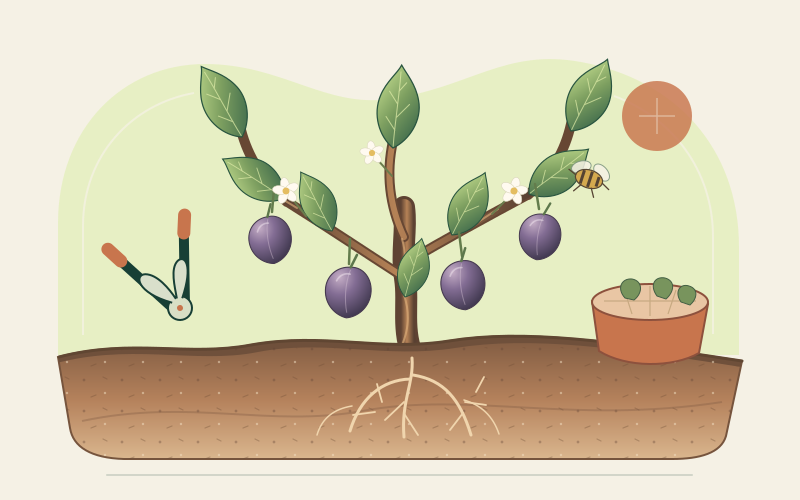
Plan for a perennial, not a seed-to-harvest annual
This guide covers European plum, Prunus domestica, and Japanese plum, Prunus salicina. Both are deciduous trees in the rose family, usually purchased as a named cultivar grafted onto a rootstock. European types range from dessert plums and gages to firm, high-sugar prune cultivars; Japanese types are often juicy fresh fruit with a more spreading tree. Their names do not describe interchangeable pollination or climate groups.
A first crop commonly arrives about two to four years after planting a young grafted tree. That is an establishment range, not a guarantee or a time from sowing a stone. Rootstock, cultivar, nursery-tree age, winter injury, inadequate chill, spring frost, poor pollination and pest damage can all delay fruiting. Full production takes longer. During the first seasons, prioritise roots and a strong framework, and follow local advice on removing early blossom rather than asking a small tree to carry a heavy crop.
Match the site to winter chill and spring frost
Choose full sun, free-draining soil, good air movement and a position where cold air does not collect. Plum trees need winter dormancy, but hardiness and chill requirement are different: a tree may survive winter yet receive too little accumulated cold for even, timely bud break and flowering. Conversely, a well-chilled early-flowering cultivar can lose its crop to a spring frost. Ask local growers or extension for cultivars with demonstrated performance rather than relying on a generic climate-zone label.
European plums often bloom later than Japanese plums, but exact dates vary. Japanese-American and other hybrids can extend choices in cold districts, provided their parentage and local performance are known. Warm Mediterranean lowlands and tropical highland sites need particular caution: a high-chill temperate cultivar may leaf and flower poorly. In cool maritime areas, a warm sheltered wall can help some trained trees, while exposed blossom still needs pollinator access and frost protection.
Avoid shade, persistent waterlogging and vigorous lawn competition. Where late frost is forecast during bloom, a small tree can be covered overnight with suitable fabric supported off the flowers; remove the cover during the day so pollinating insects can work. Protection does not make an unsuitable cultivar reliable.
Read pollination labels as a pair of requirements
A pollinizer must be both compatible and flowering at the same time. Many European plums are self-fertile, so one tree can set fruit, although another compatible cultivar may improve cropping. Others are partly self-fertile or self-sterile. Japanese plums commonly require another suitable Japanese, American or Japanese-American cultivar. Utah State Extension specifically cautions that European plum pollen is not compatible with Japanese plums; do not substitute a neighbouring P. domestica and assume the job is done.
Check nursery or extension pollination tables for the exact cultivars. “Plum” alone is not enough, and ornamental flowering cherries or unrelated stone fruit are not universal partners. Place the required partner within practical pollinator-foraging distance according to local orchard guidance, protect flowering trees from disruptive insecticide applications, and support diverse flowering habitat nearby. Cool, wet or windy weather can suppress insect flight even when compatible blossom is present.
Hand pollination can help a few accessible flowers but cannot solve incompatible pollen, non-overlapping bloom or inadequate chill. Record each tree’s bloom period and fruit set; this is more useful than guessing from one poor spring.
Plant at the right height and leave working space
Choose a healthy bare-root or container-grown tree with a known cultivar and rootstock. Rootstock influences vigour, mature size, anchorage and sometimes precocity; it does not change the fruit cultivar’s chill or pollination needs. Buy during the local planting season and keep bare roots moist but not submerged for long periods. Prepare a hole wide enough for roots without bending them, with the root flare at the finished soil level and the graft union positioned as the supplier advises.
Water thoroughly after planting to settle soil. Remove grass and perennial weeds from a broad root zone, then mulch lightly without touching the trunk. Stake only where support is needed, using a broad flexible tie and checking it often; prolonged tight staking can weaken or girdle a tree. Containers require a suitably compact cultivar-rootstock combination, a large free-draining pot and much closer watering and feeding than trees in ground.
Space for the mature crown and for safe access. Fruit thinning, inspection, netting and harvest are recurring work. A fan on a strong wall system can save ground space, but it needs a defined training routine and wires installed early. Never plan harvest around climbing onto fruit-laden limbs.
Prune for a strong, open crown—and follow the local calendar
Plums produce much of their fruit on short spurs on older wood, with some on younger shoots. The aim is a balanced framework with light penetration, not annual removal of all side growth. European plums are often trained as bushes, pyramids or modified central leaders; Japanese plums commonly suit an open-centred or vase form. Start with three to five well-spaced, sound scaffold branches as appropriate to the chosen system, remove narrow weak forks, and retain productive spurs.
Timing is not universal. RHS advises spring pruning for young plum trees and summer for established trees in Britain, avoiding winter because cuts are more vulnerable to silver leaf and bacterial canker. Utah State, under different disease and winter conditions, recommends late winter or early spring. Use the recommendation for your region and training form, prune in suitable dry weather, and avoid late-season cuts that stimulate tender growth before winter.
Use clean, sharp tools and remove dead, diseased, damaged, crossing or badly placed wood. Renovate a neglected crown over several seasons rather than making many large cuts at once. Remove rootstock suckers and check that a shoot below the graft is not replacing the named cultivar. Seek diagnosis for cankers or dieback, and dispose of infected material as local plant-health guidance directs.
Thin the crop, then water for quality rather than lush growth
A heavy fruit set can break branches, produce small fruit and contribute to uneven bearing. Thin after fruit set and the local danger of damaging frost, once it is clear which fruitlets are persisting. RHS suggests one fruit every 5–8 cm or a pair every 15 cm; Utah State suggests 4–6 in (about 10–15 cm) between European and Japanese plums. These are useful reference spacings, not competing laws. Follow local cultivar guidance and remove small, damaged or crowded fruit while keeping a modest crop on a weak young tree.
Support a still-heavy branch with a broad, secure prop that cannot slip or abrade bark; better thinning is preferable to emergency propping. Keep water consistent during dry establishment and fruit development, checking moisture below the surface. Deep root-zone watering is preferable to frequent shallow wetting or constantly saturated soil. Avoid excessive nitrogen, which encourages soft leafy growth, and use soil or leaf analysis rather than routine heavy feeding.
Inspect for regional problems such as brown rot, bacterial canker, silver leaf, aphids, plum moth, borers and bird damage. Healthy stock, airflow, sanitation and careful water management come first. Obtain a diagnosis before treatment; use only legally available products labelled for plums and the target problem, observing pollinator protections and pre-harvest intervals. Fit supported bird netting securely and check that wildlife cannot become trapped.
Harvest ripe fruit; chill it or dry it deliberately
Plums develop their best flavour on the tree. Ripeness depends on cultivar: purple, red, yellow and green types each have their own full colour. Look for a slight yield to gentle pressure, characteristic aroma and balanced flavour, and sample fruit from several parts of the crown. Pick over multiple passes, supporting each fruit and handling its natural waxy bloom gently. Leave mouldy, leaking or badly damaged fruit out of the storage batch.
Refrigerate sound ripe plums promptly and use them while in good condition; Utah State advises use within about three weeks. Wash before eating or cutting under clean running water, without soap or household disinfectant. Remove stones for prepared dishes, refrigerate cut fruit promptly, and avoid leaving cut or cooked fruit at room temperature for extended periods.
Prunes are dried plums, traditionally made from suitable high-sugar, firm European prune cultivars. Do not expect every juicy dessert plum to make a comparable product. Follow a tested fruit-drying procedure: prepare sound ripe fruit, halve and stone it where directed, and use controlled heat and airflow until pieces are fully dried with no wet centre. Cool before judging final dryness. Condition the batch in a clean covered container for seven to ten days, shaking and inspecting daily; return sound underdried pieces to the dryer and discard mouldy food. Pack thoroughly dry, conditioned prunes in clean airtight containers, labelled and stored cool, dark and dry. Shrivelled or mouldy fruit on the tree is not safely preserved.
Sources and further guidance
- Royal Horticultural Society: How to grow plums
- Royal Horticultural Society: How to prune plum trees
- Utah State University Extension: How to Grow Plums in Your Home Garden
- National Center for Home Food Preservation: Drying foods
- US Food and Drug Administration: Raw produce—selecting and serving it safely