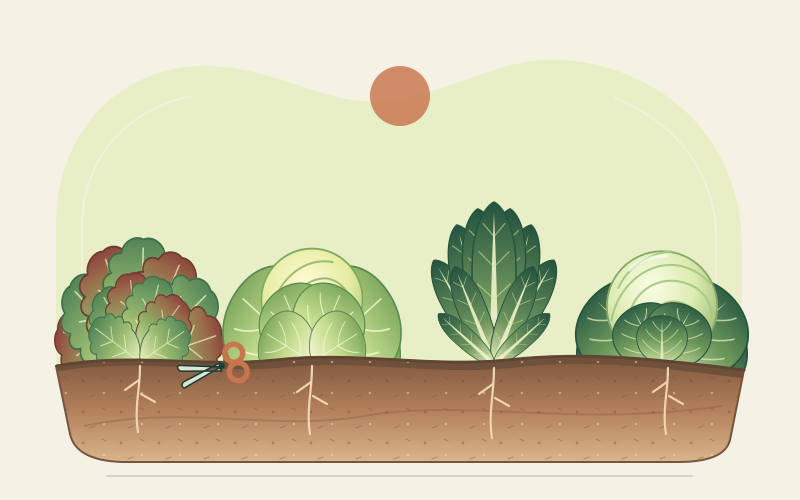
One species, several useful architectures
Common garden lettuces are Lactuca sativa, whether the packet says green oakleaf, red salad bowl, Boston, Bibb, romaine, cos, Batavia or iceberg. These words describe selected growth habits and leaf forms rather than separate species. A named cultivar is a maintained selection; a “mesclun” or mixed-leaf packet may contain several species as well as several lettuces.
Catalogue boundaries are not perfectly standardised. Compact cos, semi-cos, buttercrunch and Batavia descriptions may overlap across suppliers. Read the mature size, days to harvest, intended spacing and seasonal trial notes. Colour and frilliness are visible, but head density, bolting response and disease resistance are more consequential to the grower.
Loose-leaf and oakleaf: quick, open rosettes
Loose-leaf lettuce produces an open rosette rather than a dense heart. Leaves may be smooth, puckered, deeply frilled or lobed; green and red selections are both common. ‘Black Seeded Simpson’ is a traditional green form, while ‘Red Sails’ and ‘Salad Bowl’ illustrate red or frilled selections. The names describe particular cultivars, not a promise that every packet with a similar photograph performs identically.
Oakleaf describes a distinctive indented or lobed outline, in green or red. It is a leaf-shape class within the broader loose-leaf group, not a separate botanical identity. ‘Lollo Rossa’ and related Lollo forms are more strongly frilled and are often used for baby leaves or small decorative heads.
These types suit repeated outer-leaf picking, close baby-leaf sowing and containers. They commonly reach the first useful picking near the early end of Rooted’s 40–70-day window, often around 40–50 days under favourable conditions. A dense heart should not be the harvest criterion. Once flowering begins, leaf quality generally declines.
Butterhead: soft leaves around a tender centre
Butterhead forms a loose to moderately firm head with flexible, smooth-edged leaves and a soft, pale heart. Boston and Bibb are familiar names within this broad type; ‘Buttercrunch’ is a widely sold selection. The leaf texture is tender, not flavourless, and the cupped outer leaves work well for wraps as well as salads.
Give butterheads enough room to close without crowding. Harvest the whole plant when the centre is developed, or take a few outer leaves earlier if you accept a different harvest pattern. Small compact heads may fit the 55–70-day part of the profile, but weather and cultivar matter. Their soft leaves bruise and wilt more readily than a dense crisphead, so gentle harvest and prompt refrigeration are especially useful.
Cos or romaine: upright leaves and substantial ribs
Cos, also called romaine, makes an upright, elongated head with pronounced midribs and a crisp central heart. Outer leaves can be open and darker, while inner leaves are usually paler and more tightly folded. ‘Little Gem’ is a familiar compact choice for small gardens and individual portions; larger romaines need more space and time.
The ribbed structure gives cos a different eating texture from butterhead, and whole leaves can be used in salads, sandwiches or cooked dishes where a recipe calls for them. Upright does not mean invulnerable: soil splash and damp inner growth still matter. Harvest compact heads promptly and avoid leaving mature plants through sustained heat in the hope of an ever-larger heart.
Crisphead, iceberg and Batavia: crunch with patience
Crisphead lettuces develop dense, rounded heads of firm, brittle-textured leaves. Iceberg is the best-known subgroup, while Batavia or summer-crisp forms may be somewhat looser and more strongly coloured or blistered. ‘Great Lakes’, ‘Salinas’ and ‘Summertime’ are examples listed by Utah State University; local availability and adaptation differ.
A large crisphead usually needs more time than early loose leaves and may exceed the 70-day upper end of Rooted’s general profile. Crowding, uneven water and heat can disrupt heading or quality. Although intact crispheads often keep better than delicate loose leaves, “stores well” is relative: refrigeration, freedom from decay and prompt use still govern shelf life.
Compare the packet before you sow
| Type | Typical habit | Useful harvest | Selection point |
|---|---|---|---|
| Loose leaf | Open rosette; no dense heart | Baby leaves or repeated outer leaves | Fast start and flexible picking |
| Oakleaf | Open, indented or lobed leaves | Young leaves or small rosettes | Leaf outline, colour and frill |
| Butterhead | Soft leaves; loose to moderate head | Whole tender head | Gentle handling and shorter storage |
| Cos / romaine | Upright head with firm midribs | Compact or full upright head | Portion size and upright spacing |
| Crisphead | Dense round head; crisp leaves | Firm whole head | Longer growth and head quality |
Match claims to your actual season
“Heat tolerant,” “slow to bolt” and “winter hardy” are relative claims. Ask whether the cultivar was trialled in conditions like yours, and whether the description refers to germination, leaf quality or time to flowering. Hot soil can inhibit germination even when an established plant has some heat tolerance. Winter survival likewise depends on plant size, drainage, wind and the severity and duration of cold.
Disease-resistance codes apply to named diseases and sometimes specified races or strains; they do not indicate broad immunity. Where downy mildew, lettuce mosaic or another problem recurs, use local extension advice and read the resistance details rather than relying on a generic “healthy variety” label.
For a practical trial, grow one loose-leaf and one heading cultivar side by side. Record sowing date, emergence, first usable leaf, head formation, bolting, pest damage and the number of portions actually eaten. A smaller cultivar that fits your meals can outperform a large head that becomes a storage problem. The growing guide covers succession and spacing.