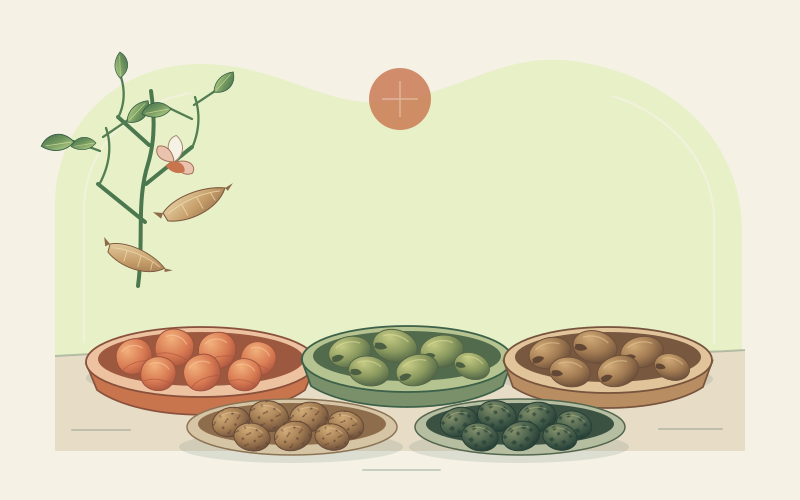
Market classes are not a botanical key
Most familiar culinary lentils belong to the cultivated species Lens culinaris. Within it, breeders and sellers distinguish cultivars and market classes by seed size, coat colour, pattern, cotyledon colour, origin, and intended use. A name on a packet may combine several of those ideas. It does not, by itself, establish a separate species, a fixed cooking time, or performance in your garden.
The seed coat is the outer layer; the cotyledons are the two large halves inside. Many green or brown coats conceal yellow or orange cotyledons. A split lentil has been divided at the natural seam, often after the coat has been removed, so it cooks faster and usually breaks down more readily. “Red lentils” in a kitchen commonly means these split, hulled seeds, but whole red-coated lentils also exist. Read the packet rather than treating colour as a complete processing description.
These labels overlap. A French green lentil is also green in the broad everyday sense, and a small Spanish-style brown lentil may be sold beside an ordinary brown class. Named cultivars within a class can differ in size, height, days to maturity, and disease response.
Five familiar labels, read carefully
Red: often a cooking form as well as a colour
Split red lentils expose orange-red cotyledons and have no intact seed coat around each half. They generally soften quickly into soups, dals, and purées. Whole red lentils retain their coats and need different handling, while red-coated seeds may look less vivid after cooking. “Red” therefore does not guarantee a uniform texture or exact minutes on the stove.
Green: a broad class with many textures
Green lentils usually retain their seed coats and are often chosen when a cooked seed should keep its outline. Their coats may be pale green, olive, dark green, or mottled, and size varies. Some soften more than others, and age, soaking policy, water, and cooking method affect the result. Do not assume every green lentil is the same as a French green or Puy lentil.
Brown: the familiar everyday class
Brown lentils range from tan to deep brown and may have flat or more rounded seeds. They are commonly sold whole and used in soups and stews. Depending on cultivar and cooking time, they may retain some shape or become quite soft. “Brown” says little about garden maturity or whether the seed is appropriate for planting.
Spanish: a regional or market description
Spanish-style lentils are often small, brown, and speckled; names such as Pardina appear in this broad area of the market. Yet a culinary label may refer to style, cultivar, or origin, and different suppliers can use it differently. Protected geographical names have their own rules. Treat “Spanish” as a prompt to read the detailed description, not as a universal species or cultivar definition.
French: distinguish style from origin
French green lentils are generally small, dark, and mottled, with a reputation for holding their shape when cooked. Puy lentils are associated with a defined production area in France and a protected geographical designation; the name should not be applied automatically to every small green seed. Other French green types may share culinary traits without sharing that origin.
| Label | Often describes | Check before buying |
|---|---|---|
| Red | Split orange-red cotyledons, or a whole red-coated class | Whole or split; hulled or with coat |
| Green | A whole-seed class with green to olive coats | Named cultivar, size, and intended texture |
| Brown | A broad whole-seed class, tan to dark brown | Size and supplier’s cooking guidance |
| Spanish | A regional style or small brown market type | Actual cultivar and stated origin |
| French | A small dark green type or a geographical tradition | Whether a protected origin is specifically named |
Choose the form for the dish
For a thick soup or dal, split red lentils are a direct choice because their exposed cotyledons break down readily. For a salad or a side dish with distinct seeds, start with a whole green, brown, Spanish-style, or French green type described as retaining its shape. Even then, cook gently and stop when the texture suits the dish; simmering until every seed collapses will erase the intended difference.
Whole and split forms are not interchangeable by volume and time alone. Follow the recipe’s form and the packet’s cooking instructions, and do not rely on colour to indicate nutritional superiority. The lentil nutrition guide uses one clearly stated cooked reference food, not a value claimed for every market class.
Choose planting seed for your climate
Kitchen categories are only a starting point for gardeners. Look for planting seed with a botanical name, cultivar, maturity information, and local supplier guidance. The general 80–110-day window needs to fit your cool season: the plants should establish in suitable temperatures and reach dry harvest before damaging heat, drought, or prolonged rain. Small-seeded does not necessarily mean early, and green does not necessarily mean late.
Locally adapted seed matters because day length, temperature, seasonal rainfall, and disease pressure differ. If possible, trial two suitable cultivars in adjacent rows and record emergence, height, lodging, first mature pods, disease symptoms, and final dry yield. Short lentil plants need no trellis, but a cultivar prone to lodging can leave low pods in wet soil. Free drainage and modest fertility remain more important than an impressive catalogue description.
Ask which diseases are recurrent locally and whether a cultivar has specific, relevant resistance. No class is immune as a group. Avoid saving seed from diseased plants, and do not treat volunteer seedlings from an old food-lentil sowing as evidence of reliable local adaptation. Our small-scale growing guide covers the full bed-to-storage process.