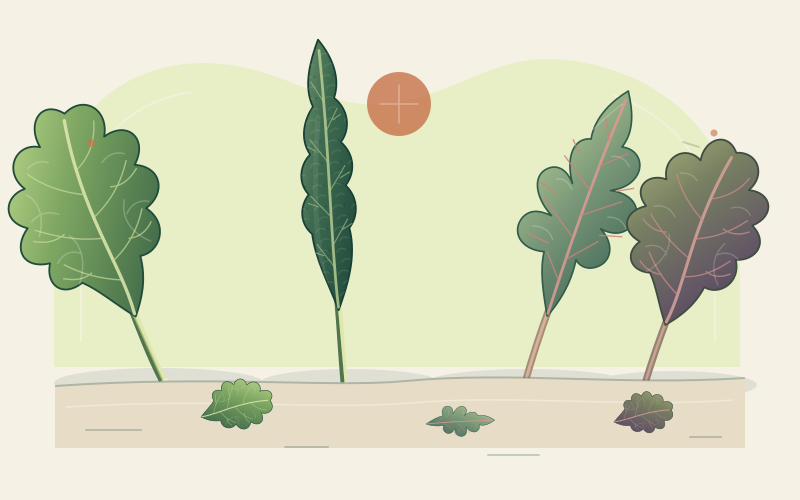
Leaf descriptions are not performance rankings
Kale is a culinary and horticultural name spanning several cultivated forms rather than one uniform plant. Many seed-catalogue kales are Brassica oleracea, in the same species as cabbage and broccoli. Others, notably Siberian and some Russian types, are Brassica napus. Curly, flat-leaf, Tuscan, red, and blue describe visible features; they do not by themselves establish the species, harvest date, cold tolerance, flavour, or resistance to pests.
Even a named cultivar can perform differently across soils and seasons. Leaf texture changes with age, water supply, temperature, and cooking. Descriptions such as “tender”, “sweet”, or “hardy” are useful clues from a supplier or trial, not guarantees for every garden. Start with locally available seed, read the complete packet description, and treat a small home trial as better evidence than a universal league table.
Three useful ways to read the foliage
Curly: frilled edges and textured leaves
Curly or Scotch kales have leaves that range from gently ruffled to densely frilled. Compact cultivars can suit smaller beds or containers, while others become tall bunching plants. Young leaves may be used in salads; mature leaves are commonly chopped for soups, stews, and sautéing. The folds can hold soil and small insects, so separate the leaves and wash them carefully. Frilliness does not guarantee a tougher leaf, and “dwarf” refers to plant habit rather than a requirement to harvest early.
Green curly cultivars include many strains sold as Dwarf Green Curled or simply curly kale. Purple curly cultivars such as Redbor illustrate how a colour descriptor can cross the same form. These are examples, not recommendations for every region, and suppliers may offer distinct strains under similar names.
Flat-leaf and Tuscan: smooth outline does not mean smooth surface
Flat-leaf is a broad description for foliage without dense curling. It can include divided or oak-leaf Russian types as well as relatively open, strap-shaped leaves. Tuscan, lacinato, dinosaur, cavolo nero, and Nero di Toscana usually refer to a distinctive group with long, narrow, blue-green leaves and a deeply puckered or blistered surface. Despite being grouped with flat-leaf kales for contrast with curly forms, their surface is conspicuously textured.
Tuscan-lacinato types can be picked young or allowed to develop longer leaves for bunching. Their shape is convenient to strip from the central rib and slice into ribbons, but thick midribs and older leaves may still need longer cooking. Leaf age and the recipe matter more than the nickname “dinosaur”. Most lacinato cultivars are placed in B. oleracea; a look-alike name alone should not be used to infer how another kale will grow.
Red, purple, and blue: colour across several forms
Red or purple pigmentation may colour the entire leaf or appear mainly in veins, stems, and margins. Blue kale usually describes a blue-green or grey-green cast rather than a literally blue leaf. Colour can occur in curly, broad, divided, and Tuscan-like plants, and it may intensify or fade with light, temperature, and maturity. Cooking can also change the appearance, so ornamental colour is not a promise of the same colour on the plate.
Red Russian-type kale is especially important to check. It is commonly listed as Brassica napus Pabularia Group, unlike the many curly and Tuscan cultivars in B. oleracea. Names and classifications can vary among suppliers, and related cultivars such as Red Ursa have their own identities. Read the botanical name supplied with the actual seed rather than assuming every red-veined kale is the same species. This matters for seed saving and understanding plant relationships; for rotation, treat all of them as brassicas either way.
| Form | Typical foliage | Kitchen or garden starting point |
|---|---|---|
| Curly | Ruffled to densely frilled; green or purple | Baby leaves, chopped greens, compact or tall cultivars |
| Tuscan-lacinato | Long, narrow, puckered, often blue-green | Ribboned leaves for soups and sautés; repeated picking |
| Russian or Siberian type | Often broad, divided, or lightly frilled | Check for B. napus; use young or cooked |
| Red or blue forms | Colour may affect blade, veins, stems, or leaf cast | Ornamental and edible value across several leaf forms |
Match the plant to the harvest
For baby-leaf production, look for cultivars explicitly described for salad or close spacing, and sow small successive batches. Almost any edible kale can be sampled young, but a packet selected for uniform baby leaves is more informative than assuming a large bunching cultivar will remain small. For full-sized greens, compare mature height, spread, stem strength, and intended spacing. Containers call for particular attention to compost volume, water, and the supplier’s mature dimensions.
Rooted’s 50–75 days is an indicative first-harvest range for developed leaves, not a cultivar rating. Baby leaves can be earlier, transplanting changes the count, and weather or crowding can delay picking. Most common kales are biennial: leaf production is followed by flowering after a cold period or as seasons change. A few perennial or long-lived heritage kales exist, but they should not be confused with every packet labelled kale. Frost tolerance and the likelihood of overwintering remain local and cultivar-dependent.
For seed saving, the species distinction becomes practical. Compatible brassicas can cross-pollinate, while isolation needs and local seed rules vary. Saving seed also requires allowing biennial plants to flower and mature rather than keeping every shoot harvested. Beginners choosing only for the kitchen need not turn that into a barrier; simply buy seed whose identity and intended use are clear.
Make a local, testable choice
Start with conditions and recurring problems
Ask local growers or extension services which kales are available and which problems recur. Heat, day length, winter lows, drainage, clubroot, and pest pressure can alter the outcome. Resistance claims must refer to a named problem and a particular cultivar; they are not immunity. No leaf colour or curl pattern predicts freedom from caterpillars, aphids, or clubroot.
Compare more than one plant in the same bed
If space permits, grow a few plants of two contrasting forms under the same conditions. Record emergence, transplant recovery, usable leaf harvest, pest damage, and flavour after your usual cooking method. Keep enough plants to avoid judging a cultivar from one damaged specimen. A curly and a Tuscan type make a useful textural comparison, but the better choice is simply the one that fits your climate, space, and meals.
Once chosen, give the plants suitable soil, spacing, protection, and repeated harvesting. Our kale growing guide covers those shared needs without treating any one form as a universal winner.
Sources and variety references
- Royal Horticultural Society: Kale forms and cultivation
- North Carolina Extension Gardener Plant Toolbox: Kale, Acephala Group
- North Carolina Extension Gardener Plant Toolbox: Lacinato Kale Group
- North Carolina Extension Gardener Plant Toolbox: Siberian kale and Russian-type cultivars
- University of California Agriculture and Natural Resources: Kale