Understand a warm-season storage root
Sweet potato, Ipomoea batatas, is a trailing member of the morning-glory family. Its edible swollen storage roots are not the tubers of an ordinary potato, and the crop is not a true yam. Gardeners normally plant slips—leafy shoots grown from a root or taken as cuttings—rather than sowing botanical seed or cutting a root into pieces.
This is a tender crop that needs full sun, warm soil, and enough time for roots to enlarge. Rooted uses a broad 90–150 day window from planting slips to harvest, but cultivar and climate matter. A short, cool summer can leave small roots even when the foliage looks impressive. Count your local frost-free period, then choose a cultivar with a realistic maturity window rather than treating the calendar as a guarantee.
Start with slips and prepare a warm bed
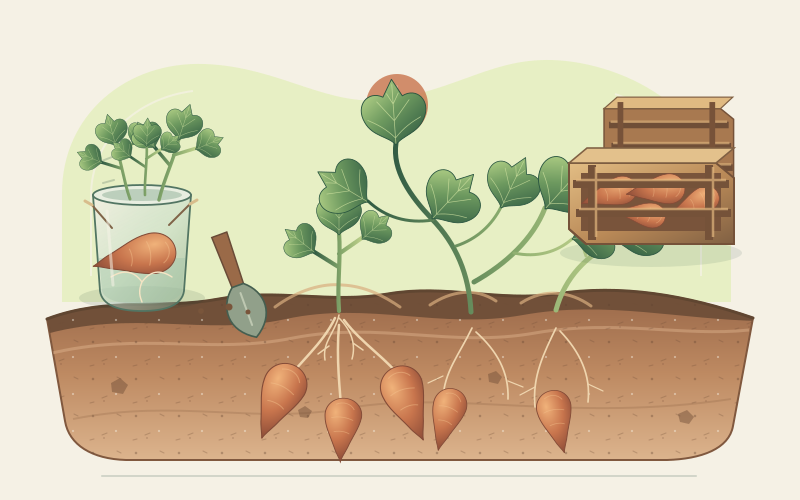
Buy clean, healthy slips or young plants from a reputable supplier, choosing varieties grown successfully in your region. Home gardeners in suitable climates can also produce slips from sound, known sweet potatoes: encourage shoots in warmth and bright light, then remove and root the shoots. A shop-bought root may be an unnamed cultivar, may have been stored in conditions that delay sprouting, and can carry pests or disease. Do not use a mouldy or rotting root, and follow local rules on propagating planting material.
Unrooted slips need prompt care. Stand their lower stems in clean water or pot them into moist cutting compost, keeping them warm, bright, and sheltered while roots form. Rooted plants still need hardening off before outdoor planting. Do not rush them into cold ground merely because the air feels pleasant for an afternoon.
Choose an open site with loose, fertile, freely draining soil. Sweet potatoes tolerate a range of soils, but compaction and waterlogging restrict roots and encourage rot. Use a soil test to guide fertility; excessive nitrogen can favour vines over storage roots. In heavy ground, broad raised ridges can improve drainage and make lifting easier. Avoid fresh manure and do not turn planting into an excuse for repeated deep cultivation.
Plant and care for the vines
-
Wait until frost has passed and soil is warm
Plant only after the local frost danger has passed and the soil has warmed—about 18°C (65°F) is a useful minimum guide. Cold, wet soil stalls or damages tender plants. In a temperate garden, pre-warm a sheltered bed with a suitable cover, ventilating as conditions require, or use a greenhouse. Protection cannot turn an unsuitably short season into a tropical one.
-
Set slips deeply enough, with space between plants
Water the slips, then plant with several lower nodes below the surface and the upper leaves above it. As a starting point, allow about 30 cm (12 in) between plants and 90–100 cm (35–40 in) between rows; follow local cultivar advice where it differs. Ridges give roots room and keep the planting position clear once foliage spreads.
-
Make a deliberate plan for the vines
Stems commonly trail for 1.5 m (5 ft) or more. Let them cover their allocated ground, guide them onto paths you can spare temporarily, or train suitable vigorous growth up a secure support. Do not repeatedly disturb rooting stems near the plants. Trim only when necessary to keep access open, and leave ample leaf area to feed root growth.
-
Use containers where the season suits them
A container can provide warm, loose growing medium on a patio or in a greenhouse. Choose a deep, sturdy pot at least 30 cm wide, with larger vessels giving more root room, and ensure free drainage. One plant per large pot is a cautious starting point. Use suitable peat-free potting compost rather than dense garden soil, and provide space or support for vines. Small grow bags and pots dry quickly and cannot compensate for inadequate heat or light.
-
Water for establishment and steady root growth
Keep the root zone evenly moist, especially while slips establish and during the first 50–60 days. Check below the surface and water deeply when needed rather than following a rigid schedule. Containers may need daily attention in hot weather. Avoid both prolonged drought and saturated soil; erratic extremes can reduce yield or contribute to splitting. Water at the base, and mulch warm soil to slow evaporation and suppress weeds.
-
Weed early and observe the whole plant
Hand-weed while plants are young, before a leafy canopy develops. Look for chewing, wilting, lesions, or poor growth and identify the cause before intervening. Protected crops can attract whitefly or red spider mite, while outdoor roots may attract local burrowing pests. Use locally recommended, food-crop-safe controls and keep garden hygiene sensible; vines alone do not prove that roots are developing well.
Adapt to tropical and temperate conditions
In tropical and subtropical areas without frost, planting may be possible across much of the year, but calendar freedom does not remove other limits. Heavy seasonal rain can waterlog beds, very hot dry periods demand irrigation, and local cultivars may respond to day length differently. Plant into the locally reliable rainfall or dry-season window, provide drainage, and seek regional advice on maturity and pests.
In temperate areas, the main challenge is accumulated warmth. Favour an early, locally proven cultivar, the sunniest sheltered site, and a greenhouse, cold frame, or well-managed cloche where appropriate. Warm the soil before planting and protect against late cold without allowing covered plants to overheat. Near season’s end, do not wait for frost to improve sweetness: it injures vines and can start decay that moves into roots.
Lift gently, cure warmly, and store frost-free
Check the cultivar’s expected maturity and inspect a sample root when the shorter end of its window approaches. Roots may be usable before the vine canopy dies, so yellowing is not the only cue. Lift before frost and before cold soil causes chilling injury. Cut back vines if needed, loosen soil from well outside the root cluster, and lift by hand. Fresh skins are fragile; avoid throwing, dropping, washing, or scrubbing the roots.
Curing is warm, not cold. For a keeping crop, spread unwashed roots in a single layer with air around them. Ideal conditions are roughly 27–29°C (80–85°F) and 80–90% relative humidity for about 5–10 days; alternative extension guidance allows a longer warm curing period. Provide ventilation without chilling or condensation, protect roots from rain and animals, and monitor any heater carefully. Curing helps surface wounds heal and can improve eating quality. Use deeply cut or badly damaged roots promptly instead of expecting curing to rescue them.
After curing, keep sound roots in breathable trays or boxes at about 13–16°C (55–60°F), with high but non-condensing humidity where possible. A frost-free cellar or indoor store may be more suitable than a shed or refrigerator. Temperatures below 10°C (50°F) can cause chilling injury, while excess warmth and dryness encourage sprouting or shrivelling. Do not seal roots in wet plastic. Inspect regularly, remove decaying roots, and wash only when preparing them for food.