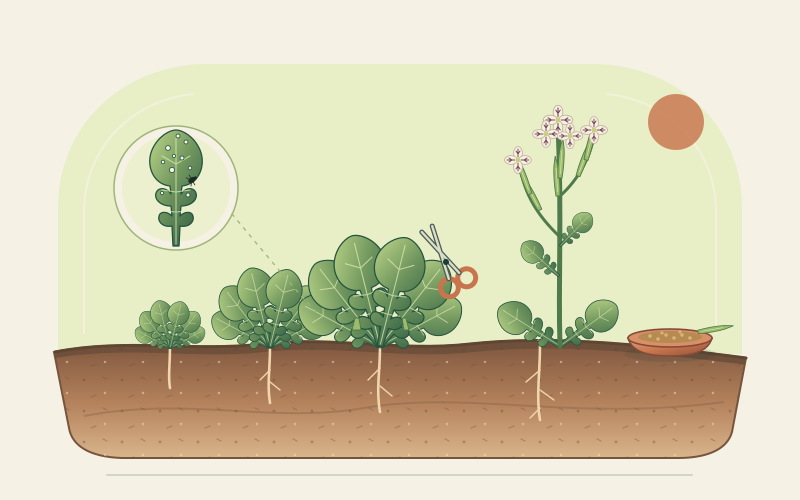
Begin with salad rocket’s short annual cycle
Salad rocket, garden rocket and arugula usually name Eruca vesicaria, commonly sold as E. vesicaria subsp. sativa or under the synonym Eruca sativa. It is an annual member of the Brassicaceae. Rooted’s 30–50-day window runs from direct sowing to the first usable salad leaves during favourable growth. A sowing can yield several pickings, but it remains short-lived rather than becoming a permanent herb plant.
Wild rocket usually means Diplotaxis tenuifolia, another Brassicaceae species with narrower, deeply divided leaves, yellow flowers and a perennial habit. It generally establishes more slowly and can continue producing after flowering. Salad rocket has broader, often less divided leaves and cream flowers marked with dark veins, and its useful leaf stage ends as it bolts and sets seed. The two can be grown together, but the fast calendar and replacement strategy on this page belong to annual Eruca.
Sow, thin and follow with another small batch
-
Choose a mild-weather growing position
Rocket grows in full sun during cool weather and appreciates light shade when summer heat would otherwise accelerate flowering. Use fertile soil that holds some moisture yet drains freely. Remove weeds, break up surface crusts and avoid working saturated ground. Mature compost can improve structure; a soil test, rather than a blanket high-nitrogen feed, is the sound basis for correcting fertility.
-
Direct sow shallowly
Make a drill about 0.5–1 cm deep, water its base if the soil is dry, sow thinly and cover lightly. Follow the seed packet where its instructions differ. Keep the surface moist until emergence without washing seeds away. Seedlings often appear within days in warm, moist soil, but cold delays them. Modules are useful for an early or protected start; transplant promptly before crowded roots check growth.
-
Give each plant useful space
For baby leaf, a denser band can be cut young. For repeated picking of larger plants, thin to roughly 10–15 cm apart, adjusting to the cultivar and packet. Snip where pulling would loosen neighbours and use sound thinnings in the kitchen. Crowded plants compete for water and light and may bolt sooner. A container should be broad and deep enough to avoid drying within hours; drainage holes remain essential.
-
Repeat every two to three weeks
Sow a short row, a strip of bed or one modest container at a time during suitable weather. The right interval depends on temperature and household use: note when each batch reaches picking size and when its first flower stems appear. Stop sowing before sustained severe heat or hard cold if experience shows poor results, and resume in late summer or under cover. Succession is more dependable than trying to keep one old sowing tender indefinitely.
-
Keep growth steady, not waterlogged
Feel below the surface and water the soil before plants wilt. Dry stress reduces growth and encourages bolting; saturated soil deprives roots of air. Mulch around, not over, established seedlings to reduce evaporation and soil splash, while keeping damp material away from stems where slugs are active. Move containers into light shade during hot spells and ventilate cloches or fleece so protection does not create excessive heat.
Read bolting as a transition, not a surprise
Bolting is the shift from leafy growth to an elongating flowering stem. Annual salad rocket naturally completes this transition, and heat, long days, crowding, age and water stress can bring it forward. A cold check can also disrupt growth; do not reduce every cause to hot weather alone. Leaves often become smaller, tougher or more pungent as flowering advances, though flavour judgements vary.
Pinching out the first stem may win a little time, but side shoots commonly follow. It does not reset the annual plant. Harvest useful leaves, then remove the plant to free space for the next sowing. Alternatively, keep a healthy plant deliberately for pollinators, edible flowers or seed. If a packet is described as slow-bolting, treat that as a comparison under specified conditions, not immunity to flowering.
Protect seedlings from flea beetles and slugs
Flea beetles are small beetles that jump when disturbed and chew tiny rounded holes, producing a shot-hole pattern. Several species attack brassicas. Light feeding on a large leaf may be mainly cosmetic, but feeding on a cotyledon or tiny seedling can seriously check or kill it. Inspect early growth rather than waiting until holes cover every leaf, and use local identification if the damage pattern is unclear.
Where flea beetles recur, fine insect mesh is most useful as prevention. Put a well-supported cover in place immediately after sowing or transplanting, before beetles arrive, and secure every edge against the soil. Do not seal already infested plants inside. Leave enough slack or hoop height for growth, and open the cover briefly for weeding and inspection when necessary. Manage brassica-family weeds and crop residues that shelter pests, rotate where practical, and keep plants growing steadily. Floating covers still need ventilation in heat.
Slugs and snails make larger, irregular holes and often leave slime, especially in damp conditions. Check after dusk or early morning, reduce unnecessary hiding places and hand collect where effective. Any pesticide is a later, locally justified choice: identify the pest, confirm the product is legal and labelled for rocket or the relevant leafy crop, follow pre-harvest intervals exactly, and protect pollinators and waterways. Mesh and slug controls address different problems.
Harvest leaves, then decide between flowers and seed
Start picking at about 30–50 days, using leaf size and plant condition rather than the date alone. Take a few outer leaves from each plant with clean snips, leaving the centre and enough foliage for regrowth. For a once-over cut, use clean scissors or a knife to cut a young plant roughly 2–3 cm above the crown; regrowth depends on cutting height, plant age and weather. Do not strip one plant while leaving its neighbours untouched. Harvest in the cool part of the day when possible.
Young leaves are usually tender and milder raw; older leaves can be wilted, sautéed briefly or added to soup and pasta. Rocket flowers are edible too. Use only correctly identified flowers from plants grown for food and not treated with a product incompatible with eating the blooms. Rinse gently if needed, dry and use promptly. Annual Eruca flowers are cream to pale yellow with conspicuous dark veins; wild Diplotaxis flowers are yellow.
For seed saving, leave healthy, representative annual plants to flower and form narrow pods. Rocket can cross with other flowering Eruca plants, so a seed saver seeking a maintained cultivar needs an appropriate isolation plan and enough plants for that seed-saving system; do not assume one isolated pod preserves the packet’s genetics. Do not assume Eruca and Diplotaxis are interchangeable seed crops.
Harvest pods when mature and drying but before they shatter, preferably into a labelled bag or container. Finish drying under cover with airflow, extract and clean the seed, then ensure it is thoroughly dry before airtight storage. Label species and cultivar, place and year. Remove unwanted self-sown seedlings before they spread beyond the garden, and follow local advice if a rocket species is invasive in your area. Fresh reputable seed is simpler for a small mixed garden.
Cool promptly and wash for the intended use
Rocket wilts quickly. Move the harvest out of sun and heat, remove badly damaged or rotten leaves, and refrigerate sound leaves promptly in a clean bag or container that limits crushing without trapping a warm, wet heap. Avoid cross-contamination from raw meat, poultry, seafood and their utensils. Pre-cut or packaged leaves should remain refrigerated; follow the package instructions and use-by information.
For loose rocket, wash hands and clean the preparation surface, then rinse leaves thoroughly under clean running water before preparing or eating. Do not use soap, household detergent or an unapproved produce wash. Drain and dry with a clean towel or salad spinner, especially for a salad or pesto. Washing can reduce surface contamination but does not make contaminated leaves sterile. If packaged rocket is labelled “pre-washed” or “ready-to-eat,” further washing is not required; prevent it from touching unclean surfaces.
Fresh rocket is not a shelf-stable storage crop. For longer keeping, use a tested recipe and suitable freezing or acidification process rather than improvising a low-acid canned pesto or leaving dressed leaves at room temperature. Refrigerate cooked leftovers promptly in a clean covered container and follow local food-safety advice for storage and reheating.
Sources and further guidance
- Royal Horticultural Society: How to grow rocket
- University of Minnesota Extension: Growing arugula
- NC State Extension Gardener Plant Toolbox: Diplotaxis tenuifolia
- University of California Statewide IPM Program: Flea beetles on leafy greens
- US Food and Drug Administration: Selecting and Serving Produce Safely