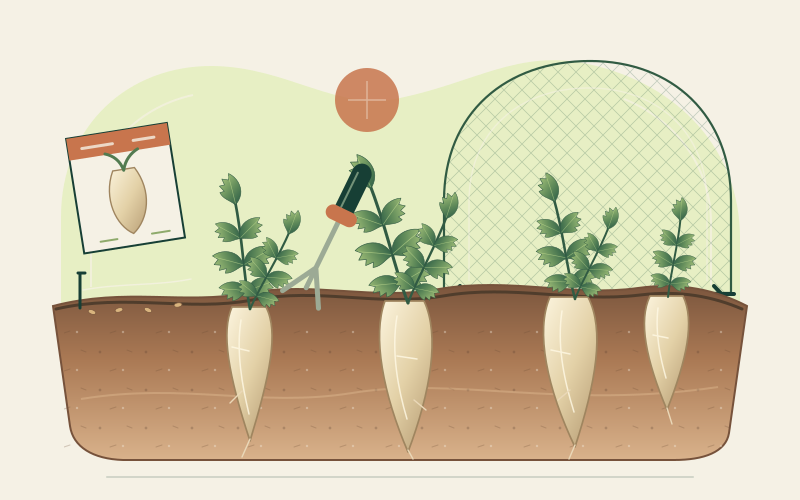
Know the crop and reserve the whole season
Parsnip, Pastinaca sativa, is a biennial in the Apiaceae family, usually grown as an annual for its swollen cream-coloured taproot. In its first year it builds leaves and the edible root; if left to complete its biennial cycle, it later sends up a flowering stem and the root becomes woody. This guide concerns cultivated parsnips grown from reputable seed, not roadside or unidentified plants.
Rooted gives a general 100–150-day window from direct sowing to first usable roots. Small roots can sometimes be pulled sooner; large storage roots, slow emergence and cold conditions can take longer. Packet timing begins under the supplier’s own conditions, so inspect a sample root instead of treating the number as an appointment.
Parsnips favour sun and cool, moderate growing conditions. They occupy a bed for much longer than carrots or salad crops. Plan succession around that commitment, and use local spring, autumn or winter windows rather than forcing the crop through hot lowland summer.
Prepare, sow and establish the row
-
Make deep room for the selected root
Remove stones and coarse debris and loosen compaction to the depth required by the cultivar, without working wet ground into clods. A fine, level surface helps shallow seed make good contact. Long types need deep, unobstructed soil; shorter or more bulbous cultivars are practical in shallower or heavier beds.
Heavy soil is not a universal prohibition. Improve structure with suitable mature organic matter where local guidance supports it, use a no-dig bed, or select a shorter root. Ground amended with compost or well-rotted manure in a previous season is preferable to fresh manure dug in just before sowing, which can encourage branching. Raised beds and very deep containers are further options.
-
Start with fresh seed every spring
Parsnip seed has a reputation for losing viability quickly. Buy only enough fresh seed for the current season, check its packed-for or sow-by date, and store the packet cool and dry. Old seed is not merely slower: it may produce a sparse, uneven row that is difficult to thin and manage. Do not compensate by burying seed more deeply.
Saving seed requires keeping selected biennial plants through flowering and preventing unwanted crossing with other Pastinaca sativa. It is a separate multi-season project, not a reason to rely on an old packet of uncertain viability.
-
Direct-sow shallowly when soil is warming
Parsnips are best direct sown because transplanting can disturb the taproot. Follow the packet first; roughly 1 cm deep, with rows about 30 cm apart, is a common starting point. Water a dry drill before sowing, distribute seed thinly or in small station groups, cover lightly and firm gently rather than compacting.
Very early sowing in cold, wet soil often disappoints. RHS guidance recommends waiting until soil is around 12°C for reliable germination; cloches can pre-warm and dry a bed before sowing. Local soil condition matters more than a fixed February or March date.
-
Keep the seed zone moist for 14–30 days
Parsnips are slow to emerge, commonly taking 14–30 days and sometimes longer in cold conditions. Check the shallow surface regularly in wind or heat. Water with a fine rose or gentle spray that will not wash seeds together. Keep it moist, not sealed in standing water.
A few radish seeds can mark the row and supply an early harvest, provided they are removed before competing with parsnips. A light permeable covering may limit crusting where locally recommended, but lift it as seedlings emerge. Do not assume a quiet row has failed before its full germination window.
-
Thin and weed before competition builds
When seedlings are large enough to handle, thin gradually to the packet spacing; about 15 cm between plants is common for full-size roots. Snip surplus shoots at soil level or pull carefully in moist soil, then firm remaining plants back in place. Crowded parsnips compete for light, water and root space even when their foliage looks healthy.
Hand-weed close to the row instead of hoeing deeply into roots and crowns. Water young plants in dry spells until established. Mature plants tolerate some dryness, but repeated severe drying followed by heavy watering can contribute to splitting; saturated soil encourages other problems.
Prevent carrot fly and canker damage
Parsnips can share carrot fly problems with carrots and related Apiaceae crops. Larvae tunnel into roots and create entry points for rot. Where the pest occurs, prevention is more dependable than repair: cover with insect-proof mesh with every edge secured, allowing enough height for mature foliage, and replace it promptly after working in the row.
Rotate away from ground that recently held parsnips, carrots or other susceptible relatives so insects do not emerge inside a new cover. Clear away thinnings and avoid unnecessary foliage bruising. Mesh does not remove pests already present in the soil, and locally timed sowing is more useful than importing a fixed flight calendar.
Parsnip canker produces dark or orange-brown rotten areas, often beginning where the shoulder or root has been damaged. Choose a resistant cultivar such as those identified by current RHS recommendations, avoid crown injury while weeding, maintain even moisture and rotate. A resistance claim reduces risk; it does not make a cultivar immune.
Use frost as a flavour option, not a harvest requirement
Cold conditions can increase parsnip sweetness as starch is converted to sugars. A period of frost can therefore improve flavour, but parsnips do not need frost to become edible. Roots lifted before frost are not unripe or unsafe. Flavour also varies with cultivar, maturity and growing conditions, so one cold night is not a universal quality guarantee.
Check a sample root after about 100–150 days and harvest at a useful size. Mark the row before foliage dies down. Loosen soil beside the root with a fork, working far enough away to avoid stabbing it, then lift without twisting or bruising. Long roots can snap if pulled by the tops alone.
Sound roots can remain in drained ground into winter where this is a locally proven method. Severe freezing can make harvest impossible, while waterlogging, rodents and repeated damage can spoil the crop. Insulating mulch may keep soil workable; lift a reserve before a forecast deep freeze rather than waiting for a thaw.
Separate edible-root guidance from wild-parsnip sap safety
Wild parsnip is also Pastinaca sativa, but a familiar cultivated root does not make wild foliage safe to handle casually. University of Illinois Extension warns that wild-parsnip sap on skin, followed by sunlight, can cause severe burns called phytophotodermatitis. This is a skin-exposure hazard, not a claim that a properly identified, cleaned cultivated root is poisonous.
Do not forage unidentified Apiaceae plants or collect seed from roadside wild parsnip. Follow local rules for invasive plants. For wild-parsnip control, wear gloves, long sleeves, long trousers and eye protection, avoid breaking tissue onto bare skin, and keep sap-contaminated clothing away from skin. If sap contacts skin, cover the area from sunlight and wash promptly with soap and water; seek medical advice for a significant reaction.
Use the same sensible barrier precautions when cutting or crushing garden parsnip foliage, especially in sunny weather. Do not eat garden parsnip leaves as a substitute for the referenced raw root. Food handling and sap protection address different risks and both belong in the harvest plan.
Store sound roots and prepare them safely
Remove tops soon after lifting so they do not draw moisture from roots, leaving a short stem stump without cutting into the crown. Brush off loose soil. Wash under clean running water before peeling, cutting or eating, using a clean produce brush on firm roots if helpful; do not use soap, detergent or disinfectant on food.
| Harvest | Handling | Storage |
|---|---|---|
| Fresh roots | Lift gently; remove tops without cutting the crown | Refrigerate sound roots with humidity but not trapped wetness |
| Keeping roots | Select mature, undamaged roots before severe freezing | Use a cool, humid, frost-free store; inspect often |
| In-ground roots | Mark rows and protect from waterlogging and pests | Lift while soil is workable; keep an indoor reserve before deep frost |
| Cooked dishes | Cool promptly in clean, shallow containers | Refrigerate covered leftovers and reheat thoroughly |
For longer keeping, use only mature, undamaged roots in clean, slightly damp packing material where recommended locally. Do not pack wet, slimy or decaying roots into an airtight container. Inspect stored roots regularly and remove spoiled produce. Freezing parsnips requires a reliable tested preparation method, commonly blanching before freezing; it is not the same as leaving roots outdoors in frozen soil.
Keep ready-to-eat roots separate from raw meat and contaminated utensils. Discard rotten, mouldy or doubtful produce rather than relying on cooking to rescue it. Refrigerate cooked dishes promptly in clean covered containers.
Sources and further guidance
- Royal Horticultural Society: Fresh seed, soil warming, germination, spacing and harvest
- University of Minnesota Extension: Growing parsnips
- University of Illinois Extension: Wild-parsnip identification and sap safety
- University of Minnesota Pesky Plant Trackers: Wild-parsnip protective clothing and first response
- US Food and Drug Administration: Selecting and serving produce safely