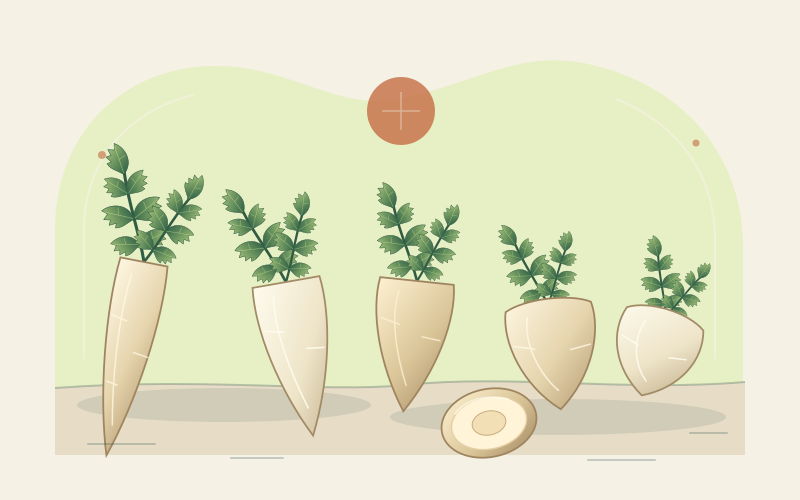
Many catalogue names, one cultivated species
Long, short, slender, broad-shouldered, white and cream garden parsnips are selections of Pastinaca sativa. Unlike the strong colour groupings found in carrots or beetroot, cultivated parsnips are relatively similar in appearance. A named cultivar can still differ meaningfully in root dimensions, uniformity, canker resistance, maturity and keeping quality.
Rooted’s indicative first-harvest window is 100–150 days from direct sowing. Small roots may be usable earlier; large storage roots and cool conditions can need longer. Seed suppliers measure days under their own conditions, and slow germination does not reset the sowing date. Treat the figure as a comparison tool rather than a fixed appointment.
Start with four constraints: the length of your suitable cool growing season, the depth and condition of your soil, the root size you want to cook, and whether canker or storage losses are local problems. A famous cultivar name comes after those practical decisions.
Root shape is a growing-space decision
Long and slender: deep beds and exhibition roots
Long selections produce the classic narrow-shouldered, extended taper. They need deep, loose, stone-free soil to approach the catalogue shape and are poor candidates for a shallow container unless harvested very young. ‘Tender and True’ is a familiar long-rooted catalogue name, but its exact performance still depends on the seed lot and local conditions.
Exceptional length is not a measure of flavour or nutrient quality. Long roots can be harder to lift intact and may provide more than a small household needs. Choose them for deep beds and culinary preference, not because the longest root is automatically the best root.
Medium, evenly tapered: a general garden choice
Many modern cultivars aim for a substantial shoulder and an even, manageable taper rather than extreme length. ‘Albion’, listed by RHS for smooth white roots and canker resistance, illustrates this practical selection goal. ‘Gladiator’ and ‘Javelin’ also appear in garden catalogues; compare each supplier’s current root dimensions, resistance claims and days to maturity rather than assuming they are interchangeable.
Half-long and bulbous: less unobstructed depth
Shorter types can suit shallower, heavier or stony beds better than exhibition-length roots. ‘Guernsey Half Long’ is a traditional name associated with a shorter, broader form. RHS also notes that shorter, more bulbous varieties are preferable where soil is heavy, shallow or stony. “Shorter” does not mean no soil preparation: compaction, overcrowding and waterlogging still reduce quality.
| Form | Typical outline | Selection cue |
|---|---|---|
| Long | Narrow shoulder, extended taper | Deep, prepared bed; large roots |
| Medium | Substantial shoulder, even taper | General garden and storage use |
| Half-long | Broader and more compact | Less usable soil depth |
| Bulbous | Short, rounded lower root | Shallow or heavier beds |
Read named cultivars as examples, not permanent winners
‘Hollow Crown’ is a long-established, long-rooted heirloom name. Gardeners choose it for traditional root character, but an heirloom label does not guarantee canker resistance, early maturity or adaptation to every climate. Compare its expected root length with your usable bed depth.
‘Albion’ and ‘Picador’ are identified in RHS guidance as canker-resistant examples. ‘Pearl’ is described by RHS as long, slender and suitable for keeping over winter in the ground. These are useful reference points, not universal recommendations: availability, local disease pressure and award lists change, so consult the current source and nearby growers.
‘Gladiator’, ‘Javelin’, ‘Tender and True’ and ‘Guernsey Half Long’ show why a packet’s full description matters. Hybrid seed may offer uniformity or a specific resistance; open-pollinated and heirloom cultivars may interest seed savers. Neither breeding category automatically predicts sweetness, storage or nutrient value.
Cream and white roots generally have similar culinary uses. Skin colour alone cannot establish superior flavour or a complete nutrient profile. Do not transfer the exact USDA raw-parsnip values into claims that one named cultivar is more nutritious without an appropriate food-composition analysis.
Match resistance and storage claims to the problem
Parsnip canker is not one universal condition with one identical cause. Darkened or orange-brown rot often begins at a damaged crown or shoulder, and wet conditions, root injury and local pathogens can contribute. A resistant cultivar is valuable where canker has been a recurring problem, but resistant does not mean immune.
Continue to avoid crown injury while hoeing, maintain even moisture, rotate away from susceptible Apiaceae crops and use complete insect-proof mesh where carrot fly occurs. A resistance claim for canker says nothing about every other root disease or pest. Our protection guide explains those shared measures.
For fresh harvest, prioritise the root size and texture you enjoy. For winter keeping, distinguish “stores well in a cool store” from “keeps in the ground”. The second still depends on drainage, rodents and whether the soil freezes too hard to dig. No cultivar makes rotten or damaged roots suitable for storage.
Let local evidence narrow the list
Ask nearby growers, extension services or trial gardens which cultivars emerge and fill roots reliably in your season. A northern spring sowing, a mild Mediterranean winter crop and a tropical-highland rainy-season crop present different constraints. Heat can impair establishment and root quality, while very cold soil delays germination. An “early” label is useful only when matched to your actual sowing window.
If space permits, sow two contrasting cultivars under the same conditions. Use fresh packets with comparable dates, label the rows, and record sowing and emergence dates, final root length, forking, canker, flavour and storage losses. Repeat a promising comparison before drawing conclusions from one unusual season.
Do not collect seed or roots from roadside wild parsnip as a cultivar shortcut. It is the same species but can be an invasive weed, and its sap can cause sunlight-activated skin burns. The sap-safety section separates that outdoor handling hazard from ordinary food preparation.
Read the whole packet before sowing
Confirm the botanical name, expected root length and form, days to harvest, recommended spacing, sowing period, resistance claims and intended use. “Gourmet”, “winter” and “exhibition” describe a market or purpose, not enough cultivation information by themselves. Pelleted seed is easier to space but still needs correct depth, moisture and fresh viability.
Buy only enough seed for the current season from a reputable supplier. Parsnip seed germinates poorly when old, so a bargain leftover packet can be false economy. Store it cool and dry as directed, sow thinly even with fresh seed, and reserve time for thinning. The seed-to-storage guide covers the shared method for every root form.