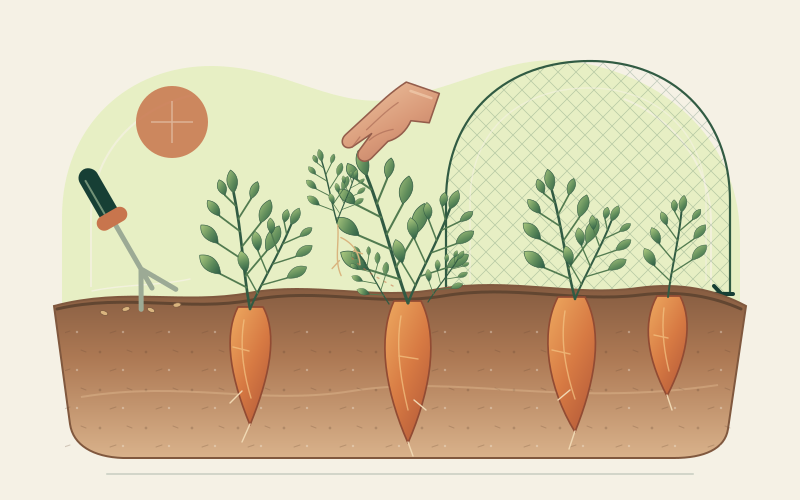
Know the crop and choose a useful harvest
Garden carrot, Daucus carota subsp. sativus, is a biennial usually grown as an annual for its swollen taproot. It belongs to the carrot or parsley family, Apiaceae, and produces finely divided leaves above ground. This guide concerns cultivated carrots from reputable seed, not wild carrot or unidentified look-alikes.
Rooted gives a general 60–85-day window from direct sowing to usable roots. Baby roots can be pulled earlier, while large or storage types and cool conditions may take longer. Packet timing, root shape, temperature, spacing, and water all matter. Use the days as planning shorthand, then inspect a sample root for the size and texture you want.
Carrots generally favour sun and cool, moderate growing conditions. In hot climates, local autumn, winter, or spring windows may work better than midsummer. Make small successive sowings where the season permits rather than sowing more than you can thin, weed, and use.
Prepare, sow, and establish the row
-
Make room for the root you selected
Remove stones and coarse debris and loosen compacted soil to the depth required by the cultivar, without working wet ground into clods. A fine, level surface helps shallow seed make good contact. Long types need deep, unobstructed soil; round and short types are practical in shallower beds or containers.
Heavy soil is not a universal prohibition. Avoid compaction and waterlogging, improve structure with suitable mature organic matter where local guidance supports it, or use a no-dig bed and a short-rooted cultivar. Raised beds and deep containers are further options. Forked roots caused by an obstruction are usually still edible if sound.
-
Direct sow the fine seed shallowly
Carrots are best direct sown because transplanting can disturb the taproot. Follow the packet first; roughly 0.5–1 cm deep is a common starting point. Water a dry drill before sowing, distribute the tiny seeds as sparsely as possible, and cover lightly with fine soil or another locally recommended seed covering. Firm gently rather than compacting.
Pelleted seed costs more but is easier to space; it still needs correct depth and moisture. Mixing seed with dry sand can help some sowers see its distribution, but does not remove the need to thin. A few radish seeds can mark a slow row, provided they are removed before they compete.
-
Keep the surface moist through germination
Carrots can take one to three weeks or longer to emerge, and the shallow seed zone must not dry out. Check it daily in wind or heat. Water with a fine rose or gentle spray that will not wash seeds together. A light, permeable covering may reduce evaporation and crusting, but lift it promptly as seedlings emerge and never seal the bed in standing water.
-
Thin before roots crowd one another
When seedlings are large enough to handle, snip surplus shoots at soil level or pull carefully in moist soil, then firm remaining plants back in place. A common final spacing is about 5–7.5 cm, but the cultivar and desired root size govern. Later small pulls can supply baby carrots while leaving room for their neighbours.
Do thinning promptly and clear away the discarded foliage. Where carrot fly occurs, avoid unnecessary bruising of leaves, work when local guidance suggests risk is lower, and replace protective mesh immediately afterwards. Crowded carrots compete for light, water, and space even when their tops look healthy.
-
Weed shallowly and water evenly
Small carrot seedlings compete poorly with weeds. Hand-weed close to the row and avoid deep hoeing near roots. Once established, water according to soil moisture and weather rather than a rigid calendar. Containers dry faster. Repeated severe drying followed by heavy watering can contribute to splitting, while saturated soil encourages other problems.
Prevent carrot fly damage with exclusion and hygiene
Carrot fly larvae tunnel into carrots and related crops, leaving rusty scars and entry points for rot. Prevention is more dependable than trying to repair a damaged root. In regions where the pest occurs, cover the crop with insect-proof mesh with every edge secured, allowing enough height for mature foliage. A complete cover generally outperforms an open-sided low barrier.
Rotate away from ground that recently held carrots or other susceptible Apiaceae crops so insects do not emerge inside a new cover. Mesh does not eliminate insects already in the soil. Locally timed later sowings may miss a generation, but flight dates vary with climate, so use regional advice rather than importing a fixed calendar.
Cultivars described as less susceptible can add protection but are not immune. Inspect roots when thinning and harvesting, and dispose of badly infested residue as local guidance recommends. Identify damage before using any control; never improvise pesticide mixtures or doses.
Harvest and store roots and greens separately
Loosen the soil beside a row with a fork if needed, then pull without twisting or bruising. Harvest at a useful size rather than waiting for maximum diameter. Protect exposed shoulders from hard frost. Late roots may remain in the ground under suitable mulch in mild conditions, but lift them where waterlogging, rodents, or severe freezing make storage outdoors unreliable.
| Harvest | Handling | Storage |
|---|---|---|
| Fresh roots | Lift gently; remove tops without cutting the crown | Refrigerate clean, sound roots with humidity but not trapped wetness |
| Keeping roots | Select mature, undamaged roots before hard frost | Use a cool, humid, frost-free store; inspect often |
| Greens | Use only sound leaves from known cultivated carrots | Chill separately and use promptly |
Remove tops soon after lifting so they do not draw moisture from the roots. Leave a short stem stump rather than cutting into the crown. Brush off loose soil and wash under clean running water before storage or use according to your chosen method. Do not pack wet, decaying roots into an airtight container. For longer keeping, use only sound mature roots in clean, slightly damp packing material where recommended locally.
Cultivated carrot greens are edible, but their flavour can be strong and bitter. Never substitute wild look-alikes, some of which are highly toxic. Wash leaves thoroughly, discard yellowed, slimy, mouldy, or pest-damaged material, and do not use foliage exposed to an unsuitable pesticide. Chill greens separately and use soon. Refrigerate cooked roots, greens, and mixed dishes promptly in clean covered containers.