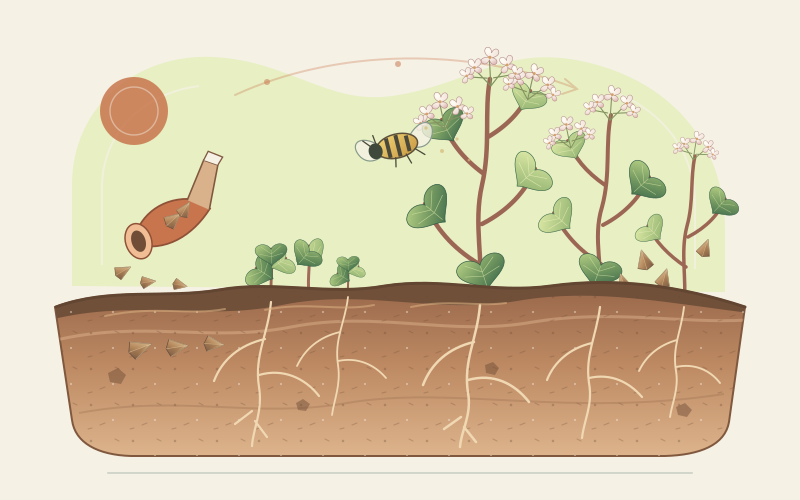
A broadleaf pseudocereal, not a wheat
Common buckwheat, Fagopyrum esculentum, is a warm-season annual in the knotweed family. Its branching reddish stems, heart-shaped leaves, and clusters of small white or pink-tinged flowers look nothing like a cereal grass. The triangular seeds are used like grain, which makes buckwheat a pseudocereal; the name does not make it a kind of wheat. This guide concerns common buckwheat, not Tartary buckwheat, which is a different species.
A general grain window is 70–100 days from sowing to harvest, with cultivar, sowing date, temperature, and moisture changing the finish. Plants grow quickly and may begin flowering within several weeks. They are also frost-tender: a light frost can kill them, and the calendar must allow both warm establishment and enough time for seeds to mature before the first autumn frost.
Warm does not mean endlessly hot. Hot, dry weather can wilt plants and reduce seed set, while cool conditions during seed filling can be helpful. In short-summer regions, sow after frost as soon as the soil is warm. Where summers are hotter, local trials may favour a later sowing so flowering and seed set escape the most intense heat. Extension guidance for your district is more useful than a universal month.
Sow directly and manage a light canopy
-
Choose seed for the intended job
Buy sound planting seed identified as F. esculentum. A named cultivar and local maturity information are especially useful for grain; cover-crop seed is often sold as “variety not stated.” Food groats have usually been hulled, and roasted groats will not grow. Do not confuse them with viable seed in its dark hull. If grain quality matters, ask a buyer about accepted cultivars before sowing.
-
Prepare a sunny, drained, modestly fertile bed
Buckwheat tolerates relatively low fertility but not compacted, saturated, or severely drought-prone ground. Loosen compaction without overworking the soil, and use a soil test to guide any amendment. Heavy nitrogen or rich manure can produce lush, tall growth that lodges—falls over—and complicates harvest. Modest fertility is not a promise that buckwheat will repair poor soil or thrive without water.
-
Direct sow shallowly into warm soil
Sow after local frost risk, when the soil has warmed and there is moisture for germination. A common starting depth is about 2–3 cm; follow the supplier’s rate and spacing for your seed size and purpose. Make small furrows for a grain bed, or broadcast and rake lightly for a cover. Firm the surface for seed-to-soil contact rather than burying the seed deeply. Water gently if rain has not moistened the seed zone.
-
Establish an even stand and conserve moisture
Seedlings can emerge quickly in warm conditions. Fill large gaps early, weed before the canopy closes, and avoid deep cultivation around the shallow roots. A dense, even stand shades many young weeds for part of the season, but thin sowing, late weeds, or an opening canopy at maturity can still leave problems. Irrigate when the root zone dries; temporary afternoon wilt does not make buckwheat drought-proof.
Flowers, pollinators, and an uneven seed crop
Buckwheat bears flowers over an extended period rather than setting one uniform head. Common buckwheat is self-incompatible and needs pollen moved between compatible flowers, with bees and other flower-visiting insects doing much of this work. Undisturbed flowering plants can provide nectar and pollen, but a flowering bed does not guarantee pest control, a particular honey harvest, or a full seed crop. Weather and local insect activity still matter.
Protect flower visitors by avoiding unnecessary pesticide use and following label and local requirements for any pest decision. At the same time, watch for lodging, drought stress, birds, and disease symptoms rather than assuming the crop is problem-free.
Flowering and seed ripening overlap. One plant can carry fresh blossoms, green seeds, and mature brown seeds together. Mature seeds may shatter before the last flowers finish, so waiting for every seed to turn brown sacrifices the earliest grain. Inspect several places in the bed instead of judging one colourful edge.
Cut at a useful majority, then dry thoroughly
For a small grain harvest, a practical cue is roughly three-quarters of the seeds brown and firm, while some greener seed and foliage remain. Cut or pull plants on a dry day, working over a clean sheet or tarpaulin to catch shattered seed. Bundle loosely or spread in shallow layers under ventilated cover. Do not leave damp plants in a deep heap, where trapped moisture can cause heating and mould.
| Stage | What to check | Action |
|---|---|---|
| Maturing | Brown, green, and forming seeds occur together | Sample widely; protect against shattering and birds |
| Cutting | About three-quarters of seeds are brown and firm | Cut gently on a dry day onto a clean catching surface |
| Drying | Plant material becomes brittle without damp pockets | Spread thinly, turn, and maintain ventilation |
| Threshing | Seeds separate without excessive cracking | Rub or tread gently, then winnow light chaff |
| Storage | Clean seed is thoroughly dry with no condensation | Seal in food-safe containers, label, and inspect |
Once the plants are dry, thresh by rubbing or treading gently inside a clean sheet. Winnow in a light breeze or with low airflow, keeping dust away from your face, and remove stones, damaged seed, and mouldy material. The familiar edible groat is the dehulled kernel; threshing releases the whole seed but does not necessarily remove its tough hull. Small-scale dehulling without cracked kernels can be the hardest processing step.
Dry the cleaned seed further if needed before closing a container. Appearance alone is not a precise moisture measurement, so use locally recommended grain-drying and moisture-testing guidance for a substantial store. Keep thoroughly dry seed in clean, food-safe airtight containers in a cool, dark, dry place. Label the cultivar and year, and check for insects, condensation, odour, or mould. Stored whole seed is not the same cooked food described in the nutrition guide.
Decide between grain and cover before maturity
For grain, allow seed to form and accept the uneven harvest described above. For a cover crop, the aim is quick ground cover and readily managed residue, not maximum seed. Terminate before viable seed becomes a volunteer problem; local cover-crop guidance may call for mowing soon after flowering begins. Frost also kills the plants, but a forecast is not a precise termination plan.
A fast canopy can cover soil and compete with some weeds, and flowers can feed beneficial insects. Those are context-dependent functions, not proof of permanent weed control or improved fertility. Buckwheat residue breaks down quickly and offers limited long-term soil protection, so plan a following crop or cover. Mature grain harvest and early termination are different endpoints; do not expect one planting to maximise both.