Plan for years, not weeks
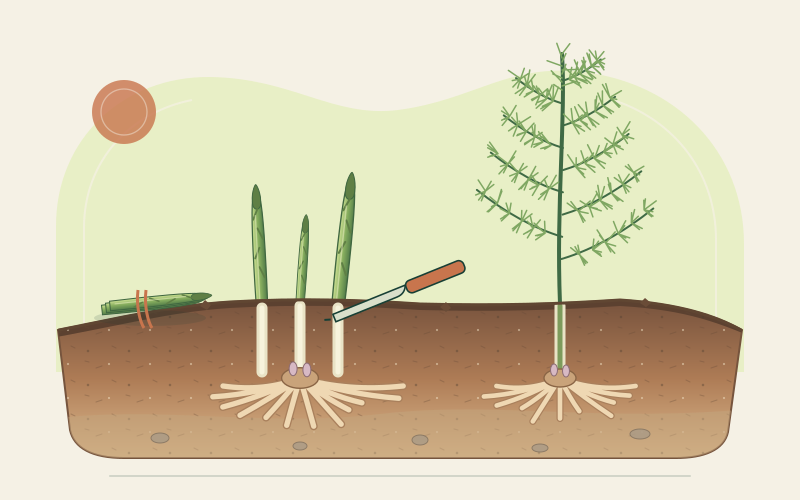
Garden asparagus, Asparagus officinalis, is a herbaceous perennial. Its edible spears are young shoots emerging from an underground crown and fleshy roots. Any shoot left uncut elongates into a branching stem covered with fine, leaf-like cladodes—the familiar summer “fern.” That foliage photosynthesises and replenishes the crown, so next year’s harvest depends on this year’s leaves.
A permanent bed can remain productive for many years, but the establishment period is not optional. Do not harvest in the planting year. Rooted’s 2–3 year first-harvest window means roughly two years after planting healthy one-year-old crowns, or three years after sowing seed. It describes a first light harvest, not an immediate full 6–8-week cut. Local extension advice may be more conservative; weak plants, drought, poor drainage or pest damage justify waiting longer.
| Stage | Harvest | Main job |
|---|---|---|
| Planting year | None | Water, weed and retain every fern |
| Following establishment year | None for seed; usually none or only locally advised light picking for crowns | Build crown size and full summer foliage |
| About year 2 from crowns or year 3 from seed | A brief first harvest if plants are vigorous | Stop early and let all later spears fern |
| Mature bed | A local seasonal window, commonly 6–8 weeks | Protect post-harvest fern and natural dormancy |
Prepare the permanent bed and plant carefully
-
Choose sun and drainage first
Pick a sunny, preferably sheltered site where mature fern will not cast unwanted shade over lower crops. Avoid a frost pocket and anywhere water remains after rain. Most soil types can work if drainage is good; on heavy ground, a raised bed is often more useful than adding a little sand to a planting hole. The crown can rot in persistently wet soil.
-
Remove perennial weeds before planting
Couch grass, bindweed and other deep-rooted weeds are much harder to remove once asparagus roots fill the bed. Clear them across the whole area, not only in planting holes. Use a soil test to guide pH and fertiliser rather than applying phosphorus or lime automatically. Mature compost can improve the bed, but no amendment corrects standing water.
-
Decide between crowns and seed
Dormant one-year-old crowns are the faster and simpler route. Buy firm, healthy plants with a good bud cluster and fleshy roots, keep them from drying out and plant promptly. Seed costs less and can produce many plants, but germination and nursery care add work and time. The plant and variety guide explains sex types and cultivar choices.
-
Raise seedlings without a check
For indoor sowing, use clean modules or small pots, fresh growing medium, bright light and the supplier’s temperature guidance. Harden seedlings off gradually before outdoor planting. In suitable climates, seed can instead be sown in an outdoor nursery bed and the strongest one-year plants moved to final spacing the following spring. Keep labels if comparing cultivars.
-
Set crowns with buds up and roots spread
A common approach is a trench or hole about 15–20 cm (6–8 in) deep, with a small mound beneath the crown. Place growing points upward, spread roots without breaking them, and allow roughly 30–45 cm (12–18 in) between plants. Row spacing varies with equipment and access; leave enough room to weed and support fern. Water after planting to settle soil around the roots.
-
Follow a local covering method
Some guides cover crowns shallowly and backfill gradually as shoots grow; others plant at final depth immediately. Both are regional practices, not interchangeable half-steps. Follow the supplier or local extension directions, and never bury established green fern while filling a trench. Avoid deep hoeing later: hand-weeding is slower but safer for shallow roots and emerging spears.
Water, weed and protect the fern
Young plants need reliable moisture through their first growing seasons. Check below the surface and water deeply when the root zone begins to dry; sandy beds need attention sooner than moisture-retentive loam. Established asparagus tolerates some dryness, but severe or repeated drought reduces fern growth and future spear size. Mulch can conserve moisture and suppress weeds, provided it does not keep crowns waterlogged.
Tall fern may need a simple stake-and-line support on exposed sites. Put supports in before stems lean or break. Asparagus beetles, slugs and other local pests require identification before action. Inspect spears and foliage, remove pests by hand where practical, and avoid routine spraying that harms beneficial insects. Any legally available pesticide must be labelled for the crop and target and used with its stated harvest interval.
After the spring harvest ends, never keep removing shoots because they are small. Every later shoot becomes the foliage that rebuilds the bed. Cut fern down only after it yellows or browns naturally in autumn or the local dormant season. Removing green stems early discards active photosynthetic growth. In cold districts, add winter mulch only according to local guidance and avoid trapping excess wetness around the crown.
Fern and berry safety
Eat only the young cultivated spears, not the fern or berries. Female plants can bear red berries later in the season. NC State Extension notes that eating the berries may cause gastrointestinal problems. Keep children and pets from sampling them, do not add berries or ornamental asparagus foliage to food, and wear gloves if handling plants irritates your skin. Berry seedlings can also become weeds, so remove unwanted volunteers without disturbing established crowns.
Harvest a seasonal flush, then stop
On an established bed, harvest young spears when roughly 15–23 cm (6–9 in) tall, while the tips remain compact. Growth can be rapid in warm weather, so inspect every day or two. Use a clean, sharp knife to cut at or just below the soil surface according to local practice, or snap sound spears without disturbing neighbouring shoots. Thin spears are not automatically a reason to stop immediately during the first light harvest, but a persistent decline is a sign to end cutting and let the plants recover.
A mature harvest commonly lasts about 6–8 weeks in a temperate spring; the first harvest is shorter. Stop on schedule even if spears continue to emerge. Extended cutting removes the foliage needed for next year. In tropical highlands, do not interpret warm temperatures as permission for year-round harvest: use a locally proven dormancy and fern-building cycle.
Cool, store and preserve safely
Cool harvested spears promptly and refrigerate them clean and covered; quality is best within a few days. Wash under clean running water just before preparation, without soap or produce disinfectant, and trim damaged or woody ends. Discard mouldy, slimy or badly decayed spears. Refrigerate cooked leftovers promptly in clean covered containers.
For freezing, the National Center for Home Food Preservation directs cooks to wash and sort tender spears by size, water-blanch small spears for 2 minutes, medium for 3 minutes and large for 4 minutes, then cool promptly, drain, package and freeze. These times apply to that tested preparation, not to every recipe. Plain asparagus is a low-acid vegetable: shelf-stable home canning requires a current tested pressure-canning process, never an improvised boiling-water-bath method. Use a tested acidified recipe for pickled asparagus.
Sources and further guidance
- Royal Horticultural Society: How to grow asparagus
- University of Minnesota Extension: Growing asparagus in home gardens
- Utah State University Extension: How to Grow Asparagus in Your Garden
- NC State Extension: Asparagus officinalis, including fruit safety
- National Center for Home Food Preservation: Freezing asparagus
- National Center for Home Food Preservation: Canning guidance