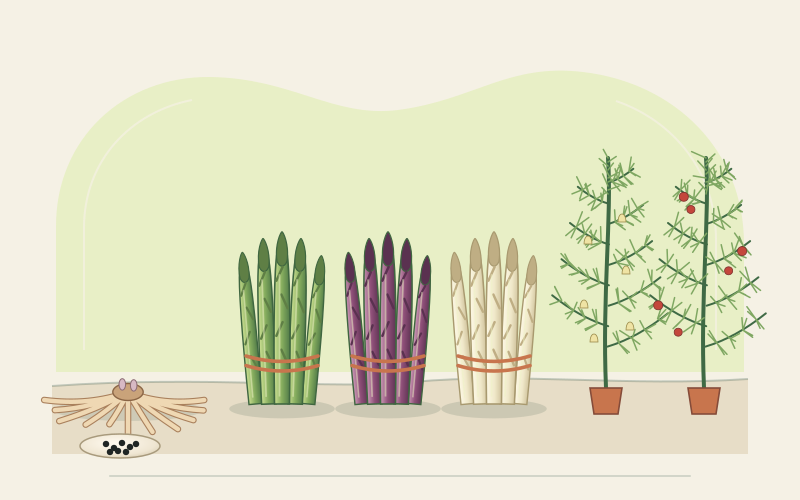
Crowns or seed: choose the starting point, not a different crop
An asparagus crown is a dormant young plant consisting of a bud cluster and fleshy storage roots. Suppliers commonly sell one-year-old bare-root crowns. They should look firm and healthy, not shrivelled, mouldy or rotten. Plant them promptly with buds facing upward and roots spread. Because the plant already has a year of growth, crowns usually bring the first light harvest forward by about a year.
Seed is less expensive per plant and gives access to cultivars not always available as crowns. It also requires germination, bright nursery conditions, watering, hardening off and careful transplanting. A packet may produce far more seedlings than a small permanent bed can hold, so sow modestly and select vigorous plants. Do not crowd a tray of surplus seedlings into the final bed.
Rooted’s 2–3 year first-harvest window means about two years after planting one-year-old crowns or three years after sowing seed. Neither route permits a full harvest in the planting year. “Two-year crown” in a catalogue describes the age of the planting material, not a promise that the bed can be heavily cut immediately. Follow regional extension advice if it recommends a longer wait.
| Choice | Advantages | Costs and care |
|---|---|---|
| One-year crowns | Simple planting; usually first light harvest about a year earlier | Higher price per plant; bulky roots must not dry or rot before planting |
| Seed | Lower cost; wider cultivar access; many potential plants | Nursery work and slower establishment; surplus seedlings need selection |
| Home-raised one-year plants | Combines seed access with transplanting at a useful size | Requires a full nursery year and careful root handling |
Understand all-male and mixed-sex cultivars
Asparagus is generally dioecious: individual plants are usually male or female. Female plants can produce small flowers followed by red berries. Energy goes into seed production, and fallen berries can create volunteer seedlings that compete with the intended bed. Male plants do not bear those berries and are often more productive in garden comparisons.
All-male F1 hybrids have been bred to produce predominantly or entirely male plants. They are popular for strong spear production and reduced self-sowing. Read the supplier’s description precisely: breeding systems and occasional off-types mean “all-male” should not be treated as a promise that no berry will ever appear. It also says nothing by itself about winter hardiness, heat adaptation or disease performance in your district.
Open-pollinated and older cultivars generally contain male and female plants. They may remain locally useful and can be less expensive, but berry seedlings require weeding. Saving seed from an F1 hybrid will not reliably reproduce the parent’s combination of traits. Whatever the sex type, do not eat the berries; the fern and berry safety guidance applies to every cultivar.
Read cultivar names as examples, not universal winners
Jersey types and other all-male hybrids
Jersey Giant and Jersey Knight are named in Utah State University Extension guidance as productive all-male varieties with large green spears and useful disease resistance in that region. Other catalogues offer different all-male lines, including European selections such as Backlim or Gijnlim. These names illustrate the category; they are not interchangeable and do not guarantee equal performance in every soil or climate.
UC 157 and mixed-sex production
UC 157 F1 is a widely grown mixed male-and-female cultivar. Utah State describes it as better adapted to warmer parts of that state than some alternatives, which is a bounded regional observation rather than a reason to plant it in every hot climate. Its berries and volunteer seedlings still need management. Local trials, availability of clean planting stock and disease pressure should guide selection.
Mary Washington and older open-pollinated stock
Mary Washington is an older open-pollinated cultivar with green spears and male and female plants. It remains familiar in seed listings, but familiarity is not proof that it is the highest-yielding or best-adapted choice today. Some extension guides prefer newer hybrids. Where an older cultivar persists successfully in local gardens, compare its actual performance and seed quality rather than relying on reputation alone.
Purple selections
Purple Passion is one example of a purple-speared cultivar. Purple colour comes from pigments in the growing spear and often fades toward green during cooking; interior colour can differ from the skin. Purple asparagus may have a different texture or perceived sweetness, but colour alone does not establish nutritional superiority. Many purple cultivars are mixed-sex, so check the packet rather than assuming all-male breeding.
Green, purple and white describe the harvest differently
Green asparagus grows above ground in light and develops chlorophyll. Purple asparagus is genetically selected for purple pigmentation, though heat, maturity and cooking can alter appearance. White asparagus is usually produced by excluding light from developing spears through soil mounding, blanching covers or a similar system. It is a growing and harvesting method, not automatically a separate botanical species or a particular seed colour.
White production changes labour and harvest technique: the grower must maintain light exclusion and cut before tips become exposed and coloured. Any packet marketed specifically for white production should still be checked for climate and disease traits. Green, purple and blanched white spears all come from the same perennial crown and require the same post-harvest fern period.
| Description | What creates it | What still needs checking |
|---|---|---|
| Green | Light-grown spears with green pigmentation | Cultivar season, sex type and local adaptation |
| Purple | Selected purple pigmentation in the spear | Cooking colour change and whether plants are mixed-sex |
| White | Light exclusion during spear growth | Blanching labour, local production directions and cultivar fit |
| All-male | Breeding for male rather than berry-bearing plants | Not a colour, harvest season or climate guarantee |
Select for your climate and the life of the bed
Start with local adaptation. A permanent asparagus bed may remain in place for well over a decade, so winter hardiness, summer heat tolerance, dormancy, rust or Fusarium pressure and reliable water matter more than a small difference in catalogue spear size. “Disease resistant” should identify the disease; resistance is not immunity and does not fix waterlogged soil.
Then choose the planting route that matches your time and budget. A handful of healthy crowns suits a small bed and earlier first picking. Seed suits a grower prepared for nursery work or wanting a cultivar unavailable as crowns. Compare sex type, expected spear colour and season, and buy from a reputable supplier with clear cultivar identity.
If space permits, trial two locally plausible cultivars in clearly labelled sections under the same care. Record establishment, fern vigour, pest or disease problems, spear thickness and the date when cutting must stop. Keep the trial harvest equally light in the establishment years. The growing guide supplies the shared care; local experience determines which named cultivar deserves the long-term space.
Sources and variety references
- Royal Horticultural Society: Crowns, seed, cultivars and male and female plants
- Utah State University Extension: Variety examples, planting and establishment
- University of Minnesota Extension: Asparagus planting material and first harvest
- University of Missouri Extension: Growing Asparagus in Missouri
- NC State Extension: Plant characteristics and berry safety