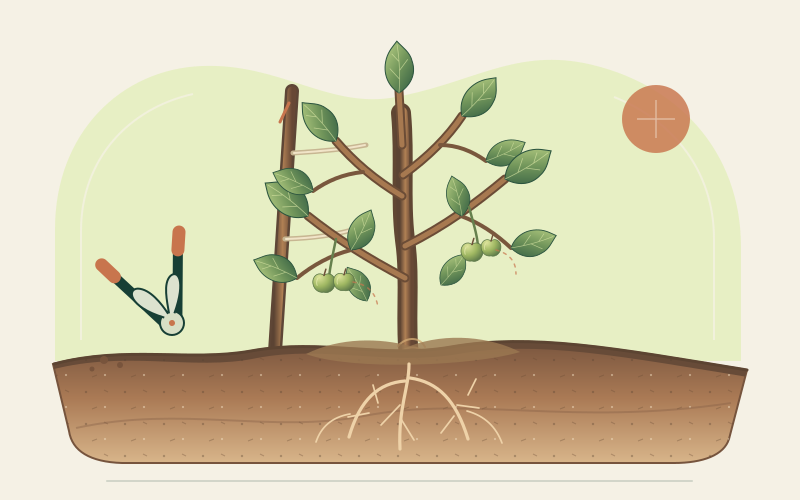
Know the crop and expect establishment first
Cultivated apple, Malus domestica, is a deciduous tree in the rose family, Rosaceae. Most garden trees are grafted: the upper scion determines the named fruit cultivar, while the lower rootstock supplies roots and strongly influences vigour, mature size, anchorage and time to bearing. An apple seed does not reliably reproduce its parent cultivar, so seedling trees are not a shortcut to a known harvest.
Rooted gives a general 2–4-year window from planting suitable young dwarfing or semi-dwarfing grafted stock to its first useful crop. Flowers or a handful of apples may appear earlier. Removing much of that early fruit helps roots and the permanent framework establish. Vigorous standard trees can need eight years or more, and full production follows first cropping rather than arriving with it.
This is a perennial, not a plant-and-replace annual. Winter injury, insufficient chill, spring frost, incompatible pollen, poor pruning or disease can delay or eliminate a crop. Choose the tree for the place you have, then keep records of bloom, thinning and harvest from year to year.
Select the whole tree: roots, cultivar and pollen
Let rootstock set the working size
Rootstock names are more useful than a generic “dwarf” label, although their performance still depends on scion vigour, soil and climate. Very dwarfing and dwarfing stocks suit small spaces, containers where recommended, and restricted forms, but often need permanent support and attentive water. More vigorous stocks offer anchorage and larger trees, at the cost of later bearing and harder pruning, thinning and picking.
| Rootstock example | General tendency | Planning question |
|---|---|---|
| M.9 | Strongly size-limiting and precocious | Can you provide permanent support and suitable disease management? |
| M.26 | Dwarfing, with early fruiting | Is it suited to local winter and disease conditions, and what support is advised? |
| MM.106 | Semi-dwarfing to moderately vigorous | Is there room for a larger free-standing tree? |
| MM.111 | Relatively vigorous and well anchored | Can you manage later bearing and a taller crown? |
Do not bury the graft union. If the scion roots above the rootstock, the intended size control can be lost. Follow the nursery’s planting-height instruction because graft and soil conditions vary.
Match winter chill and ripening season
Apples need winter dormancy followed by sufficient accumulated chill for normal bud development and flowering, but requirements differ among cultivars and chill models. There is no single apple-wide hour count. In mild maritime, Mediterranean or tropical-highland sites, a high-chill cultivar may leaf and flower poorly even though it survives. In cold districts, winter injury and a short ripening season become additional constraints.
Ask local growers which named cultivars flower and ripen reliably, not merely which trees are for sale. Also check spring frost exposure: a site with enough winter chill can still lose its crop when open blossom freezes.
Provide compatible pollen at the same time
Most apples crop best with pollen from a different compatible apple cultivar. Bees and other insects move that pollen, so the partner must flower during an overlapping period and be close enough for practical foraging. A flowering crabapple can sometimes serve, but its bloom must also be compatible and coincident. Some cultivars are described as self-fertile and may set alone; a suitable partner can still improve reliability. Triploid cultivars have special pollen limitations and should not be the only partner for another tree.
Pollination groups are shorthand, not a guarantee that every adjacent label flowers together in every climate. Confirm with a regional nursery or extension guide. Avoid insecticide exposure during bloom and provide pesticide-free flowering habitat without assuming that planting flowers can compensate for an incompatible pollen partner.
Plant, support and train an open crown
-
Choose a sunny, drained site
Full sun supports ripening and a productive crown; University of Minnesota recommends at least eight hours of direct sun. Avoid shade, standing water and low pockets where cold air collects. Test soil before making major pH or nutrient corrections. Leave enough space for the mature rootstock–scion combination, access for pruning and picking, and air movement around the crown.
-
Plant at the correct depth
Plant bare-root stock in local dormancy when soil is workable, neither frozen nor saturated. Make a hole wide enough for spread roots but no deeper than needed, with most backfill being the excavated soil. Correct circling or sharply bent roots and keep the graft union above the finished soil line as directed. Water to settle soil without compacting it into a hard mass.
-
Install support and reduce competition
Stake or permanently support the tree according to rootstock and training form, using broad flexible ties that do not cut bark. Clear grass and weeds around the young tree. Apply a moderate mulch layer over the root zone but leave a gap around the trunk to reduce bark rot and rodent shelter. Protect the trunk from local browsing or gnawing animals without creating a damp sealed sleeve.
-
Begin a named training form
For a free-standing tree, select well-spaced scaffold limbs and maintain either a central leader or an open-centre system appropriate to local practice. For cordons, espaliers, fans and step-overs, install wires before planting and use a suitably dwarfing rootstock. Tie new growth without strangling it, and direct each shoot toward the intended permanent structure.
Prune for the form, then manage the annual crop
Pruning is not a contest to remove the most wood. Start by taking out dead, diseased, damaged, rubbing and clearly misplaced branches. Preserve the branch angles and fruiting wood required by the chosen system. Apples commonly bear on short-lived shoots called spurs and on older wood, with cultivar-specific differences, so cutting every shoot back indiscriminately can remove future fruit.
Free-standing trees are commonly pruned while dormant after the harshest cold and before growth begins. Restricted forms generally need summer pruning as well, timed to local guidance so remaining foliage can ripen replacement growth. Use clean, sharp tools and make cuts just outside the branch collar rather than flush into the trunk. For an old overcrowded tree, stage renovation over several years; excessive one-year removal stimulates a thicket of upright regrowth.
Water young trees through dry establishment periods, directing water to the root zone. Check below the surface instead of following a rigid litre-per-week rule. Established trees still benefit from water during prolonged drought and fruit sizing, but saturated soil is harmful. Avoid excessive nitrogen and lush growth; base additions on growth, soil tests and local recommendations.
Inspect leaves, shoots, bark and fruit regularly. Apple scab, mildew, fire blight, canker, codling moth and other problems differ by region. Correct identification comes before treatment, and resistant cultivars are not immune to every disease. Remove infected material only as local guidance directs; do not compost or burn material indiscriminately. Any pesticide must be legally available, labelled for the crop and target, and used exactly as directed, with particular care around pollinators.
Thin after natural drop, before limbs carry too much
A heavy set divides the tree’s resources among many small fruits and can contribute to biennial bearing: an exhausting heavy crop followed by a light one. Trees naturally shed some young fruit in early summer, often called June drop, but further hand-thinning can still help.
After natural drop, remove damaged, misshapen and the smallest fruitlets first. University of Minnesota suggests one or two fruit per cluster, or about 10–15 cm (4–6 inches) between fruits for best quality. Treat that as a practical starting point, not a universal law; cultivar, branch strength and local growing advice govern. Support heavily laden limbs without tying tight bands around bark.
On newly planted trees, remove most developing fruit to favour roots and crown development. The temporary sacrifice supports more dependable later harvests and keeps a small tree from carrying a crop it cannot support.
Harvest by maturity, then separate fresh, keeping and drying fruit
Red blush alone does not prove maturity. Look for the cultivar’s background or ground colour changing from bright green, sample flavour and aroma, and note whether the fruit releases with a gentle upward lift and twist. Seeds often darken as apples mature, but this is only one cue. Pick in several passes, cupping the fruit so it does not bruise and preserving the spur that carries future buds. Apples do not require frost to become sweet.
| Use | Fruit and handling | Storage approach |
|---|---|---|
| Early fresh apples | Pick at developed flavour; handle gently | Chill and use promptly; many early cultivars are not long keepers |
| Late storage apples | Select mature, unbruised, disease-free fruit | Keep near 0–3°C with high humidity; inspect and remove decay |
| Dried apples | Wash, peel if desired, core and slice sound fruit uniformly | Dry by a reliable method, cool, condition, then pack airtight |
| Cooked apples | Wash before cutting; discard rotten fruit | Refrigerate cooked dishes promptly in clean covered containers |
University of Minnesota reports longest home storage at approximately 0.5–3°C (33–38°F) and about 85 percent humidity. A perforated plastic bag or loosely covered container can limit shrivelling in a dry refrigerator. Alternatively, use a clean, dark, frost-free, ventilated store with fruit in shallow trays. Do not store damaged or rotting apples beside sound ones, and inspect regularly. Cultivar storage life varies from days to months.
For dried apples, follow a research-based recipe and equipment instructions. Uniform slices dry more evenly; an ascorbic-acid pretreatment can limit browning but is not a substitute for drying. Dry until pieces are pliable or leathery with no moist centre, then cool. Condition the batch loosely in a closed container for about a week, shaking and inspecting daily; if moisture appears, return sound fruit to the dryer. Discard mouldy or spoiled food. Pack only thoroughly dried, conditioned fruit in clean airtight containers, labelled and kept cool, dark and dry.
Wash fresh apples under clean running water before peeling, coring or slicing, including fruit from your own tree. Do not use soap, detergent or disinfectant on produce. Keep fruit separate from raw meat and contaminated utensils, refrigerate cut fruit promptly, and discard rotten or mouldy produce rather than preserving it.
Sources and further guidance
- Royal Horticultural Society: How to grow apples, including rootstocks, training, thinning and storage
- University of Minnesota Extension: Growing apples, pollination, rootstocks, thinning and harvest
- University of California Agriculture and Natural Resources: Dried Apples
- US Food and Drug Administration: Selecting and serving produce safely