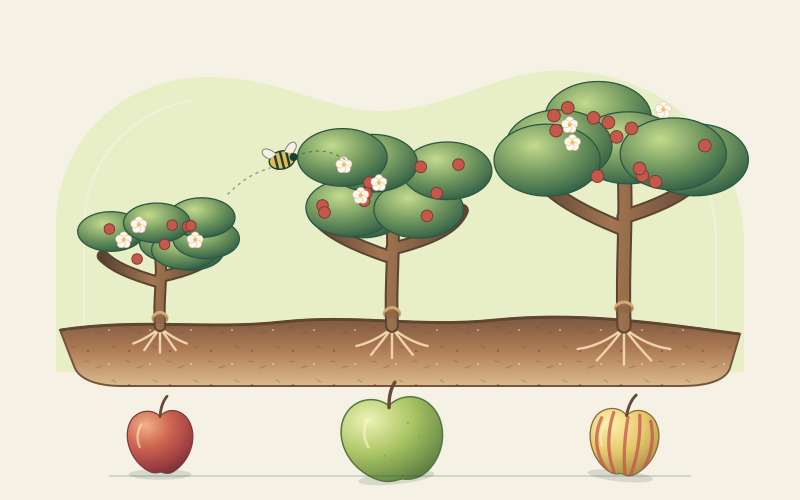
One species, thousands of cultivated selections
Apple cultivars belong to Malus domestica, but their fruit differs in acidity, sweetness, aroma, firmness, skin, harvest season and keeping quality. “Dessert” generally means pleasant fresh eating, “culinary” means suited to cooking, and “dual-purpose” spans both. These are use categories, not rankings of nutritional value or tree quality.
A cultivar is normally propagated by grafting rather than seed. The scion supplies the named fruit; the rootstock changes tree performance without changing the cultivar’s genetic identity. ‘Gala’ on M.9 and ‘Gala’ on a vigorous stock should both produce Gala apples, but the trees’ mature size, support and time to bearing can differ considerably.
Rooted’s 2–4-year first-useful-crop window applies to suitable young trees on dwarfing or semi-dwarfing rootstocks under favourable conditions. It is not a guarantee attached to every cultivar. Standard-sized trees commonly take longer, while precocious dwarf stock can flower so early that fruit should be reduced to protect establishment.
Choose rootstock by space and management
Rootstock labels are part of the cultivar decision. A favourite apple on an over-vigorous rootstock can outgrow its site and place blossom and fruit beyond reach. A very dwarfing stock fits a small garden or restricted form but may require permanent staking, more regular irrigation and careful control of crop load.
| Example | General role | Trade-off to check |
|---|---|---|
| M.9 | Small trees, cordons and other restricted forms | Weak anchorage and permanent support; local fire-blight susceptibility |
| M.26 | Compact free-standing or trained trees | Support needs and local cold or disease performance |
| MM.106 | Moderate-sized free-standing trees | More space and potentially later cropping than strongly dwarfing stock |
| MM.111 | Vigorous, well-anchored trees in suitable conditions | Later bearing and greater pruning and harvest reach |
| Locally named stock | Regional adaptation not captured by these examples | Ask for evidence on winter, soil, anchorage and disease |
Do not calculate mature height from a single nursery label. Scions differ in vigour, pruning changes crown size, and poor soil can stunt even a nominally vigorous combination. Ask for an expected local range and spacing. For containers, use a rootstock and large pot explicitly recommended by the supplier, with a realistic commitment to watering, feeding and eventual repotting.
Rootstock does not improve every site limitation. Waterlogging, unsuitable winter chill, spring frost and incompatible pollen cannot be solved by choosing a smaller tree.
Match kitchen use and harvest season
Dessert apples: texture and balance
Dessert cultivars range from mild and sweet to sharply aromatic. ‘Gala’ is widely grown for sweet fresh fruit, ‘Fuji’ for crisp sweetness and later maturity, and ‘Honeycrisp’ for a distinctive crisp juicy texture. Those broad descriptions do not guarantee identical flavour in every climate or store. A locally adapted older cultivar can be more useful than a famous name that cannot ripen reliably.
Culinary apples: acidity and cooked texture
Cooking cultivars may retain slices, break down into a smooth purée, or offer a useful intermediate texture. ‘Bramley’s Seedling’ is a familiar sharp cooking apple in Britain, but its triploid pollination needs and vigorous habit must be planned. ‘Granny Smith’ is firm and tart and can be used fresh or cooked, yet needs enough warmth and season length to mature well.
Dual-purpose and storage fruit
Some apples begin tart enough for cooking and become milder with maturity or storage, while others remain useful in both roles throughout harvest. Read a cultivar description for actual behaviour rather than assuming every tart apple is dual-purpose. ‘Haralson’ and ‘Liberty’, for example, appear in University of Minnesota listings for fresh use and cooking, with local hardiness and disease information that matters more than category alone.
| Cultivar | Common use | Selection caution |
|---|---|---|
| Gala | Fresh eating | Confirm pollen partner and local disease response |
| Fuji | Fresh eating | Late season; requires adequate warmth and compatible pollen |
| Honeycrisp | Fresh eating and some cooking | Site, fruit disorders and handling need local attention |
| Granny Smith | Fresh and culinary | Late maturity and chill needs limit some sites |
| Bramley’s Seedling | Culinary | Vigorous triploid; plan two suitable partners rather than relying on its pollen |
| Haralson | Fresh and culinary | Especially useful to compare in suitable cold-climate trials |
| Liberty | Fresh and culinary | Disease resistance is specific, not immunity to all apple problems |
Early cultivars often supply immediate eating but can have short storage lives. Late cultivars may keep for months when harvested mature and undamaged, yet they risk autumn frost or incomplete ripening in short seasons. Planting several trees that all ripen in one week can create a preservation bottleneck. Stagger harvest only after confirming that flowering still overlaps enough for pollination.
Check chill and flowering compatibility together
Winter chill is the cool exposure needed for normal dormancy release and subsequent flowering. Cultivars differ, and several methods exist for calculating chill, so a catalogue number from one climate should not be transferred uncritically to another. Warm coastal, Mediterranean and highland tropical sites can fail to meet a high-chill cultivar’s requirement. Cold sites can meet chill yet damage buds with extreme winter temperatures or open flowers with late frost.
Look for local evidence of regular flowering and cropping. “Low chill” is a relative label, not permission to ignore winter altogether, and no fixed number applies to every apple. Elevation alone does not provide a reliable chill estimate because tropical and continental temperature patterns differ.
Most cultivars need pollen from a different compatible apple. Select a partner in the same or an adjacent locally appropriate flowering group, close enough for bee movement. Some self-fertile cultivars set fruit alone but often benefit from cross-pollination. Triploids such as ‘Bramley’s Seedling’ generally need two other suitable diploid cultivars: one to pollinate the triploid and another to pollinate that partner, because the triploid is not a dependable polliniser for them.
Crabapples can pollinate apples if their bloom overlaps and they are otherwise compatible. An ornamental tree hidden far beyond normal garden foraging distance is not a dependable plan. Do not spray insecticide on open blossom or nearby pollinator habitat.
Use local evidence to narrow the final list
Start with nearby extension trials, botanical gardens, orchard groups and nurseries that can name both scion and rootstock. Ask about regular cropping rather than one exceptional harvest, and distinguish resistance to a named disease from general “easy care”. Apple scab, fire blight, mildew, canker, insect pressure and fruit disorders differ by climate.
Heritage cultivars can preserve regional flavours and useful adaptation, but age alone proves neither disease resistance nor current suitability. Modern cultivars may carry specific resistances or storage qualities, but a new release is not automatically better in every garden. Taste fruit locally where possible, because stored supermarket samples cannot show how a cultivar performs freshly picked at your site.
If space permits, compare two locally plausible cultivars on comparable rootstocks. Record winter injury, bloom dates, fruit set, thinning, harvest, flavour, cooking texture and storage losses for several seasons. A single unusual spring should not decide the trial. Keep the original graft labels and do not confuse root suckers with scion regrowth.
Finally, plan what you will do with the fruit. A household that wants fresh snacks, sauce and dried rings may choose a staggered mix rather than the largest possible crop. Our thinning guide explains how to manage the set, while fresh and dried nutrition explains why equal weights of those foods are not equivalent.
Sources and variety references
- Royal Horticultural Society: Apple rootstocks, use categories, trained forms and cultivar selection
- University of Minnesota Extension: Regional cultivar table, hardiness, storage and rootstocks
- Royal Horticultural Society: Apple pollination groups and compatible partners
- Orange Pippin: Apple cultivar descriptions and flowering references