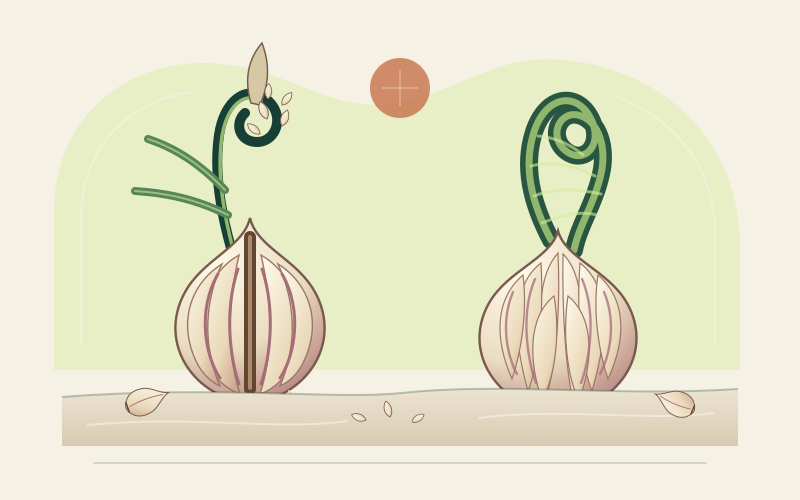
What “hardneck” and “softneck” actually describe
Both are cultivated garlic, Allium sativum, but the terms describe the flower-stalk habit and the structure left in the bulb. Hardneck garlic usually produces a stiff central scape. After harvest, its woody base remains in the middle of the bulb, commonly with one ring of relatively large cloves arranged around it. Softneck garlic usually does not produce that rigid stalk; its foliage stays flexible, and bulbs often contain more cloves in several layers.
These are practical horticultural groups, not absolute laws. Stress can induce unusual flowering in softnecks, and some hardneck horticultural groups bolt less consistently. Clove count, wrapper colour, pungency and keeping quality vary within both categories. A purple streak does not by itself identify a variety, and a strong aroma in one kitchen does not guarantee the same flavour after another season and storage period.
| Feature | Hardneck | Softneck |
|---|---|---|
| Central stalk | Usually firm; produces a scape | Usually flexible; scape uncommon |
| Clove arrangement | Often fewer, larger cloves in one ring | Often more cloves in multiple layers |
| Extra harvest | Tender scapes; bulbils if scapes mature | No regular scape or bulbil harvest |
| Storage tendency | Often shorter | Often longer when well cured |
| Climate tendency | Many types suit cold winters | Many types suit milder winters |
Local adaptation comes before category loyalty
Garlic needs cultivar-appropriate cold and seasonal growth to form a well-divided bulb. Many hardnecks are dependable in cold-winter regions, while many softnecks perform well where winters are milder. That tendency does not make every hardneck hardy everywhere or every softneck unsuitable in the north. Winter minimum, snow cover, freeze–thaw cycles, day length, rainfall and planting date all shape the result.
Buy from a supplier who can name the cultivar and describe its performance in conditions comparable to yours. Ask whether it has been trialled locally, when it is normally planted and how it stores after a proper cure. In tropical highlands or other places without a northern winter, locally proven stock is especially important: importing a “cold-climate” label is not a substitute for observing bulb division under local temperatures.
Start with a small comparison where space allows. Plant the same number of similarly sized cloves from two suitable cultivars on the same day, label them and record emergence, scape formation, leaf condition at harvest, bulb size and storage losses. Keep the planting stock healthy and comparable; a trial with one large bulb and one small damaged bulb does not fairly compare genetics.
Named groups and cultivars add useful detail
Within the broad neck categories, names such as Porcelain, Purple Stripe and Rocambole commonly describe hardneck horticultural groups. Artichoke and Silverskin are familiar softneck groups. Their typical clove patterns, wrappers and scapes help organise collections, but naming is not perfectly consistent among suppliers and countries. Buy the identified cultivar, not just a colour or group word.
| Cultivar | Common classification | Why a grower might trial it |
|---|---|---|
| Music | Hardneck, Porcelain | Large cloves and a cold-climate track record where locally offered |
| Chesnok Red | Hardneck, Purple Stripe | Distinctive wrappers and a culinary reputation; storage is not unlimited |
| Inchelium Red | Softneck, Artichoke | A softneck option for gardens where this group has performed well |
| California Early | Softneck, Artichoke | A widely recognised fresh and general kitchen garlic in suitable climates |
| Arno or Cristo | Softneck cultivars listed by RHS | Named options for gardeners comparing cultivars available in Britain |
A cultivar’s reputation is a starting hypothesis, not a promise. Flavour changes with maturity, curing and storage. Storage comparisons also need sound, fully cured bulbs under the same conditions. Do not choose an unnamed eating bulb simply because it resembles a photograph of a desired cultivar.
Autumn and spring planting are not interchangeable labels
Autumn planting gives suitable cultivars time to root and experience winter cold before spring leaf growth and bulb formation. It is the usual route in many cool and cold climates. Plant early enough for root establishment, but follow local advice to avoid excessive top growth before severe cold. Mulch can buffer cold and weeds; apply and manage it according to local snow, rodents and freeze–thaw patterns.
Spring planting requires a cultivar explicitly suited to that window and an early start into workable soil. It can be useful on ground too wet for overwintering or where autumn planting failed. Spring crops may be smaller or later, particularly if they miss required cold or plant after temperatures rise. Starting cloves in cool modules for later transplanting can solve wet-soil logistics, but it does not erase the cultivar’s environmental needs.
Do not choose spring planting solely to make a softneck store longer or a hardneck skip its scape. The desired harvest and local conditions should set the calendar. Our growing guide covers the practical sequence.
Cloves, bulbils and the question of seed
Cloves are the standard route to a full bulb in one growing cycle. Separate a sound bulb shortly before planting, preserve the skin and choose large, healthy cloves for the main crop. The flat end is the basal plate where roots emerge; the pointed end goes upward. Small cloves remain edible or can be planted for green garlic, but using the smallest cloves for a storage crop generally reduces their starting reserves.
Bulbils are miniature vegetative bulbs formed in a hardneck flower head. They are not the same as cloves and are not true botanical seed. A mature scape can yield many, making bulbils useful for multiplying a valued cultivar or rebuilding stock with less underground planting material. Their small size is also their disadvantage: first-year plants often produce small single-clove rounds, which must be replanted to approach normal bulb size in later seasons.
Leave selected scapes to mature only if propagation justifies the likely reduction in underground bulb size. Dry the heads, extract and label bulbils, then sow in a carefully weeded nursery bed. Keep each cultivar separate and propagate only from healthy stock. Although garlic flowers can sometimes make true seed under specialised conditions, ordinary garden propagation relies on cloves and bulbils; “garlic seed” in a planting catalogue usually needs closer inspection to determine what is actually being sold.
Choose for storage without promising a year
Softneck bulbs often store longer than hardneck bulbs, and their flexible stems can be braided before curing is complete. Silverskin types are particularly associated with long keeping, while some hardneck groups are usually used sooner. Yet curing, maturity at lifting, bruising, humidity and temperature can outweigh the broad label. An immature or damaged softneck is not a dependable winter store.
For a steady kitchen supply, grow a small early-use hardneck and a locally successful softneck rather than relying on one bulb type. Lift each at proper maturity, cure fully and label the storage batch. Use opened or damaged bulbs first. Elephant garlic, often displayed beside these cultivars, is Allium ampeloprasum, a different species more closely related to leeks; its large mild cloves and growth habit should not be used to judge true garlic cultivars.