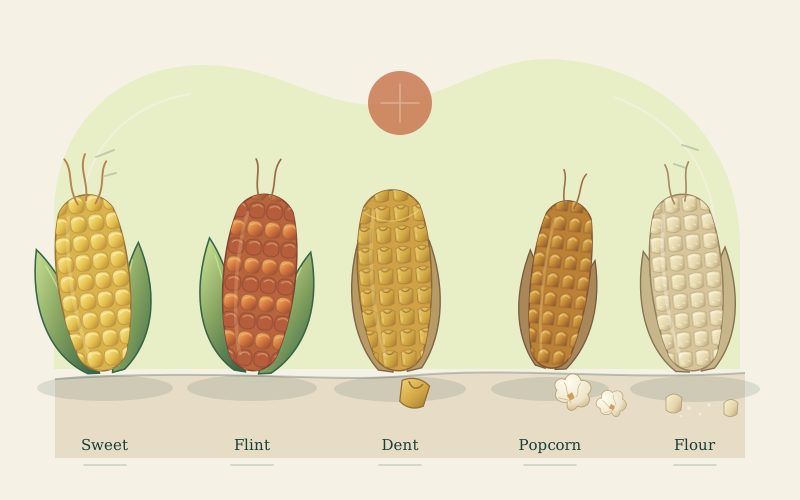
Many kernel types, one cultivated species
Sweet corn, field corn, popcorn and colourful grinding corns are all selections of Zea mays. Their familiar groups are distinguished largely by the endosperm, the storage tissue inside the kernel: how much is hard or soft, how much sugar remains at the fresh stage, and how the kernel behaves when dried, heated or milled. The outer pericarp and the germ matter too.
A kernel group is not a cultivar. Two sweet-corn cultivars can differ in maturity, sweetness system, plant height and disease resistance; two dent cultivars can be selected for very different regions and uses. Read the complete packet description rather than expecting the group name to guarantee local performance.
Rooted’s indicative 70–150-day window from sowing to harvest spans different crops and seasons. Early sweet corn often finishes sooner than grain corn, but cultivar and weather can overturn that expectation. Dry grain also needs suitable drying and storage after maturity. Begin with your intended food, then check whether your season and drying space can support it.
Five useful kernel groups
Sweet: a tender, immature harvest
Sweet corn carries inherited changes that slow the conversion of sugars to starch in developing kernels. It is picked at the milky stage for fresh eating, freezing or canning, not normally left as dry milling grain. Standard sugary types, sugary-enhanced types and supersweet types differ in sweetness, texture, storage life and isolation needs. The abbreviations su, se and sh2 refer to particular sweetness systems; read the supplier’s instructions because some crosses reduce eating quality.
Flint: a hard, glassy outer endosperm
Flint corn has mostly hard, glassy endosperm and a smooth, firm kernel. Mature kernels are dried for grinding and other food uses, and many traditional and ornamental selections display striking colours. Colour does not establish flavour or nutrient superiority, and “ornamental” does not automatically mean toxic. Confirm the named cultivar’s intended use and handle any food grain safely. Flint is a kernel form, not a promise that every selection pops.
Dent: hard sides and a soft central crown
Dent corn combines harder starch at the sides with softer central starch. As the mature kernel dries, the crown contracts to form the characteristic indentation. Dent types are widely grown as field corn for livestock feed, industrial ingredients and human foods such as meal, grits, flour and starch. “Field corn” is broader than a single food category, and mature dent grain is not the same product as fresh sweet corn. Its food use depends on suitable variety, processing and safe storage.
Flour: soft starch for grinding
Flour corn has a high proportion of soft endosperm and a relatively thin pericarp, making mature grain comparatively easy to grind. Traditional selections are used for meals and flours with distinct flavours and textures. The name describes kernel composition, not a ready-to-bake product on the stalk: ears still need full maturity, careful drying, shelling and milling. Flour corn is not simply sweet corn that was harvested late.
Popcorn: a specialised flint-like kernel
Popcorn is generally a small-kernelled flint type, with a hard outer structure surrounding a small amount of softer, moist starch. Suitable moisture turns to steam during heating until the pericarp ruptures and the endosperm expands. Pearl types have rounded crowns; rice types are more pointed. Not every flint or dry field kernel pops well. Cultivar, intact pericarp, drying and final moisture all affect expansion, so follow popcorn-specific harvest and conditioning advice.
| Group | Kernel character | Usual harvest and use |
|---|---|---|
| Sweet | Sugar conversion slowed | Milky stage; fresh or preserved kernels |
| Flint | Mostly hard, glassy endosperm | Mature dry grain; grinding and other uses |
| Dent | Hard sides, soft crown that dents | Mature field grain for food, feed or industry |
| Flour | Mostly soft starch, thin pericarp | Mature dry grain for meal and flour |
| Popcorn | Small, hard, flint-like kernel | Conditioned mature grain for popping |
Waxy corn, with a distinctive starch composition, and pod corn, with a glume around each kernel, are additional groups. Blue, red, white, yellow and multicoloured descriptions cut across several groups rather than identifying another consistent kernel type.
Fit the cultivar to your plot and kitchen
For sweet corn, compare days to fresh harvest, sweetness system, eating texture and the number of blocks you can sow. For grain, prioritise enough frost-free time to reach maturity and a secure, ventilated place to finish drying. A colourful long-season flour corn is a poor practical choice if autumn rain reliably ruins the drying crop, however appealing the catalogue photograph.
All corn needs a pollination-friendly block. Ask whether you have space for several plants, rather than choosing a solitary container plant and expecting full ears. Consider access for weeding and harvest, mature height, exposure to wind and the processing equipment you will actually use. Grinding dry grain is a different commitment from cooking a fresh cob.
Local growers and extension trials can identify cultivars that emerge, flower and finish reliably. Treat disease-resistance claims as specific to the named disease, not general immunity. If possible, trial two suitable cultivars in separate adequate blocks while managing crossing, and record emergence, silking date, harvest quality and storage losses.
Plan for crossing before mixing types
Corn pollen travels by wind, and different types can cross. The pollen parent can affect the kernels formed in the same season, a phenomenon called xenia. Field-corn pollen can reduce the quality of standard sweet corn; pollen crossing into popcorn can impair popping. Some supersweet cultivars require isolation from other sweet types as well.
Use the supplier’s prescribed distance, flowering-time separation or other locally appropriate isolation method. A nominal distance on one packet cannot account for every wind, landscape and neighbouring planting. Do not sow sweet, popcorn and dry corn in adjacent rows and assume their labels will keep them distinct. Within one block, plants still need compatible pollen for good kernel fill.
Keep hybrid, open-pollinated, heirloom and GMO distinct
A hybrid cultivar results from controlled crossing of selected parents. It may offer useful uniformity, vigour or particular traits, but saved seed generally produces a variable next generation rather than recreating the original hybrid. Hybrid breeding is not, by definition, genetic engineering. “F1” describes a breeding generation, not a safety grade, flavour guarantee or pesticide requirement.
An open-pollinated cultivar can produce reasonably consistent seed when isolated from incompatible pollen and maintained with an adequate population. It is the usual choice for seed saving, but wind pollination makes corn isolation and genetic diversity demanding in a small garden. “Heirloom” generally refers to an older, often open-pollinated selection; it does not guarantee adaptation, high yield or nutritional superiority.
A GMO claim concerns genetic modification or engineering, not whether a cultivar is sweet, flint, dent, flour, popcorn, hybrid or heirloom. Different jurisdictions use different legal definitions and labels. Read precise supplier information and local rules instead of treating “hybrid” and “GMO” as synonyms, or assuming either open-pollinated or engineered seed says anything automatic about how a particular crop was sprayed.
Sources and variety references
- New Mexico State University Extension: Specialty corns and kernel classification
- University of Wisconsin Corn Agronomy: Origin, adaptation, and types of corn
- South Dakota State University Extension: Indian corn and popcorn
- University of Maine Cooperative Extension: An introduction to seed saving
- US Food and Drug Administration: Science and history of GMOs and other food-modification processes