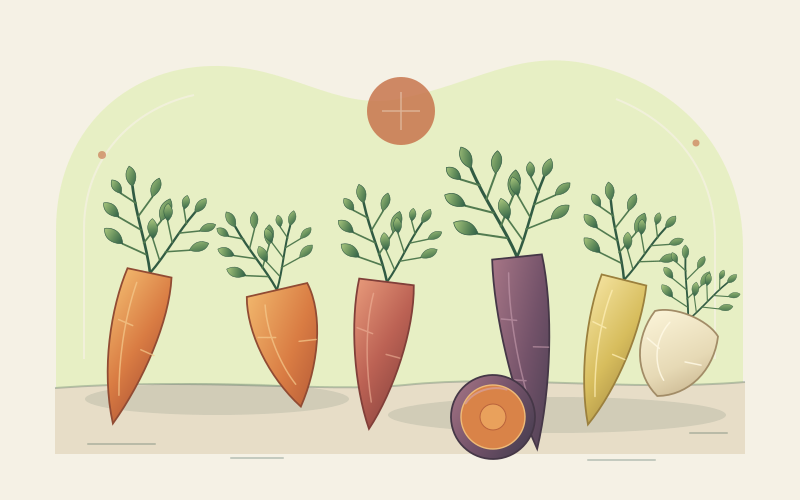
Many catalogue names, one cultivated crop
Orange, purple, yellow, white, red, long, blunt, and round garden carrots are selections of cultivated carrot, Daucus carota subsp. sativus. Labels such as Nantes or Imperator usually describe a root-form group; a named cultivar within that group has its own maturity, flavour, and performance. The group alone does not guarantee a result.
Rooted’s indicative first-harvest window is 60–85 days from direct sowing. Baby and round roots may be useful earlier; large storage roots and cool-weather crops can need longer. Seed suppliers measure days under their own conditions, so treat the figure as a comparison tool rather than a fixed appointment.
Start with four constraints: the length of your suitable growing season, the depth and condition of your soil, the size you want to eat, and whether you need storage roots. Colour and a famous cultivar name come after those practical decisions.
Root shape is a growing-space decision
Nantes: cylindrical and blunt-tipped
Nantes types typically have straight, fairly cylindrical roots with blunt ends and a medium length. They are familiar fresh-eating carrots and suit prepared beds with enough loose depth for the named selection. “Nantes” covers many cultivars rather than one identical root; Scarlet Nantes and Nantes Half Long illustrate the variation in catalogue names.
Chantenay: broad-shouldered and shorter
Chantenay types are generally conical, with broad shoulders and roots shorter and stockier than Imperator types. Their more compact form is a practical candidate for shallower or heavier beds and suitably sized containers, although stones, compaction, and overcrowding can still distort them. Red Core Chantenay and Royal Chantenay are familiar examples.
Danvers: sturdy tapered roots
Danvers types usually have substantial shoulders and a pronounced taper, often at an intermediate length. They have a reputation for adaptable garden performance, but that does not make every Danvers-labelled cultivar suited to every climate. Danvers 126 and Danvers Half Long appear in extension and seed listings; compare the supplier’s dimensions and timing.
Imperator: long and slender
Imperator types are known for long, tapered roots. They need deep, loose, stone-free soil to approach the catalogue shape and are poor candidates for a shallow pot unless harvested very young. Length is not a measure of flavour or nutrient quality. Choose this form for its kitchen and garden characteristics, not because it looks most like a supermarket carrot.
Round and mini: small roots for restricted depth
Paris Market or Parisian-type carrots form small, nearly round roots. Other mini and finger types are short and slender. These forms suit shallow beds and containers when the container still provides the supplier’s required depth. “Baby” can also mean an ordinary carrot harvested early or a manufactured cut root in a shop, so read seed descriptions carefully.
| Form | Typical outline | Selection cue |
|---|---|---|
| Nantes | Medium, cylindrical, blunt tip | Prepared bed; fresh use |
| Chantenay | Short, broad shoulder, tapered | Less depth than long forms |
| Danvers | Intermediate, sturdy taper | General garden candidate |
| Imperator | Long and slender | Deep, unobstructed soil |
| Round or mini | Globe, finger, or short root | Containers and shallow beds |
Colour is pigment and presentation, not a rank
Orange roots are familiar sources of orange carotenoid pigments, but intensity varies with cultivar and growing conditions. Purple roots owe their colour to anthocyanins; some have an orange or pale interior, so a cut root may look different from its skin. Cooking and the acidity of a recipe can alter purple presentation.
Yellow roots contain their own pigment profile, while white roots lack the strong orange or purple exterior colour. Red selections can contain lycopene and other pigments. These distinctions are chemically interesting, but colour alone cannot supply a complete nutrient analysis or establish superiority. Do not apply the exact values for a cooked orange reference carrot to every coloured cultivar without an appropriate food-composition source.
Mixed seed packets offer a colourful harvest, but the component cultivars may differ in root length, maturity, and storage quality. If a packet does not identify them, expect less uniform rows. For orderly cooking or storage, sow separate short rows and keep labels. A pale shoulder or a forked root is not a reason to discard an otherwise sound carrot.
Let local evidence narrow the list
Ask nearby growers, extension services, or trial gardens which cultivars emerge and fill roots reliably in your season. Cool-season timing differs sharply between a short northern summer and a mild winter climate. Heat can impair establishment and root quality, while very cold soil delays germination. An “early” label is useful only when matched to your actual sowing window.
Check disease or pest claims precisely. A carrot described as less susceptible to carrot fly is not immune, and a claim about one pathogen does not cover all leaf or root diseases. Continue to use complete insect-proof mesh, rotation, clean residue handling, and other locally appropriate prevention. Our carrot fly guide explains the limits of each measure.
For fresh harvest, prioritise the size and eating quality you enjoy. For a keeping crop, look for explicit storage performance and allow time to reach suitable maturity before damaging frost. Hybrid cultivars may offer uniformity or specific resistances; open-pollinated cultivars may interest seed savers. Neither category automatically predicts flavour, adaptation, or nutritional value.
If space permits, sow two contrasting cultivars under the same conditions. Record sowing and emergence dates, final root length, forking, texture, flavour, and storage losses. Repeat a promising comparison before drawing conclusions from one unusual season. A small local trial is more useful than a universal “best carrot” list.
Read the whole packet before sowing
Confirm the botanical name, root form, expected length, days to harvest, recommended spacing, and intended sowing period. Pelleted seed is easier to handle but still needs the same moist seedbed. “Rainbow”, “baby”, and “gourmet” describe a mix or marketing use, not enough cultivation information by themselves.
Buy viable seed from a reputable supplier and store it cool and dry as directed. Carrot seed does not remain vigorous indefinitely, so an old packet may emerge sparsely and unevenly. Sow thinly even with fresh seed, and plan time for thinning. The seed-to-storage guide covers that shared method for every shape and colour.