Start with the botanical name
Most buckwheat grown for familiar groats, flour, and summer cover is common buckwheat, Fagopyrum esculentum. It is a broadleaf annual in the knotweed family, not a grass in the wheat genus. Its edible triangular seeds earn the description pseudocereal because they are handled like grain. “Buckwheat” on its own does not identify a cultivar, and “common” on seed may mean the cultivar was not stated rather than naming one registered variety.
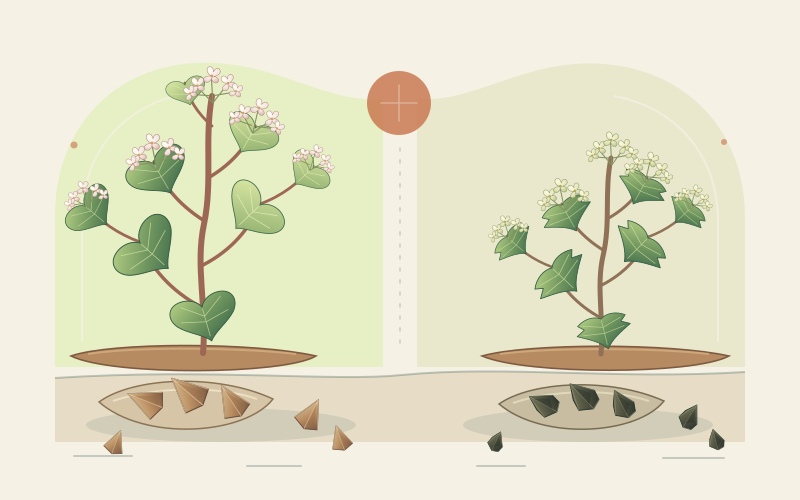
Tartary buckwheat, Fagopyrum tataricum, is a separate cultivated species with different flavour, agricultural traits, and food traditions. It should be labelled and considered in its own right, not treated as a darker or more nutritious version of a common-buckwheat cultivar. Wheat, meanwhile, is principally Triticum aestivum in ordinary flour production. These names are not interchangeable, even when seeds or flours share a kitchen.
Within common buckwheat, breeders and suppliers distinguish cultivars by characteristics such as seed size, maturity, yield, plant habit, and performance under regional conditions. Seed colour or a recipe name does not reliably reveal those traits. Read the full seed label rather than expecting “Japanese,” “silverhull,” “black,” or “ancient grain” to provide a complete botanical and agronomic description.
Named cultivars are examples, not universal winners
North American references list Mancan and Manor as older, similar, large-seeded Canadian releases, alongside cultivars including Koto, Koban, Koma, Manisoba, Springfield, and Horizon. These examples show that real cultivar choices exist, but they are not a worldwide catalogue or a recommendation to seek every name. Availability changes, some grain cultivars are tied to production contracts, and a cultivar that performed well in one region may disappoint elsewhere.
| Evidence | Why it matters | Question to ask |
|---|---|---|
| Regional trials | Yield, maturity, and lodging depend on place and season | Was it tested under conditions like mine? |
| Seed size and quality | Processors may require particular size or food-grade traits | Does my buyer or intended milling use specify it? |
| Release date and origin | Older names may remain useful without being locally best | Is there newer local comparative evidence? |
| Contract terms | Some cultivars are available through a particular buyer | Who supplies the seed and purchases the harvest? |
| Certification and lot data | Identity and germination are more reliable in documented seed | What are the cultivar, lot, and germination details? |
A large seed is not automatically earlier, higher yielding, or better in a home kitchen. Likewise, a newer release does not repeal the need for warm establishment, suitable moisture, pollination, and timely harvest. Use cultivar descriptions to narrow a trial, not to promise an outcome.
Put local adaptation ahead of catalogue adjectives
The general 70–100-day crop window must fit your own frost-free period and summer pattern. Ask when flowering and seed filling will occur: very hot, dry conditions can reduce seed set, while frost ends growth. Nearby extension services, seed suppliers, and experienced growers may recommend a spring or later summer sowing that differs from advice written for another latitude. A cultivar’s reported days are comparative information, not a guaranteed harvest date.
For grain, record emergence, flowering, lodging, seed fill, maturity, and clean yield. If two suitable cultivars are available, trial them side by side in the same soil and sowing window rather than comparing different years. For a cover crop, unnamed common buckwheat may be sufficient and economical; a premium food-grain cultivar adds little if the stand will be mowed before seed maturity. For a grain contract, reverse that priority and consult the buyer before ordering seed.
Common buckwheat is cross-pollinated and self-incompatible. Seed saved from a small, mixed planting may not remain true to a named cultivar, especially where other common-buckwheat plants flower nearby. Maintain cultivar seed according to local isolation and population-size guidance if identity matters. Do not assume volunteers from a cover crop are certified cultivar seed, and do not sow roasted or dehulled culinary groats.
Tartary buckwheat is a different crop choice
Tartary buckwheat is associated with distinctive regional foods, including bitter flours, teas, and other specialised products. Its bitterness and processing expectations mean it should not be substituted blindly for common buckwheat in a familiar groat or pancake recipe. Buy seed and food that name the species and intended use, and seek locally relevant growing instructions rather than assuming every common-buckwheat recommendation transfers.
Rutin is another reason the two are sometimes confused in marketing. Research has found substantially more rutin in Tartary buckwheat seed than in the common-buckwheat samples studied, with content influenced by cultivar and growing conditions. A higher rutin figure is not evidence that a food prevents or treats disease. It does not make Tartary buckwheat a superior everyday choice for everyone, and concentrated rutin supplements or extracts are not equivalent to cooked groats.
Products promoted for rutin can vary in dose, ingredients, and quality; supplements can also raise questions about medicines and individual suitability. Discuss those products with a qualified health professional rather than treating a variety guide as dosage advice. Choose ordinary buckwheat foods for flavour, culinary fit, tolerability, and a varied diet—not for a promised medical effect. People can also be allergic to buckwheat independently of wheat or gluten concerns.
Do not mistake processing for a variety
Whole groats are dehulled buckwheat kernels; kasha commonly refers to roasted groats or a dish made from them. Flour may be light or darker depending on dehulling and milling, while soba noodles can contain wheat flour as well as buckwheat. These are processing and recipe distinctions, not proof of separate plant varieties. Read ingredient and allergen labels, and use the cooked-groat nutrition guide only for its stated reference food.
Pure buckwheat is naturally gluten-free, but shared harvesting, storage, milling, and packaging equipment can introduce wheat, barley, or rye. That is a cross-contact issue rather than a cultivar trait. People requiring a gluten-free diet should follow specialist guidance and choose appropriately labelled finished products.
Sources and variety references
- University of Missouri Extension: Buckwheat varieties, seed sources, and uses
- USDA Natural Resources Conservation Service: Common buckwheat cultivars and plant guide
- Canadian Food Inspection Agency: Koto buckwheat variety description
- Journal of Agricultural and Food Chemistry, via PubMed: Tartary buckwheat as a source of dietary rutin