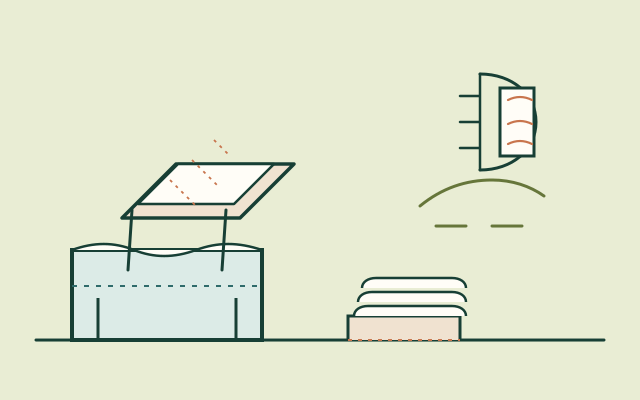
Paper is a mat of plant fibres, felted together from water and pressed dry. It does not require a factory, but it does require fibre that has been separated from lignin and softened enough to bond. The best primitive paper comes from bast plants and rags, not from wood.
Paper is felted fibre
Plant cells are held together by lignin and pectin. Cooking the fibre in an alkali dissolves much of that “glue” and frees the cellulose. Beating then shortens and fibrillates the fibres so they can interlock when a sheet is formed. Sizing — starch, gelatin or rosin — fills the gaps so ink does not bleed.
Wood is a poor choice for handmade paper unless you can pulp and bleach it industrially; it is full of lignin, which makes brittle, yellowing paper. Use bast fibres (flax, hemp, nettle, mulberry, lime bark), cotton or linen rags, or clean straw. These give strong, flexible sheets with simple equipment.
Fibre
- Flax or hemp straw
- Nettle stalks
- Cotton or linen rags
- Clean straw or grass
- Optional: mulberry bark
Chemistry
- Wood ash for lye, or slaked lime
- Clean water
- Washing soda if available
- Starch for sizing
Equipment
- Mould and deckle
- Large vat or tub
- Wooden mallet or mortar
- Felts, boards and a press
- Drying line or boards
Ret and clean the fibre
Bast fibres are embedded in the stem. Retting lets water and microorganisms break the pectin that holds them. For nettle, cut stalks before the seed sets, strip the leaves, and bundle the stems. Submerge them in a pond, stream or tank for 1–3 weeks, until the fibre slips easily from the woody core when pinched. Dew retting — spreading the stalks on grass — is slower but uses no water.
Dry the retted stalks, then break the woody core and scrape or comb away the shive. For rags, cut them into pieces of 2–5 cm and remove buttons, seams and synthetic thread. Cotton and linen rags need less cooking than raw bast, but they still benefit from a wash and a cook.
Make an alkali from ash
Wood ash contains potassium carbonate, which makes a mild alkali when leached with water. Put ash in a barrel or basket lined with straw or cloth, set it over a collecting vessel, and pour rainwater through it slowly. The dark liquid that runs out is lye. It is caustic and its strength is variable. Strain it through cloth before use.
For a safer and more predictable cook, use slaked lime (calcium hydroxide) or washing soda if you have them. Lime is less caustic than lye but still irritates skin and eyes. Whatever you use, cook outdoors or in a well-ventilated space, wear goggles and gloves, and never add water to concentrated lye — add lye to water slowly.
Cook, rinse and beat
-
Soak
Soak the cleaned fibre in water overnight. This softens it and removes dust. Squeeze out excess water.
-
Cook
Put the fibre in a pot with water and enough alkali to make the water slippery (roughly 1–2% of the fibre weight for lye, or a handful of lime per bucket). Simmer, covered, for 1–3 hours. Do not let it boil dry. The fibre is ready when it pulls apart easily and feels soft, not springy.
-
Rinse thoroughly
Drain and rinse in clean water until the water runs clear and the fibre no longer feels slippery. Residual alkali makes brittle, discoloured paper and can burn your hands.
-
Beat
Beat the fibre with a wooden mallet on a block, in a mortar, or in a trough with a paddle. The goal is to separate the fibres and fibrillate them, not to cut them into dust. This can take 30–90 minutes by hand. A mechanical Hollander beater is faster but is industrial equipment; hand-beating is the primitive route.
-
Make pulp
Dilute the beaten fibre in a large vat of water — roughly one handful of fibre to 10–20 litres of water. Stir gently. The mixture should look like cloudy water with suspended fibres, not lumpy porridge.
Build the mould and deckle
The mould is a wooden frame with a screen stretched across it; the deckle is a second frame that sits on top and defines the sheet’s edges. A sheet about 20 × 30 cm is a good size for a first batch. Make the frame from straight timber, join the corners securely, and stretch a fine mesh — metal window screen, woven cloth or a bamboo screen — over it. The deckle should fit snugly around the mould without gaps.
A simple press can be two boards with weights, or a screw press. You also need felts: smooth cloth or blankets to separate wet sheets, and a flat surface to couch them onto. A clean, smooth wall or board is fine for drying; a line with pegs works for thin sheets.
Pull and couch sheets
-
Stir the vat
Stir the pulp gently before each sheet so the fibres stay suspended. Agitation should be slow; a whisk introduces air bubbles that weaken the sheet.
-
Dip the mould
Hold the mould and deckle together, screen side up, and dip them into the vat at an angle. Straighten them horizontally under the surface, then lift them steadily. The layer of pulp on the screen is the sheet.
-
Shake to felt
While the mould is still wet, shake it gently side to side and front to back. This interlocks the fibres and gives an even sheet. Do not shake so hard that the pulp washes off the edges.
-
Drain and remove the deckle
Let the water drain until the surface is matte, then lift off the deckle. If the edges are ragged, the pulp was too thin or the deckle was loose.
-
Couch onto a felt
Turn the mould face down onto a damp felt and press the back of the screen with a sponge or your hand. Lift the mould carefully; the sheet should stay on the felt. Cover it with another felt and repeat, building a stack of sheets and felts.
-
Press
Press the stack firmly to squeeze out water. A board with weights, a screw press or even a heavy stone will do. Press gradually; too much pressure at once can shift the sheets. Separate the sheets while damp and hang or lay them to dry.
-
Dry and finish
Dry sheets flat under light weight to prevent curling, or hang them for a rougher, “laid” look. When nearly dry, you can burnish the surface with a smooth stone or a wooden spoon. Trim the edges with a sharp knife once fully dry.
Size and finish
Unsized paper is absorbent, like blotting paper. For writing, add starch sizing: cook a thin paste of wheat or rice flour, dilute it, and either add it to the pulp or dip the dried sheets and dry them again. Gelatin or hide glue also works but attracts mould in damp conditions. Test a sheet with ink before sizing a whole batch.
Colour can come from the fibre, from a tea or onion-skin dye, or from mineral pigments. Keep it simple; the strength and surface of the sheet matter more than its colour. If you plan to bind books, fold the paper along the grain and use a strong stitch; handmade paper tears easily at a sharp fold.
Troubleshooting
| Problem | Likely cause | Fix |
|---|---|---|
| Sheets fall apart | Fibre insufficiently beaten; too little pulp | Beat longer; use more fibre per vat; add a little cooked starch |
| Lumpy, uneven sheets | Pulp not separated; poor shaking | Beat and disperse the pulp; stir before each dip; shake gently |
| Paper is brittle or brown | Residual alkali or lignin; overcooking | Rinse thoroughly; use bast or rag fibre; avoid over-cooking |
| Ink bleeds | No sizing; surface too absorbent | Add starch or gelatin size; burnish the surface |
| Mould grows in storage | Damp sheets or sizing | Dry thoroughly; store in a dry, ventilated place; avoid gelatin in humid climates |
Safety
Alkali burns. Lye and lime are caustic. Wear sealed goggles, gloves and long sleeves; add alkali to water, never the reverse; keep children away from the cooking pot. Heat. Simmering pulp and hot water scald; use stable pots and long tools. Dust and mould. Dry fibre and paper dust irritate lungs; work ventilated, and discard mouldy pulp. Water. A vat is a drowning hazard for small children; empty it when not in use.
Sources and further reading
- Wikipedia: Papermaking — fibre preparation, forming and sizing.
- Wikipedia: Retting — water and dew retting of bast fibres.
- Appropedia: Paper — small-scale papermaking notes.
- Wikipedia: Paper — history, properties and recycling.