What it does
Phenylpropanoid found in clove buds, holy basil, and cinnamon leaf oil. Strong COX-2 inhibitor 1 and local anaesthetic — numbs tissue on contact via sodium channel blockade 2. Also potent antimicrobial against both gram-positive and gram-negative bacteria 3. Heat-stable: survives boiling and decoction well. Alcohol extracts eugenol efficiently (>90% recovery in tincture). Drying concentrates eugenol as water evaporates. Oxidation converts eugenol to eugenol oxide and dieugenol, which are less bioactive. In clove oil, eugenol comprises 72–90% of volatile fraction.
Plants that contain it
Ayurveda · European · TCM · Unani Serious cautions
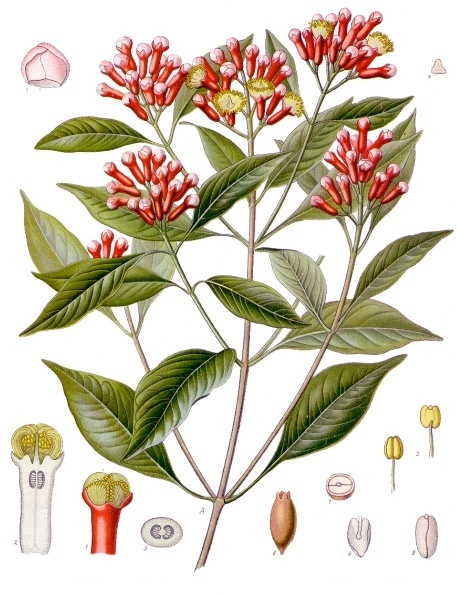
Clove
Syzygium aromaticum
Traditionally used for nausea with cold stomach; vomiting that is watery or clear.
- chewing
- oil
- paste
- powder
- Used for
- 4 conditions
- Body systems
- Digestive, Pain & Inflammation +1

Ayurveda Serious cautions
Holy Basil / Tulsi
Ocimum tenuiflorum / O. sanctum
Traditionally used for chronic stress and exhaustion; stress with respiratory component; stress-related cognitive difficulties.
- chewing
- powder
- tea
- tincture
- Used for
- 1 condition
- Body systems
- Nervous System & Mental State
Research references
- Kim SS et al.. Eugenol suppresses cyclooxygenase-2 expression in lipopolysaccharide-stimulated mouse macrophage RAW264.7 cells. Life Sciences, 2003.
- Park CK et al.. Molecular mechanism for local anesthetic action of eugenol in the rat trigeminal system. Pain, 2009.
- Marchese A et al.. Antimicrobial activity of eugenol and essential oils containing eugenol: a mechanistic viewpoint. Crit Rev Microbiol, 2017.