What it does
Vanilloid compound responsible for chili pepper heat. Binds TRPV1 receptors on C-fiber nociceptors 1 — initial activation causes burning pain, but prolonged exposure depletes substance P, producing analgesia 2 (basis of capsaicin cream for neuropathic pain 3). Thermogenic: increases metabolic rate via sympathetic activation. Heat-stable: survives all cooking temperatures. Drying concentrates capsaicin — dried cayenne is more potent than fresh. Alcohol tincture extracts capsaicin efficiently (cayenne tincture). Not significantly water-soluble — oil or alcohol are better solvents. Scoville heat units measure capsaicin content. Dihydrocapsaicin (found alongside capsaicin) has similar but slightly less potent activity.
Plants that contain it

European Serious cautions
California Poppy
Eschscholzia californica
Traditionally used for insomnia with pain component; children’s sleep difficulties; anxiety-related insomnia.
- tea
- tincture
- Used for
- 2 conditions
- Body systems
- Nervous System & Mental State

Ayurveda
Cayenne
Capsicum
For cold extremities; For circulatory insufficiency
- Used for
- 2 conditions
- Body systems
- Circulatory, Emergency & Survival Priorities
Ayurveda Serious cautions
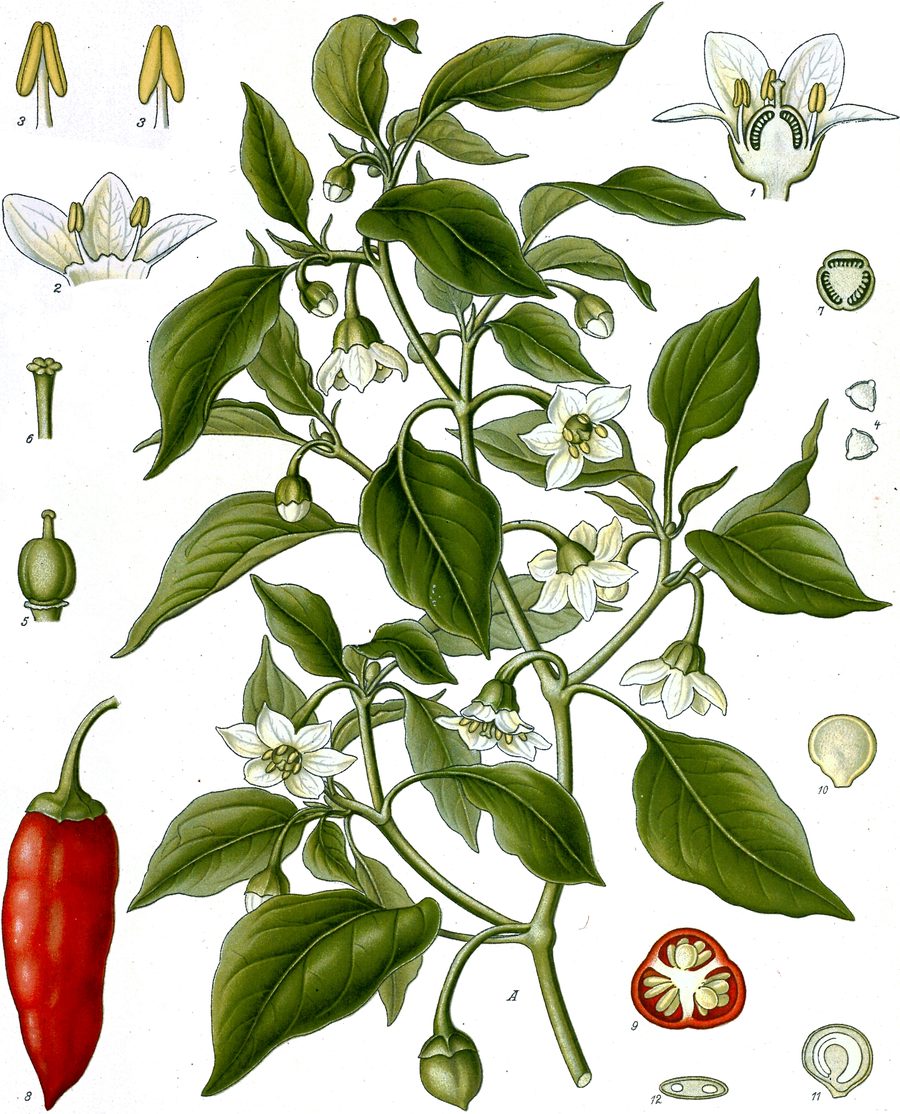
Cayenne/Capsicum
Capsicum annuum, C. frutescens
Traditionally used for muscle pain; arthritis pain; neuropathic pain.
- cream
- oil
- powder
- Used for
- 3 conditions
- Body systems
- Pain & Inflammation, Circulatory
Research references
- Caterina MJ et al.. The capsaicin receptor: a heat-activated ion channel in the pain pathway. Nature, 1997.
- Yaksh TL et al.. Intrathecal capsaicin depletes substance P in the rat spinal cord and produces prolonged thermal analgesia. Science, 1979.
- Anand P, Bley K. Topical capsaicin for pain management: therapeutic potential and mechanisms of action of the new high-concentration capsaicin 8% patch. Br J Anaesth, 2011.