What it does
Isoquinoline alkaloid found in goldenseal, Oregon grape, and barberry. Bright yellow color. Activates AMPK pathway — improves insulin sensitivity and glucose metabolism 12. Antimicrobial against bacteria, fungi, and protozoa. Poor oral bioavailability (~5%) due to P-glycoprotein efflux in gut 3. Heat-stable: survives decoction. Alcohol tincture extracts berberine efficiently (it is soluble in ethanol). Drying preserves berberine well. Synergistic with 5′-methoxyhydnocarpin (found in same plants), which inhibits bacterial efflux pumps.
Plants that contain it
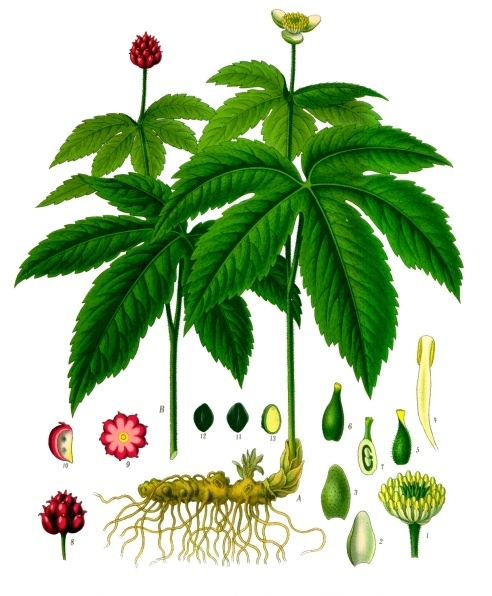
European Serious cautions
Goldenseal
Hydrastis canadensis
Traditionally used for mucous membrane infections; infected wounds; eye infections.
- decoction
- gargle
- tincture
- Used for
- 1 condition
- Body systems
- Fever & Infection

Ayurveda Serious cautions
Guduchi
Tinospora cordifolia
Known as ’Amrita’ (divine nectar) in Ayurveda.
- capsule
- decoction
- juice
- powder
- Used for
- 2 conditions
- Body systems
- Pain & Inflammation
European Serious cautions
Oregon Grape
Mahonia aquifolium
Traditionally used for skin conditions with infection component; digestive infections; a bitter tonic and liver support.
- compress
- decoction
- tincture
- Used for
- 1 condition
- Body systems
- Fever & Infection
Research references
- Lee YS et al.. Berberine, a natural plant product, activates AMP-activated protein kinase with beneficial metabolic effects in diabetic and insulin-resistant states. Diabetes, 2006.
- Turner N et al.. Berberine and its more biologically available derivative, dihydroberberine, inhibit mitochondrial respiratory complex I. Diabetes, 2008.
- Pan GY et al.. The involvement of P-glycoprotein in berberine absorption. Pharmacol Toxicol, 2002.