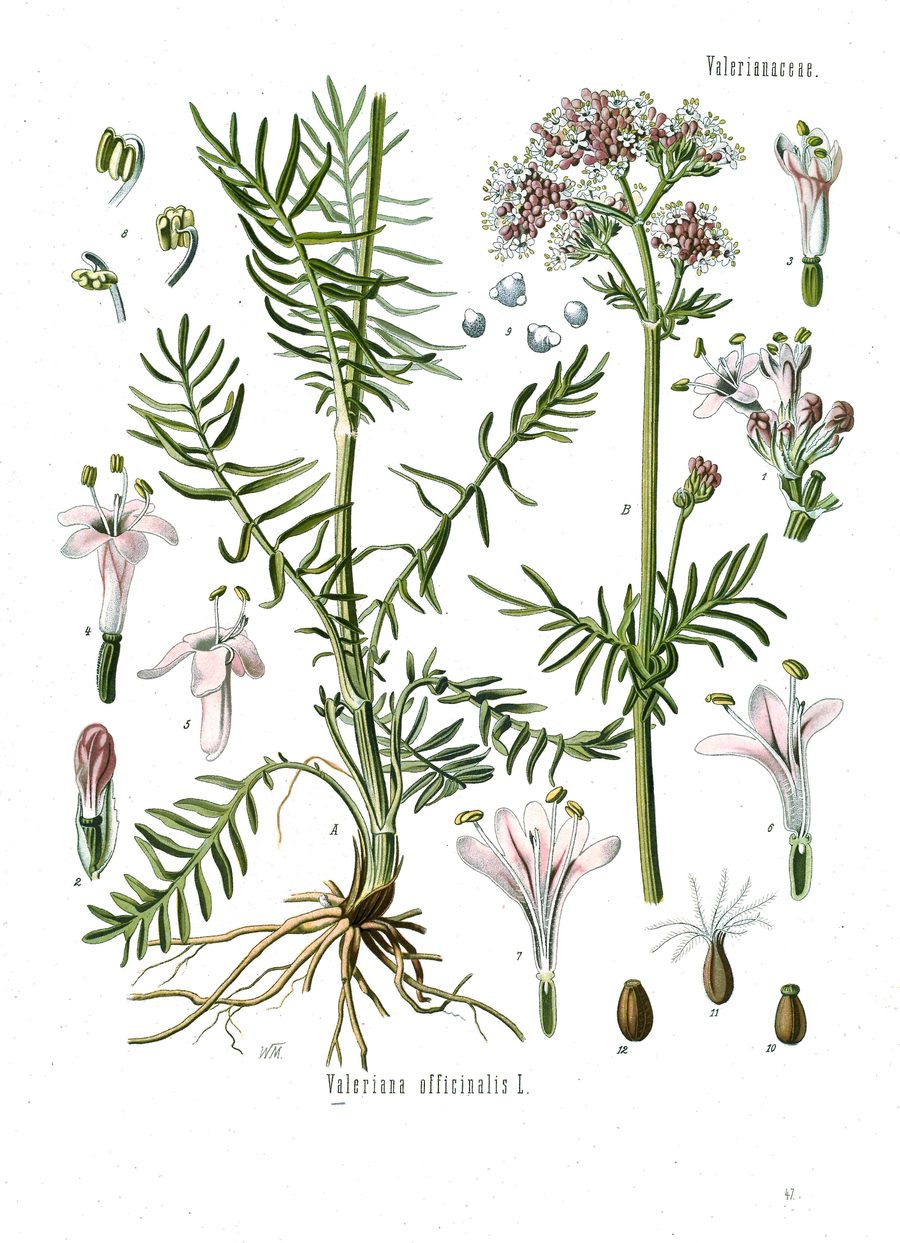
Traditionally used for muscle tension related to stress or anxiety; muscle spasms; tension-type pain with difficulty relaxing.
Traditional uses
- For muscle tension related to stress or anxiety
- For muscle spasms
- For tension-type pain with difficulty relaxing
- Often combined with cramp bark for muscle-related issues
Conditions it is used for
Pain & Inflammation
Nervous System & Mental State
In the old texts
Valerian has been used for nervous conditions since ancient Greece and Rome. Hippocrates described it; Galen recommended it for insomnia. It became a standard nervine in European medicine and was used during World War I for “shell shock” (combat-related anxiety). Its name may derive from Latin “valere” (to be strong/healthy).
What does the work
- Valerenic acid
- Sesquiterpene acid found in valerian root.
- Volatile oils
- Complex mixtures of terpenes, terpenoids, and phenylpropanoids responsible for plant aromas and many therapeutic effects.
Combines well with
Cramp Bark European, Native American
Muscle relaxation + antispasmodic for tension pain
How: Valerenic acid is a positive allosteric modulator of GABA-A receptors (central muscle relaxation); scopoletin and viopudial (cramp bark) directly relax smooth muscle via calcium channel blockade
Hops European
Classic European sleep formula; complementary sedation
How: Valerenic acid is a positive allosteric modulator of GABA-A receptors; 2-methyl-3-buten-2-ol (hops degradation product of alpha-acids) acts as a direct GABA-A agonist; complementary GABAergic sedation at distinct binding sites
Passionflower Western herbalism
Triple nervine for anxiety with sleep disturbance
How: Valerenic acid modulates GABA-A receptors; chrysin and apigenin (passionflower) act as partial agonists at the benzodiazepine binding site; rosmarinic acid (lemon balm) inhibits GABA-transaminase, increasing synaptic GABA concentration
Lemon Balm Western herbalism
Triple nervine for anxiety with sleep disturbance
How: Valerenic acid modulates GABA-A receptors; chrysin and apigenin (passionflower) act as partial agonists at the benzodiazepine binding site; rosmarinic acid (lemon balm) inhibits GABA-transaminase, increasing synaptic GABA concentration
Cautions
- Drug interactions Serious
Herbs can alter drug metabolism via CYP450 induction (St. John’s wort induces CYP3A4 1) or inhibition (piperine inhibits CYP3A4 and P-glycoprotein), causing subtherapeutic or toxic drug levels. - Surgery Take care
Herbs affecting coagulation (garlic, ginkgo, ginger inhibit platelet aggregation) or anesthesia metabolism (kava, valerian potentiate sedatives) should be discontinued 2–3 weeks before elective surgery. - Sedation Worth knowing
GABAergic herbs (valerian, kava, passionflower) potentiate GABA-A receptor activity, producing additive sedation when combined with benzodiazepines, barbiturates, or alcohol 2.
These are the cautions recorded for this plant, not a complete list. Doses, preparations and interactions vary; ask a pharmacist or qualified practitioner before combining a herb with medication.
Research references
- Moore LB et al.. St. John’s wort induces hepatic drug metabolism through activation of the pregnane X receptor. Proc Natl Acad Sci USA, 2000.
- Khom S et al.. Valerenic acid potentiates and inhibits GABA(A) receptors: molecular mechanism and subunit specificity. Neuropharmacology, 2007.