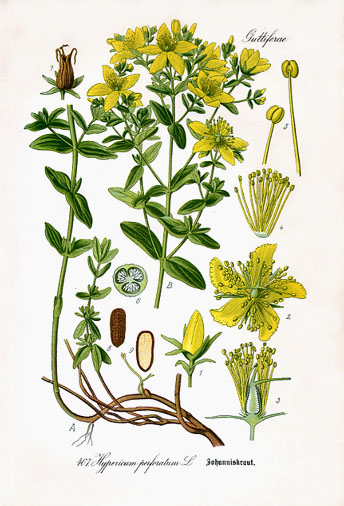
Traditionally used for mild to moderate depression; seasonal affective disorder; anxiety with depression.
Traditional uses
- For mild to moderate depression
- For seasonal affective disorder (SAD)
- For anxiety with depression
- For menopausal mood changes
- Full effects may take 4-6 weeks
Conditions it is used for
Nervous System & Mental State
In the old texts
St. John’s Wort has been used since ancient Greece for wound healing and nervous conditions. Its use for depression became prominent in European folk medicine and was validated by extensive German research in the 20th century. It is now one of the most thoroughly studied herbal antidepressants, with efficacy comparable to standard antidepressants for mild to moderate depression in multiple clinical trials.
What does the work
- Hypericin
- Naphthodianthrone pigment from St.
Cautions
- Blood thinners Serious
Many herbs inhibit platelet aggregation (via COX-1, thromboxane A2, or PAF pathways) or potentiate warfarin metabolism (CYP2C9/3A4 interactions), increasing bleeding risk when combined with anticoagulant drugs 1. - Drug interactions Serious
Herbs can alter drug metabolism via CYP450 induction (St. John’s wort induces CYP3A4 2) or inhibition (piperine inhibits CYP3A4 and P-glycoprotein), causing subtherapeutic or toxic drug levels. - Heart conditions Serious
Cardiac glycoside-containing plants (foxglove, lily of the valley) inhibit Na+/K+-ATPase; sympathomimetics (ephedra) increase cardiac workload; both carry arrhythmia risk in pre-existing cardiac disease. - Liver conditions Serious
Hepatotoxic constituents including pyrrolizidine alkaloids, pulegone (pennyroyal), and kava lactones can cause veno-occlusive disease, centrilobular necrosis, or cholestatic injury in susceptible individuals 3. - Pregnancy Serious
Many herbs cross the placental barrier and may stimulate uterine contractions (emmenagogue/oxytocic effects) or disrupt fetal development. Alkaloids, volatile oils, and anthraquinone laxatives carry particular risk 4. - Photosensitivity Worth knowing
Furanocoumarins and naphthodianthrones (hypericin from St. John’s wort) absorb UV radiation and generate reactive oxygen species in skin cells, causing phototoxic dermatitis 5.
These are the cautions recorded for this plant, not a complete list. Doses, preparations and interactions vary; ask a pharmacist or qualified practitioner before combining a herb with medication.
Research references
- Heck AM et al.. Potential interactions between alternative therapies and warfarin. Am J Health Syst Pharm, 2000.
- Moore LB et al.. St. John’s wort induces hepatic drug metabolism through activation of the pregnane X receptor. Proc Natl Acad Sci USA, 2000.
- Teschke R et al.. Herbal hepatotoxicity: a tabular compilation of reported cases. Liver Int, 2012.
- Ernst E. Herbal medicinal products during pregnancy: are they safe?. BJOG, 2002.
- Miskovsky P. Hypericin--a new antiviral and antitumor photosensitizer: mechanism of action and interaction with biological macromolecules. Curr Drug Targets, 2002.