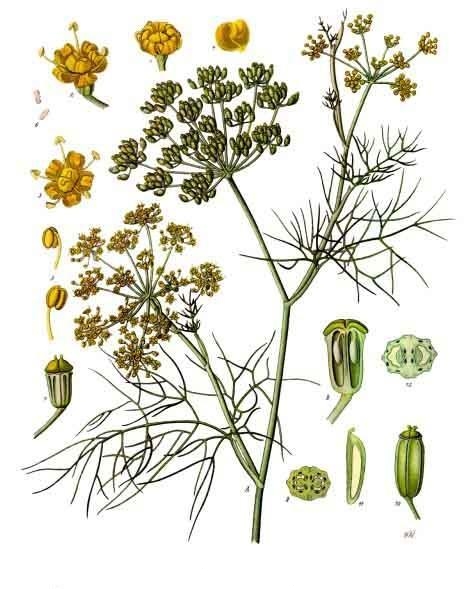
Traditionally used for bloating and gas; acid indigestion.
Traditional uses
- After meals to prevent indigestion
- For bloating and gas (carminative effect)
- For acid indigestion—fennel is cooling and balances both excess and deficient digestion
- Safe for nursing mothers (traditionally used to support milk production and ease infant colic through breast milk)
Conditions it is used for
Digestive System
Women’s Health
Eye Conditions
Oral & Dental Health
In the old texts
Fennel appears in the Ebers Papyrus (Egypt, ~1550 BCE), Dioscorides, Charaka, and Ibn Sina. This is one of the most consistently documented digestive herbs across cultures and millennia. Traditionally offered after meals throughout India and the Middle East.
What does the work
- Anethole
- Phenylpropanoid ether responsible for the sweet licorice-like flavor of fennel, anise, and star anise.
- Volatile oils
- Complex mixtures of terpenes, terpenoids, and phenylpropanoids responsible for plant aromas and many therapeutic effects.
Combines well with
Cumin Ayurveda
Balanced digestive support—cumin stimulates, coriander cools, fennel soothes
How: Cuminaldehyde stimulates digestive enzyme secretion; linalool (coriander) is antispasmodic on GI smooth muscle; anethole (fennel) relaxes intestinal musculature via calcium channel modulation
Coriander Ayurveda
Balanced digestive support—cumin stimulates, coriander cools, fennel soothes
How: Cuminaldehyde stimulates digestive enzyme secretion; linalool (coriander) is antispasmodic on GI smooth muscle; anethole (fennel) relaxes intestinal musculature via calcium channel modulation
Cautions
- Allergic reactions Take care
Asteraceae (chamomile, echinacea, feverfew) contain sesquiterpene lactones that can trigger contact dermatitis and cross-reactive IgE-mediated responses in ragweed-sensitive individuals. - Estrogenic effects Take care
Phytoestrogens (isoflavones, coumestans, lignans) and structurally estrogenic compounds (anethole) bind estrogen receptors, potentially stimulating hormone-sensitive tissue proliferation 1.
These are the cautions recorded for this plant, not a complete list. Doses, preparations and interactions vary; ask a pharmacist or qualified practitioner before combining a herb with medication.
Research references
- Albert-Puleo M. Fennel and anise as estrogenic agents. J Ethnopharmacol, 1980.