Food resilience · Soil and seed
Feed the soil, keep the seed.
A crop is a withdrawal from the soil; compost, manure, cover crops and rotation are the deposits. Seed saving is the other half of independence.
Soil is not a dead growing medium. It is a structure of minerals, organic matter, water, air and living organisms. Feed it with organic matter, protect it from erosion and compaction, and it will hold water and nutrients through a dry summer.
- Keep cover
- Add organic matter
- Rotate families
- Save open-pollinated seed
- Compost
- Browns + greensMoist, aerated, covered and turned.
- Rotation
- 3–4 yearsBetween crops of the same family, where possible.
- Seed test
- 10 seedsIn damp paper; count what sprouts.
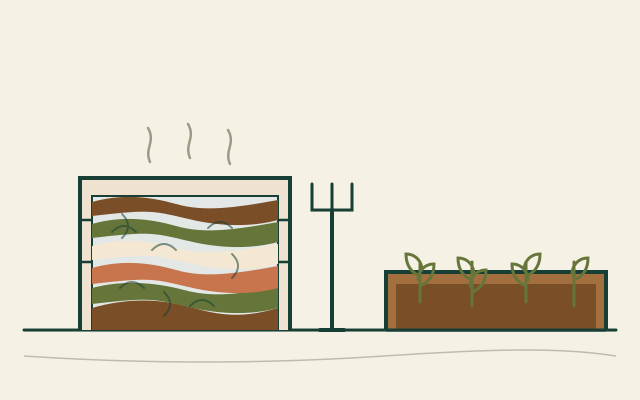
The living layer
Read the soil before you feed it
Texture, structure, organic matter, pH and biology all matter. A jar test and a spade tell you more than a bag of fertiliser.
A jar test separates sand, silt and clay; a ribbon test estimates clay; a infiltration test shows how fast water enters. Dig a spade-depth hole and look for earthworms, roots, compaction layers and a dark crumbly topsoil. Soil that crusts, runs off or sets like concrete needs organic matter and cover, not more tillage.
Most garden and field crops prefer a pH near neutral, but potatoes, blueberries and some ornamentals differ. If you can, test pH and major nutrients before adding amendments. Lime raises pH; sulphur lowers it; wood ash raises it and adds potassium, but use it sparingly. Do not add sand to clay to “improve drainage” — it can make brick. Add compost, grow deep roots and keep the surface covered.
The core skill
Compost
A compost pile is a managed decomposition. The recipe is simple; the management is moisture, air and time.
Mix browns — dry leaves, straw, sawdust, cardboard, wood chips — with greens — fresh weeds without seed, grass clippings, vegetable scraps, manure. Aim for roughly 25–30 parts carbon to one part nitrogen by weight; in practice, two or three buckets of browns to one of greens is a reasonable start. Chop coarse material, keep the pile as moist as a wrung-out sponge, and turn it to add air. A pile of at least one cubic metre holds heat better than a small bin.
Hot composting can reach 55–65 °C and kill many pathogens and weed seeds, but small or cool piles may not. Turn the outside to the inside, and cure the finished compost for several weeks before use. It is ready when it is dark, crumbly, earthy and the original materials are unrecognisable. Use it as mulch, in potting mixes or incorporated into beds.
Do not compost meat, dairy, pet waste, diseased plants, glossy printed paper or persistent herbicides. These attract pests or carry pathogens and residues. A compost heap is not a landfill.
Animal fertility
Manure and mulch
Manure is a resource and a hygiene risk. Compost it, incorporate it, and keep it away from water and ready-to-eat crops.
Fresh manure can carry E. coli, Salmonella, parasites and weed seeds. Compost it with browns, or spread it well before planting and incorporate it. Keep manure heaps covered, away from wells, springs, ponds and drainage lines, and downhill from water. Do not use fresh manure on leafy greens or root crops that will be eaten raw. Wash produce and hands.
Mulch protects the soil surface from rain, wind and sun, conserves moisture and suppresses weeds. Straw, leaves, wood chips, grass clippings and compost all work; keep mulch a little away from stems and do not bury crowns. Wood chips are better on paths and around perennials than dug into annual beds, where they can tie up nitrogen while they decompose.
Human waste is different. Do not use fresh or poorly composted human waste on food crops. See sanitation and greywater for the containment, treatment and reuse rules.
Keep the ground covered
Cover crops and rotation
Bare soil erodes, dries and loses organic matter. A cover crop is a living mulch and, if it is a legume, a nitrogen factory.
Legumes — clover, vetch, peas, beans — fix nitrogen with rhizobia. Grasses and cereals — rye, oats, barley — produce biomass and scavenge nutrients. Brassicas — mustard, radish — can break compaction and suppress some pests. Buckwheat flowers feed pollinators and smothers weeds. Choose species for the season and the next crop, and terminate before they set seed.
Rotate crop families to interrupt pests and diseases: do not follow potatoes with tomatoes, or cabbage with broccoli, in the same bed. A simple four-group rotation — leaf, fruit, root, legume — is enough for a garden. Keep a map and a record; memory is a poor rotation planner.
Cover crops need water and timely termination. If you cannot manage them, a thick mulch and a period of rest are better than bare ground. Do not let a cover crop go to seed and become a weed.
The seed is the library
Seed saving
Save seed from healthy, true-to-type plants — not from the weakest survivor. Open-pollinated varieties breed true; F1 hybrids do not.
Learn the life cycle of the crop. Annuals — beans, tomatoes, lettuce — flower and set seed in one season. Biennials — carrots, onions, cabbage, beetroot — need a second year and a cool period before flowering. Save from enough plants to avoid inbreeding: a dozen or more for most vegetables, more for corn. Keep isolation distances between varieties that can cross, or bag flowers and hand-pollinate.
Harvest seed when it is mature and dry. Wet-seeded crops such as tomatoes and cucumbers are usually fermented: squeeze the seed and gel into a jar, add water, ferment for a few days until the viable seed settles, rinse and dry. Dry-seeded crops — beans, peas, lettuce, brassicas — are harvested when the pods or heads are brown and dry, then threshed and winnowed. Dry seed thoroughly in a warm, shaded, ventilated place; it should snap, not bend.
Store seed in a cool, dark, dry place in labelled paper envelopes or airtight jars with a little dry silica. Keep it away from mice and damp. Test germination before sowing: count 10 seeds on damp paper or cloth, keep them moist and warm, and count the sprouts after the expected period. If fewer than seven sprout, sow thicker or find fresher seed.
Make more plants
Propagation
Seed is not the only way. Cuttings, division, layering and grafting multiply the plants you already have.
Softwood and semi-ripe cuttings root in a humid, shaded bed; hardwood cuttings root in winter. Division works for clumping perennials, herbs and grasses. Layering roots a stem while it is still attached to the parent. Grafting joins a scion to a rootstock and is essential for many fruit trees; learn it from a local grafter, and keep tools clean.
Use clean, sharp tools, a free-draining mix and labeled pots. Keep cuttings out of direct sun until they root. Not every plant roots easily; start with willows, mint, comfrey, rosemary and other reliable species before trying difficult ones.
Sources and further reading
Where to check the details
Soil, climate and varieties are local. Use local extension advice, a soil test and your own records.
- Wikipedia: Compost — ingredients, process and use.
- Wikipedia: Cover crop — species and functions.
- Wikipedia: Crop rotation — family rotation and pest control.
- Wikipedia: Seed saving — isolation, harvesting and storage.
- Wikipedia: Vermicompost — worm composting.
Start with one pile and one seed crop.
Build a compost pile you can turn, and save seed from one easy open-pollinated crop. Then add a cover crop and a rotation.