
Crop 020 / Triticum aestivum

Sow for the season. Harvest for the dry jar.

Grow bread wheat as a spring crop for a same-season harvest or as an autumn-sown winter crop with cultivar-specific cold exposure. Choose locally adapted planting seed, keep the stand drained and moderately fed, and plan the hand work from mature ears to clean, dry grain.

Harvest
Mature, hard grain Cut before prolonged rain or shattering, then dry, thresh and winnow before storage.
Typical crop window
90–300 days Fast spring types can approach 90–150 days; autumn-sown winter types occupy roughly 180–300 days including winter dormancy.
Season
Spring or winter habit Match the cultivar’s vernalization requirement and maturity to the local sowing window.
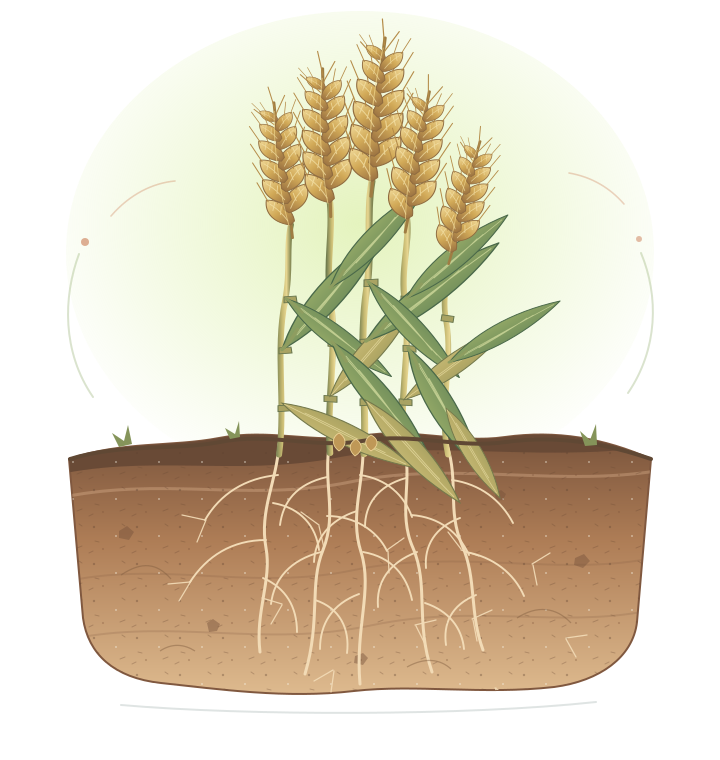
Bread wheat plant with jointed stems, long leaves, ripe awned ears and fibrous roots in a soil cutaway.
Bread wheat forms additional shoots from the base and finishes with grain-bearing ears. Mature kernels—not merely yellow straw—determine harvest readiness.

Know the crop

Crop profile

A cool-season cereal grown for mature grain, with spring and winter habits in Triticum aestivum. Spring types are sown for a same-season harvest, while winter types are sown earlier and require cultivar-specific cold exposure before heading. Grain can be cooked whole, milled for food or used in feed rations; every route needs mature, clean and safely dried grain.

Crop essentials

Botanical name
Triticum aestivum
Growth
90–300 days From sowing to mature grain. Fast spring types can approach 90–150 days, while autumn-sown winter types occupy roughly 180–300 days including winter dormancy. Cultivar, vernalization requirement, sowing date, temperature, day length, elevation and harvest weather determine the actual window.
Family
Poaceae, the grass family
Origin
The Fertile Crescent of southwestern Asia
Habit
Cool-season annual cereal with spring and winter habits, jointed stems and grain-bearing ears; distinct from durum, spelt and einkorn

Nutrition / cooked khorasan wheat berries

Nutrition, in context

High Editorial nutrient-density rank 3. This is Rooted’s qualitative category for protein, fibre, folate, iron and potassium in the site’s cooked-food comparison, with highlights adding context. It is not an official nutritional score or a universal ranking of foods.

Reference nutrients per 100 g cooked khorasan wheat berries; explicitly not a bread-wheat-specific analysis
Nutrient Amount
Protein 5.71 g
Fibre 4.3 g
Folate 11 µg
Iron 1.76 mg
Potassium 164 mg
  • The cooked whole-berry reference provides protein, fibre and non-heme iron, with selenium (31.9 µg), magnesium (48 mg) and zinc (1.84 mg) in the same 100 g.
  • These are cooked hydrated wheat-berry values, not raw dry grain, flour, bread or bran values; water uptake makes raw and cooked weights non-interchangeable.
  • The exact USDA food is khorasan wheat, so its figures illustrate a cooked whole wheat berry rather than measuring every T. aestivum cultivar or preparation.

Basis: Approximate values per 100 g cooked khorasan wheat berries (USDA FoodData Central SR Legacy 169744). Khorasan is Triticum turgidum subsp. turanicum, not T. aestivum; this is the closest USDA cooked whole-wheat-berry reference, not a bread-wheat-specific analysis. Cook sorted, rinsed whole berries until tender before using the stated cooked basis. Wheat and the khorasan reference contain gluten and are unsuitable for a gluten-free diet. For food or feed storage, harvest mature grain, clean it and dry it to locally recommended moisture for the storage period; protect against insects and mould and discard mouldy lots rather than processing them into food or feed.

At the table

Build a varied meal around wheat

  • Lentils, chickpeas or beans — Complementary amino-acid patterns. Pulses and wheat have different essential-amino-acid patterns that can complement each other across a varied diet. They also add fibre and folate; the foods need not share one meal. Serve cooked wheat berries with lentil and vegetable stew, or use whole-grain bread beside chickpea salad.
  • Peppers, tomatoes, citrus or leafy greens — Vegetables and non-heme iron. Vegetables broaden the meal, and vitamin-C-rich choices can support absorption of non-heme iron from plant foods. The effect depends on the whole diet and iron status. Make a cooked wheat-berry bowl with chickpeas, leafy greens, peppers and a lemon dressing.
  • Eggs, fish, yogurt or tofu — Protein variety. These accompaniments add protein and different nutrients to a wheat-based meal. Choose according to preference and dietary needs; no single pairing is essential. Serve cooked wheat berries with tofu and vegetables, or with fish and a leafy salad.

The essentials

From the right habit to clean, dry grain

Six practical stages for a small cereal plot. Adapt cultivar, seed rate and timing to local winter conditions, seasonal rainfall and harvest weather.

  1. Confirm the species and seasonal habit

    Common bread wheat is Triticum aestivum. Durum is T. turgidum subsp. durum; spelt is T. spelta, also classified as T. aestivum subsp. spelta; einkorn is T. monococcum. Their processing and growth differ, and all contain gluten: none is suitable for a gluten-free diet or safe for people with coeliac disease. Buy sound planting seed with its species, cultivar and spring or winter habit identified.

  2. Match spring or winter sowing to the site

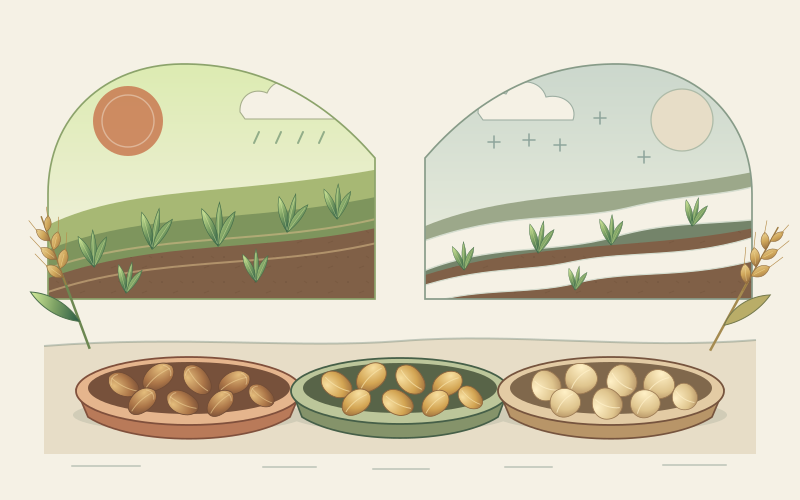
    Sow spring wheat at the locally recommended start of spring growth for harvest later that season; fast types can approach 90–150 days. Sow winter wheat in autumn early enough to establish before cold, allowing roughly 180–300 days including dormancy. Winter cultivars need suitable cold exposure before normal heading, so autumn sowing is not simply an earlier spring sowing and an unverified winter type sown in spring may remain vegetative.

  3. Calculate the seed rate and prepare drainage

    Start with local guidance and roughly 250–300 established plants per m² for spring wheat or 220–250 for winter wheat. Use packet thousand-kernel weight and realistic emergence to calculate grams per square metre rather than relying on a scoop; excessive density increases competition and lodging. Sow evenly about 2–4 cm deep into a fine, firm seedbed in full sun, avoiding sticky or saturated soil. Relieve compaction and correct drainage before sowing.

  4. Keep nitrogen modest and limit lodging

    Use a soil test and local nutrient advice instead of routine rich feeding. Too much available nitrogen, especially with dense growth and ample water, produces lush stems that can lean or fall over—lodging that slows harvest and makes grain harder to dry. Avoid fresh manure and heavy late applications without ignoring a demonstrated deficiency. Weed early, water by need without waterlogging, rotate away from recent cereals where advised and inspect for local disease.

  5. Harvest mature grain and dry with airflow

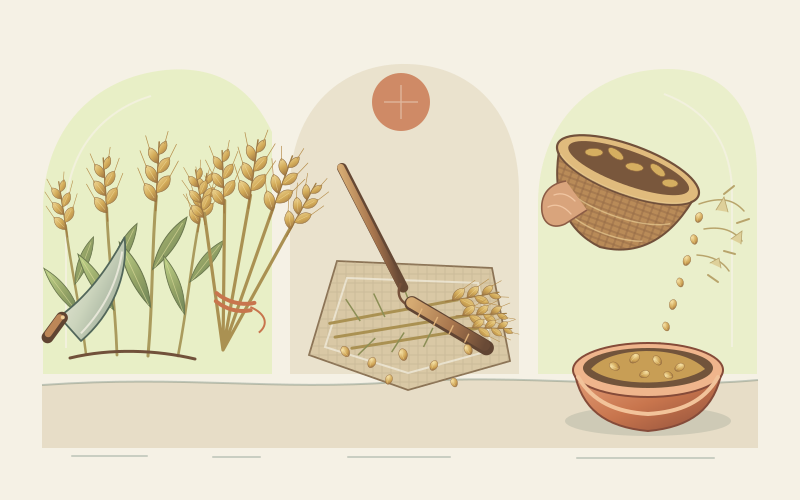
    Check kernels as heads and stems yellow: harvest when grain is hard and mature, before shattering or prolonged rain. Cut surface-dry plants with clean hand tools over a sheet to catch loose heads. Spread heads thinly or hang small, loose sheaves under cover with strong airflow; never heap damp sheaves into a warm stack. Hard kernels and rattling are clues, not a moisture measurement, so use suitable testing before relying on longer storage.

  6. Thresh, winnow and store with safe equipment

    Thresh dry heads gently, winnow in a gentle cross-breeze or before a guarded, stable low fan, then sieve and remove stones, damaged grain and contaminants. Avoid breathing dust and keep bystanders clear; tie back loose clothing and hair, disconnect powered equipment before clearing blockages, never bypass guards or reach into moving threshers or mills, and control grain dust around ignition sources. Store only demonstrably dry, cool grain in clean food-safe airtight containers, labelled and inspected for condensation, insects, heating, odour or mould.

Growing notes by place

Read your region, then read your weather

Compare broad growing conditions, then adjust for your own frost dates, altitude, rainfall and soil.

Cool, temperate and often maritime, with mild winters in many lowlands and wet harvest weather in some districts.

Northwestern Europe

Winter wheat fits many suitable lowland sites, while spring wheat avoids winter occupancy but still needs a dry finish. Small plots require threshing and winnowing as well as growing time.

Indicative planting
Sow locally adapted winter wheat around September–October, early enough to establish before cold; sow spring types around February–April when soil is workable. Use the habit recommended for the district.
Indicative harvest
Harvest winter wheat around July–August and spring wheat around August–September when grain is hard and mature. Cut before prolonged rain damages quality, then dry thoroughly before storage.
Soil and moisture
Fertile, well-drained medium loam with good structure; avoid waterlogging and excessive nitrogen that encourages lodging, and rotate to limit cereal diseases.

Field note: Match winter or spring habit to the local calendar, net only where bird pressure warrants it and do not store grain merely because the straw looks dry.
Dates are indicative. Local frost forecasts, seasonal rainfall and recent weather—not the calendar alone—should guide sowing and harvest.

Northwestern Europe · winter wheat example

An autumn-to-summer grain rhythm

A compact planning guide, not a fixed schedule. Shift it with cultivar, latitude, altitude, winter survival and local conditions.

  1. September–October

    Choose a locally adapted winter cultivar, calculate the seed rate and prepare a sunny, well-drained seedbed. Sow early enough to establish before cold without following an autumn date that is unsuitable for the district.

  2. October–March

    Check establishment and drainage without compacting wet soil. The stand overwinters and meets its cultivar-specific cold requirement; avoid heavy nitrogen and do not mistake winter dormancy for crop failure.

  3. April–June

    Monitor spring regrowth, weeds and local disease while keeping feeding moderate to limit lodging. Watch heads and kernels as they develop, and prepare clean sheets, ventilated drying space and safe hand tools.

  4. July–August

    Cut when kernels are hard and mature, before prolonged rain or shattering. Dry with strong airflow, thresh and winnow carefully, test dryness for the intended storage period and pack only clean, cool grain.

This example follows an autumn-sown winter crop within the broad 90–300 day range. For locally adapted spring wheat, sow around February–April when soil is workable and expect harvest around August–September; weather and cultivar still determine maturity.

From the field journal

Grow, choose and cook your wheat

Practical reading for a small grain harvest, informed species and cultivar choices, and balanced meals with an explicit cooked reference and gluten warning.

Your next harvest begins here

Start with a small plot and the right habit.

A modest cereal trial is enough to learn establishment, tillering, lodging and harvest in your conditions. Choose locally adapted seed, calculate the stand and make drying, cleaning and safe storage part of the plan from sowing day.

Open the growing guide