
Crop 029 / Corylus avellana

Plant the pair before the promise of nuts.

Grow European hazelnut as a patient perennial on a sheltered, well-drained site. Match compatible pollen to flowering time, choose a shrub or tree form early, and plan careful drying before the first mature nuts fall.

Perennial establishment
Roots and framework first A healthy selected shrub needs compatible pollen, several seasons of growth and annual form maintenance.
First crop
3–5 years From planting a young shrub, with full production commonly later; local cold, disease and failed pollination can delay cropping.
Harvest to storage
Collect, dry, then seal Gather mature nuts promptly and dry with moving air at controlled low heat before cool, airtight storage.
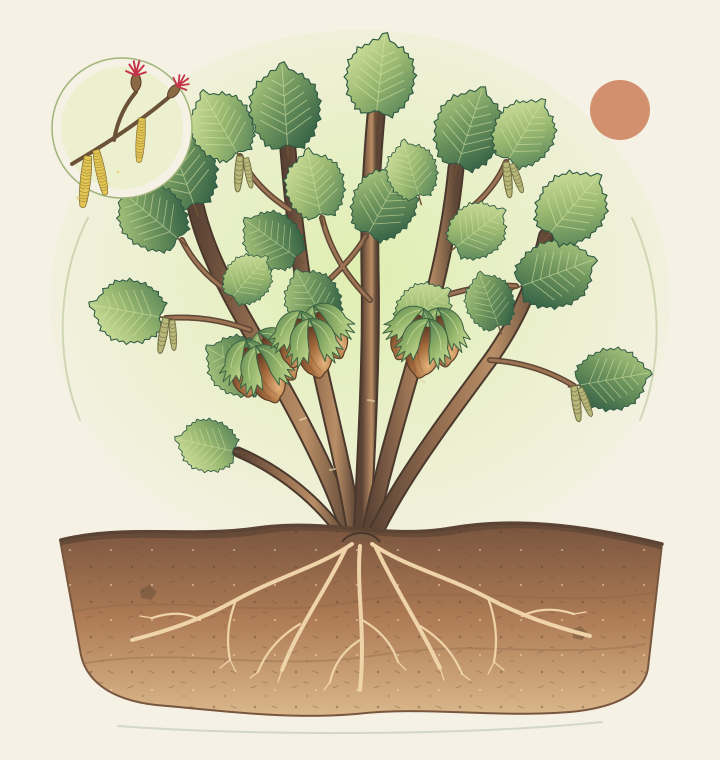
Multi-stem hazelnut shrub with serrated leaves, long male catkins, small red female flowers, leafy husks around brown nuts, and branching perennial roots.
A hazelnut carries separate male catkins and tiny female flowers on one shrub, but compatible pollen from another selection is still required for a reliable crop.

Know the crop

Crop profile

A deciduous, long-lived shrub or small tree grown for edible nuts. This entry centres on Corylus avellana; American, beaked and Asian Corylus species and their hybrids may be more reliable locally, but their size, hardiness, disease response and pollination needs differ. European hazelnuts are wind-pollinated and self-incompatible: productive plantings need a genetically compatible pollinizer whose pollen shed overlaps female receptivity. Expect about 3–5 years from planting a young selected shrub to a first crop, not an annual harvest cycle, and longer to full production.

Crop essentials

Botanical name
Corylus avellana
Growth
3–5 years From planting a young selected shrub to a first useful crop under suitable conditions. Utah State reports initial production around 3–4 years and full production around 7–8 years; cultivar, planting material, winter injury, early flowering, drought, pruning, disease and compatible pollen can delay or prevent cropping. This is perennial establishment, not days from annual sowing.
Family
Betulaceae
Origin
Europe and western Asia
Habit
Deciduous perennial shrub or small tree; wind-pollinated and generally self-incompatible

Nutrition / raw edible kernels

Nutrition, in context

High Editorial nutrient-density rank 3. This is Rooted’s qualitative category for protein, fibre, folate, iron and potassium in the site’s food comparison, with highlights adding context. It is not an official nutritional score or a promise of a health outcome.

Approximate values per 100 g raw hazelnuts or filberts, edible kernels.
Nutrient Amount
Protein14.95 g
Fibre9.7 g
Folate113 µg
Iron4.70 mg
Potassium680 mg
  • The raw reference provides protein, fibre, folate, non-heme iron and potassium, plus vitamin E (15.03 mg), magnesium (163 mg) and copper (1.725 mg) per 100 g.
  • Hazelnuts are energy-dense: the exact raw reference lists 628 kcal and 60.75 g total fat per 100 g, mostly monounsaturated fat (45.652 g). A 100 g reference amount is larger than a typical handful.
  • Hazelnut is a tree nut. Anyone with a diagnosed hazelnut allergy must avoid hazelnut ingredients and manage cross-contact according to their clinician’s advice; nutrient value never overrides allergy safety.

Basis: Approximate values per 100 g raw hazelnuts or filberts, edible kernels (USDA FoodData Central SR Legacy 170581; food attribute Corylus avellana). The same 100 g contains 628 kcal and 60.75 g total fat; these are not roasted, blanched, ground, oil or spread values. View the USDA reference.

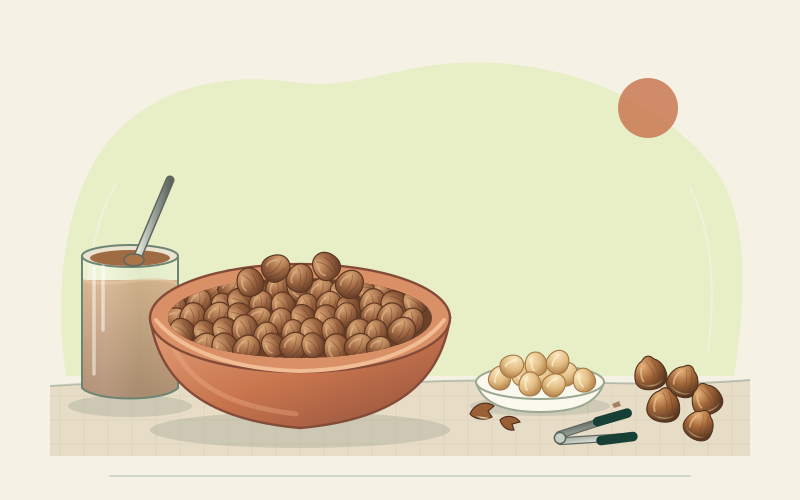
Harvest mature nuts promptly, then dry them with moving air at a controlled low temperature before storage. Utah State recommends 95–105°F (35–40.5°C), avoiding temperatures above 110°F (43°C) that can harm flavour; drying time is not a universal safety endpoint. Store only clean, thoroughly dry nuts in airtight containers, cool and dark, with refrigeration or freezing for longer quality. Discard mouldy, insect-infested, rancid or otherwise doubtful nuts. Raw, dried, roasted and ground products are not nutritionally or microbiologically interchangeable.

At the table

Use an energy-dense nut in a varied meal

  • Oats and fresh or stewed fruit — Energy-dense garnish: A measured sprinkle of chopped hazelnuts adds texture, fat, protein and fibre to a grain-and-fruit breakfast. The nuts remain calorie-dense, so portion size matters more than a superfood label. Chop hazelnuts over oatmeal with apple or pear; use another topping where tree nuts must be avoided.
  • Beans or lentils with vegetables — A varied savoury meal: Pulses and vegetables broaden the protein, carbohydrate, fibre and micronutrient pattern of a meal. Hazelnuts can add richness and crunch without being treated as a required health ingredient. Add a small amount of chopped hazelnut to a lentil and roasted-vegetable salad, checking every diner’s allergy needs first.
  • Whole-grain bread and vegetables or fruit — Practical portions and processing: Bread and produce make a more varied snack or light meal alongside a modest portion of nuts. Pure hazelnut paste is different from sweetened chocolate spreads, whose sugar, fat and other ingredients require their own labels. Serve whole-grain toast with a thin layer of unsweetened hazelnut butter and sliced fruit, or keep whole nuts separate from allergen-free food.

The essentials

From compatible shrubs to dry stored nuts

Six practical stages for Corylus avellana. Adapt species, cultivar, pollinizer placement and harvest handling to your climate and local growing advice.

  1. Confirm the species and local fit

    Choose full sun or very light shade, shelter from damaging wind and deep, free-draining soil. C. avellana flowers early, so avoid frost pockets even where dormant wood is hardy. In cold or blight-prone North American districts, ask whether native C. americana, C. cornuta or tested hybrids are more dependable; in East Asia, locally adapted C. heterophylla or other Corylus may be preferable. Their nuts and management are not interchangeable.

  2. Plant a documented pollination pair

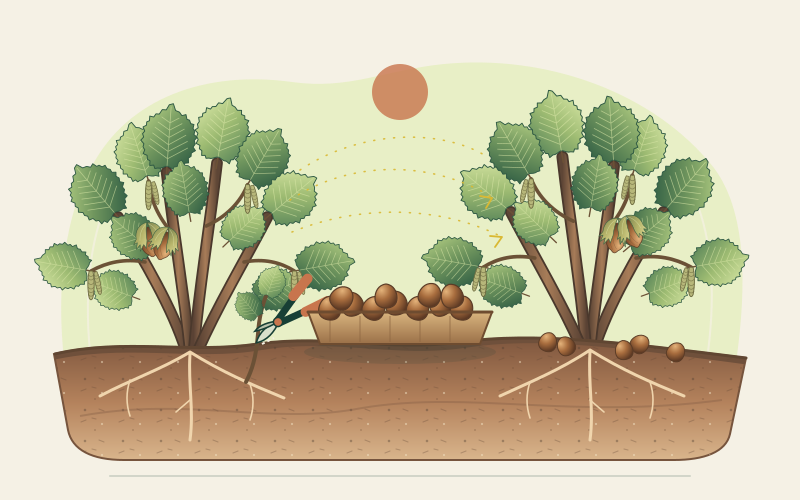
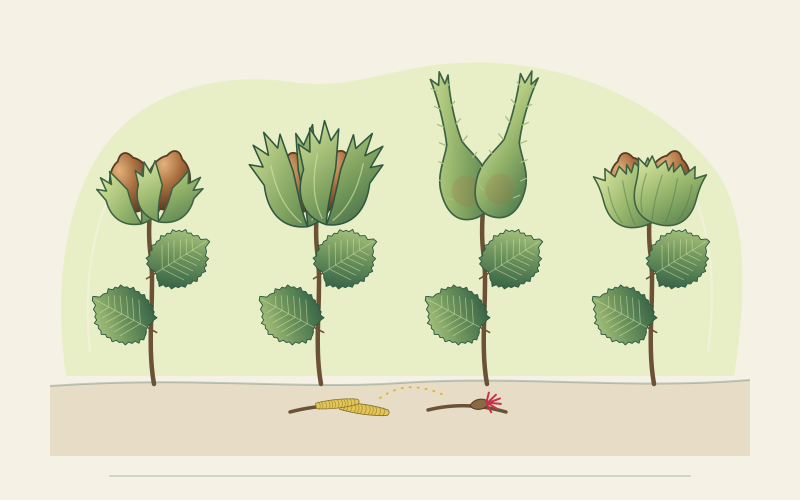
    Hazelnuts carry male catkins and female flowers on the same plant, but are wind-pollinated and self-incompatible. Two plants of the same clone do not solve this. Choose a compatible pollinizer whose pollen shed overlaps the main cultivar’s red female flowers, and place it nearby rather than assuming distant pollen is enough. Examples from Utah State include ‘Jefferson’ with ‘Eta’ or ‘Theta’, and ‘Butler’ with ‘Ennis’; verify current local compatibility and disease advice before buying.

  3. Establish roots without waterlogging

    Plant healthy bare-root or container stock during the locally recommended dormant or spring window, at the original root-collar depth. Keep roots moist before planting, spread them naturally and water thoroughly after backfilling. Maintain a wide weed-free zone and mulch without touching the stems. Water young shrubs deeply when the root zone begins to dry, especially for the first two years; frequent shallow watering and saturated soil both undermine establishment.

  4. Choose shrub renewal or sucker removal

    Left alone, European hazel naturally forms a multi-stem shrub. For that form, remove roughly 15–20% of the oldest stems near the base annually to renew growth, following local pruning guidance. For a small tree, select three to five strong scaffold branches and remove basal suckers every year. Use clean sharp tools during the appropriate dormant window, keep the crown reachable and open, and never strip all vigorous young growth merely to make the plant tidy.

  5. Protect flowers, developing nuts and soil moisture

    Test soil before fertilising; excessive nitrogen and late feeding encourage soft growth. Inspect early flowers after frost and developing nuts through summer, and maintain moisture without saturation because drought can reduce kernel filling. Buy healthy stock and use resistant cultivars where eastern filbert blight occurs. Diagnose cankers, insects or mildew locally before treatment, and use only legally available products labelled for hazelnuts and the target problem. Collect nuts frequently to limit squirrel, jay and insect losses.

  6. Harvest mature nuts and dry before storage

    Harvest when husks brown and open and mature nuts fall, collecting several times a week from clean ground. Sort out damaged, mouldy or doubtful nuts. Dry promptly in shallow layers with moving air; a published home method uses 95–105°F (35–40.5°C) for 72–96 hours, but load and humidity change the endpoint and time alone proves nothing. Avoid heat above 110°F (43°C). Cool, inspect and pack only thoroughly dry nuts in clean airtight containers, stored cool and dark; refrigerate or freeze for longer quality and discard mouldy or rancid food.

Growing notes by place

Read your region, then read your winter

Compare broad conditions, then adjust for local winter chill, early-flowering frost, altitude, rainfall, summer drought, soil and available Corylus species.

Cool temperate, often maritime conditions with winter wet, variable summer warmth and damaging wind or late frost on exposed sites.

Northwestern Europe

Corylus avellana is native and widely suited to sheltered, well-drained sites. Reliable nut set still depends on compatible cultivars with overlapping winter flowering, while wet harvest weather makes prompt drying important.

Indicative planting
Plant healthy dormant stock from late autumn to early spring when soil is workable and not frozen or waterlogged. Set out at least one documented compatible pollinizer, allow room for a multi-stem shrub or train a single trunk, and expect a first crop around 3–5 years after planting.
Indicative harvest
Gather fallen mature nuts frequently, commonly September–October according to cultivar and season. Where husks brown but nuts cling, pick only when locally judged mature; start controlled drying promptly rather than leaving nuts damp on the ground.
Soil and moisture
Deep, moisture-retentive but free-draining loam in sun or very light shade; avoid frost hollows, compacted saturated soil and excessive nitrogen. Mulch over the root zone without touching stems and water young plants through dry spells.

Field note: Choose locally proven compatible pairs rather than two plants of one clone, remove unwanted basal suckers for tree form or renew selected older stems for shrub form, and dry the harvest under cover.
Dates are indicative. Local winter chill, frost forecasts, flowering weather, rainfall and recent conditions—not the calendar alone—should guide species, planting, pruning and harvest.

Cool-temperate Northern Hemisphere · example

A perennial hazel’s rhythm

A compact planning guide, not a fixed schedule. Shift it with latitude, altitude, cultivar, species, flowering weather and harvest rainfall.

  1. December–February

    Inspect supports, guards and drainage. Prune in the locally appropriate dormant window, renewing old shrub stems or removing suckers from tree-form plants. Observe catkin pollen and red female flowers to confirm overlap.

  2. March–April

    Plant when soil is workable and severe frost is easing, keeping roots moist and the root collar at the proper depth. Water during establishment, maintain a weed-free mulched zone and protect tender growth where late frost threatens.

  3. May–August

    Check soil moisture through nut filling, inspect new growth for locally important disease and remove unwanted suckers promptly. Keep ground cover manageable so mature nuts can be found and collected cleanly.

  4. August–October

    Watch husks and natural fall rather than picking by colour alone. Gather sound nuts several times a week, begin controlled low-temperature drying promptly, then inspect and store the thoroughly dry crop in labelled airtight containers.

The 3–5 year window runs from planting a young selected shrub to a first useful crop, not from annual sowing. Full production can take 7–8 years or longer; frost, incompatible pollen, drought and disease can prevent a crop in any season.

From the field journal

Pair, prune, dry and understand your hazelnuts

Practical reading for perennial establishment, informed species and cultivar choices, safe storage, and an explicit raw-food nutrient reference.

Your next harvest begins here

Start with a compatible pair and a drying plan.

Choose locally proven planting material, decide on shrub or tree form, and give roots and framework priority. Patient establishment and prompt post-harvest care turn a small nut crop into useful stored food.

Open the growing guide