Market classes are not alternative species lists
Most bread wheat is Triticum aestivum. Seed catalogues and flour bags may describe its kernel texture, bran colour, growth habit, intended use, and named cultivar all on the same label. “Hard red spring wheat”, for example, combines three independent descriptions. It is not a synonym for every bread wheat, and “soft white” does not identify a single cultivar.
Commercial grading systems differ between countries. The USDA recognises classes including hard red spring, hard red winter, soft red winter, hard white, soft white, and durum, alongside unclassed and mixed wheat. These classes help trade and processing, but a gardener still needs the actual cultivar’s maturity, winter survival, height, disease response, and local trial record.
| Label pair | What it describes | What it does not prove |
|---|---|---|
| Hard / soft | Endosperm texture and typical processing characteristics | Exact protein percentage or performance in every recipe |
| Red / white | Pigment in the bran layer | Whether flour is wholegrain or refined |
| Spring / winter | Growth habit and cold requirement for normal heading | The calendar date in every climate |
Hard and soft describe the kernel’s milling character
Hard wheat has a harder, more vitreous endosperm and generally produces coarser milling fractions with more starch damage than soft wheat. Hard classes often contain more protein and form stronger doughs suited to many breads, but hardness and protein are not identical measurements. Cultivar, soil, weather, and nitrogen supply can change protein content, while dough quality depends on gluten composition as well as quantity.
Soft wheat mills more readily into a fine flour and commonly has lower protein. It is frequently chosen for tender biscuits, cakes, pastries, and some flatbreads. That is a tendency rather than a prohibition: flour specifications and a tested recipe tell you more than the class word alone. “Strong” on a bread-flour bag refers to dough behaviour, not to a nutritionally superior grain.
Both hard and soft wheat can be milled as wholegrain flour or refined flour. Wholegrain flour retains the kernel’s bran, germ, and endosperm in their natural proportions, although milling changes particle size. Refined flour normally removes bran and germ. Do not assume that a fine texture means the grain is refined, or that a coarse, brown product is automatically 100% wholegrain.
Red and white refer to bran, not refinement
Red wheat has reddish-brown pigment in the bran; white wheat has a paler bran layer. When milled with all kernel components retained, white wheat still makes whole wheat flour. Its lighter colour and often milder flavour do not turn it into white refined flour. Conversely, caramel colour, malt, or added bran can darken a product without proving that the entire kernel is present.
Red and white classes each include hard and soft forms, depending on the market. Colour can influence flavour and the appearance of bread, but it does not establish a nutritional ranking. Read “100% wholegrain” or the applicable local wholegrain declaration and the ingredient list. The whole-versus-refined guide explains why cooked berries and dry flour should not be compared directly per 100 g.
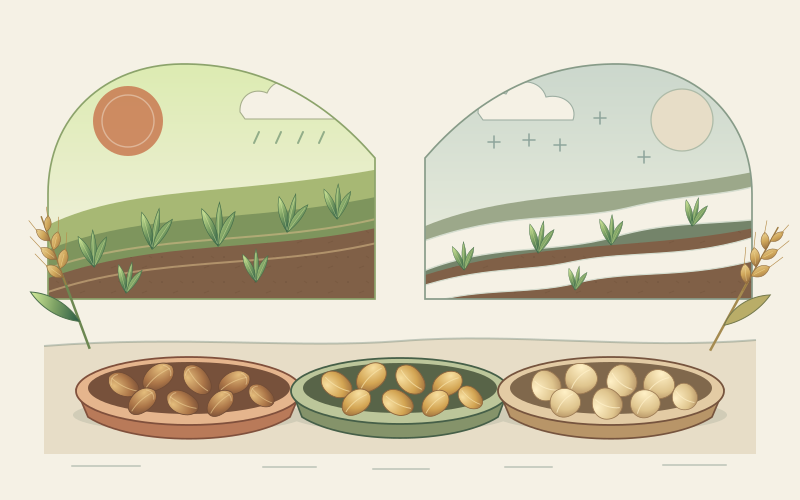
Spring and winter describe the plant’s seasonal programme
A spring-habit cultivar is sown for growth and harvest within the local growing season and does not require vernalisation to head normally. A winter-habit cultivar is sown in autumn so it can establish before winter. It usually requires cold exposure before producing a normal grain head. Intermediate or facultative types exist in some regions, so use the supplier’s precise habit and sowing instructions rather than forcing every cultivar into two choices.
Winter wheat is not simply a tougher spring wheat. Autumn establishment, winter survival, vernalisation, and spring regrowth all have to fit the site. A cultivar proven in a snowy continental district may fail in a mild, waterlogged winter, while a spring cultivar sown in autumn may not survive or may head at the wrong time. Regional sowing lists and nearby growers are better guides than a hardiness slogan.
Either habit can occur with red or white bran and hard or soft kernels. For a first plot, choose a locally trialled cultivar whose maturity avoids damaging heat or persistent harvest rain. The growing guide covers stand targets and timing.
Durum, spelt, and einkorn are not just colour classes
Durum: a different wheat species with a familiar pasta role
Durum is Triticum turgidum subsp. durum (also written Triticum durum), a tetraploid wheat distinct from hexaploid common bread wheat. Its hard, amber grain is commonly milled into semolina for pasta and couscous. Durum has strong gluten characteristics, but “strong” does not mean interchangeable with every bread flour. It requires locally suitable seed and agronomy, not merely a packet labelled “pasta wheat”.
Spelt: a hulled wheat with its own botanical identity
Spelt is Triticum spelta in species-based classifications, and is also treated as Triticum aestivum subsp. spelta under a broader common-wheat classification. Either way, it is not a hard/soft or red/white market class. Its hull remains tightly attached in ordinary threshing, so dehulling is an extra processing step. Spelt flour has its own dough behaviour and should not be substituted by assumption on the basis of an “ancient grain” label. Age of cultivation does not demonstrate better nutrition, easier digestion, or safer gluten.
Einkorn: another hulled wheat with a different genome
Einkorn is Triticum monococcum, a diploid wheat distinct from both common wheat and durum. It is also hulled and usually needs dehulling before food use. Its kernels, dough, and agronomic traits differ from modern common-wheat cultivars. “Einkorn” is a botanical identity, not a general word for any heritage cereal; emmer and Khorasan wheat are different again.
All of these wheats contain gluten and are unsuitable for people with coeliac disease. Wheat berries, durum, semolina, spelt, farro, and einkorn all appear on the Celiac Disease Foundation’s gluten-containing list. Refined flour, sourdough fermentation, organic production, and ancient ancestry do not make them safe. Wheat allergy is a separate condition requiring its own professional diagnosis and management.
Select for the plot first and the recipe second
Confirm species and growth habit
Check the botanical name and whether the cultivar is spring, winter, or another stated habit. Do not infer sowing season from colour, hardness, or the word “heritage”.
Check local maturity and disease evidence
Ask whether the cultivar heads and dries within your season, survives the local winter where relevant, and has useful resistance to diseases actually found nearby. Resistance is specific and never immunity.
Match height and processing to your resources
Consider lodging risk, available drying space, and whether you can dehull spelt or einkorn. Hulled grain requires more than the simple thresh-and-winnow routine used for free-threshing common wheat.
Choose the intended kitchen use
Use protein and flour specifications, not class alone, to guide bread, pastry, pasta, or whole-grain cooking. Trial a small amount before storing a large harvest.
Keep records of emergence, heading, lodging, disease, harvest, and eating quality. A side-by-side trial of two locally plausible cultivars teaches more than comparing names from different climates.
Sources and variety references
- USDA Agricultural Marketing Service: United States Standards for Wheat
- Whole Grains Council: What is a whole grain?
- Celiac Disease Foundation: Sources of gluten
- Peer-reviewed comparison of gluten proteins in common wheat, spelt, durum, emmer, and einkorn
- University of Minnesota Extension: Growing small grains