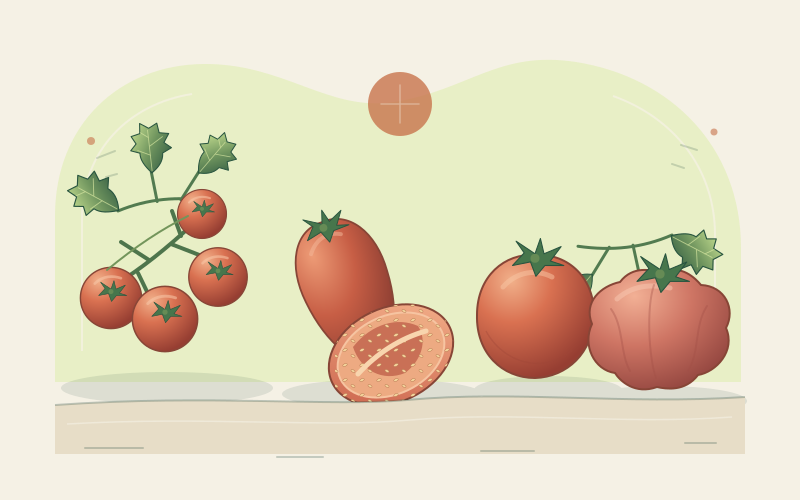
Read two labels instead of chasing a “best” tomato
All commonly cultivated tomatoes belong to Solanum lycopersicum, but cultivars differ greatly in stem growth, fruit size, colour, earliness, texture, and disease resistance. A large striped heirloom and a compact red cherry plant can be equally authentic tomatoes while demanding quite different space and care.
Start with the complete packet description. Growth habit tells you something about support and pruning; fruit type tells you something about shape and kitchen use. Neither establishes flavour, yield, or suitability in every climate. Earliness is especially useful where summers are short, while a named resistance matters only for the disease or pathogen strain specified by the supplier.
Determinate and indeterminate are growth habits
Determinate: a more limited framework
Determinate tomatoes, often called bush tomatoes, reach a more genetically limited size and tend to set a comparatively concentrated crop. Many suit large containers, small beds, or growers who want a batch for sauce. They still vary in height and spread, and heavily laden branches can need a cage or short stakes. “Bush” does not mean every plant is tiny or trailing.
Do not routinely remove side-shoots from an ordinary determinate plant. Those shoots contribute to its fruiting structure, and cordon pruning can reduce the crop. Some compact or trailing cultivars need almost no training, but follow the individual packet rather than assuming all determinate tomatoes have identical needs.
Indeterminate: continued stem extension
Indeterminate tomatoes continue producing new stem growth, flowers, and fruit while conditions suit them. They commonly need a tall, strong support and regular tying. When trained as a single-stem cordon, the grower removes side-shoots from leaf joints and eventually stops the leader according to local season and the desired number of trusses.
Indeterminate does not require every possible training system. Multi-stem and other managed forms exist, and semi-determinate cultivars blur a simple two-box choice. What matters is knowing the supplier’s intended method before growth becomes tangled. Our growing guide explains the shared planting and watering routine.
| Habit | General tendency | Training starting point |
|---|---|---|
| Determinate or bush | More limited stems; often a concentrated crop | Support laden branches; retain side-shoots |
| Indeterminate | Continued stem growth and sequential flowering | Tall support; cordon systems remove side-shoots |
| Semi-determinate or specialist | Intermediate or supplier-specific habit | Follow the cultivar’s stated training method |
Cherry, plum, and beefsteak describe the harvest
Cherry: small fruit on more than one kind of plant
Cherry tomatoes are small, usually round or oval fruit borne in clusters. They are convenient for salads, roasting, and eating out of hand, and many ripen relatively early. That is a tendency, not a promise: days to maturity and flavour depend on the cultivar and season. Both determinate and indeterminate cherry tomatoes exist, so fruit size alone cannot tell you whether to prune.
Currant and grape tomatoes overlap this small-fruited territory in catalogues. A grape type is generally more elongated, while names such as currant may imply especially tiny fruit. Check the actual plant habit and mature size instead of treating these marketing descriptions as strict botanical classes.
Plum: dense flesh for cooking
Plum or paste tomatoes are usually elongated, with relatively thick walls and a smaller proportion of watery seed gel than many slicing types. They suit sauces, roasting, and preserving recipes where a less watery pulp is useful. Roma- and San Marzano-type cultivars are familiar examples, but names and strains vary. San Marzano is not a guarantee that any similarly shaped fruit has the same origin or culinary quality.
Many paste cultivars are determinate, which can provide a useful batch for processing, but indeterminate plum types also exist. A glut still needs safe handling: follow a tested canning recipe and its acidification directions rather than relying on a fruit type to determine acidity.
Beefsteak: large slicing fruit
Beefsteak tomatoes are large, often broad and irregularly lobed fruit with substantial flesh for slicing. Their size can mean a longer ripening period and a greater load on stems. They can be red, pink, yellow, striped, or dark-coloured, and include heirloom and modern cultivars. Large fruit is not necessarily more flavoursome or nutritious than small fruit.
Medium round or oval “salad” and “slicing” tomatoes fill the space between these extremes. They are useful all-rounders, but the category is no more a growth habit than cherry or beefsteak. Support and pruning still come from the cultivar description.
| Fruit form | Typical character | Common kitchen use |
|---|---|---|
| Cherry | Small round or oval fruit in clusters | Salads, snacks, roasting |
| Plum or paste | Elongated; often dense, less watery pulp | Sauces, roasting, tested preserves |
| Beefsteak | Large, often lobed slicing fruit | Sandwiches, salads, thick slices |
| Salad or slicing | Medium round or oval fruit | General fresh and cooked use |
Match the cultivar to season, space, and meals
Rooted’s 60–100 days is an indicative first-harvest window, not a rating attached to every fruit category. Check whether a supplier counts from sowing or transplanting. In a short season, compare early cultivars and consider greenhouse protection where appropriate. In hot climates, local advice may favour different planting dates or heat-tolerant selections. No national calendar travels unchanged.
For a container, verify pot-size guidance, mature height, and whether the plant trails, bushes, or needs a tall cane. For sauce, decide whether a concentrated determinate crop or a longer sequence of indeterminate picking suits your kitchen. If disease has been identified before, compare only resistance claims that name that problem; “disease resistant” alone is incomplete.
Where space permits, trial two contrasting cultivars side by side and record transplant date, first ripe fruit, usable yield, support needs, and flavour. One plant is not a fair trial, and one season is not universal proof. The best tomato is the one whose habit fits your garden and whose fruit you will actually use.
Sources and variety references
- Royal Horticultural Society: Tomato forms and cultivation
- Utah State University Extension: Tomato varietal selection
- University of Minnesota Extension: Choosing and growing tomatoes
- North Carolina Extension Gardener Plant Toolbox: Tomato
- National Center for Home Food Preservation: Tomato canning essentials