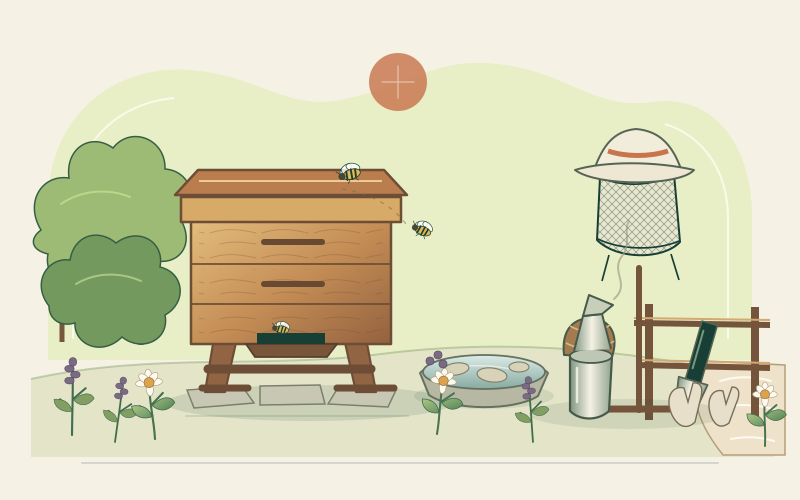
Learn with bees before living with them
A book can explain a brood frame, but it cannot let you practise lifting one steadily while bees move around your hands. Begin with a reputable beginner’s course and supervised apiary sessions. A local association, extension educator, or bee inspector can teach colony anatomy, calm handling, swarm prevention, food assessment, and pest and disease recognition in the context of your climate. Ask how a course combines classroom learning with repeated practical work.
A mentor is most useful before problems become emergencies. Agree when to make contact, what observations to record, and who can help if you are away. Visit through more than one season if possible: a small spring nucleus colony, a crowded summer hive, and a colony being prepared for winter pose different tasks. Handling bees also lets you discover whether the lifting, bending, heat, or stings are manageable for you. Anyone with a known serious sting allergy should seek personal medical advice before taking part.
Check the law, the neighbours, and the site
Beekeeping rules are local. Before buying equipment, ask the relevant council, landlord, housing association, and agricultural or animal-health authority about registration, hive numbers, setbacks, water, nuisance rules, and restrictions in parks or conservation areas. Requirements for moving or importing bees may be separate from rules for keeping them. Registration can also connect an apiary with disease alerts and inspection services. Do not assume that a rural plot, an allotment, or a roof is automatically permitted.
Speak with nearby residents early and listen to concerns about stings, flight paths, pets, children, and garden use. Explain where hives will stand and how you will manage swarming and water; do not promise that bees will never sting or swarm. A screen, hedge, or fence can direct departing bees above head height where local advice recommends one, but it must not block hive access or create a damp, airless corner. Keep hives away from busy paths, doors, washing lines, and boundaries where routine activity could cause conflict.
Assess forage and water across the whole year, not just during one spectacular bloom. Bees need a reliable, clean water source and access to varied nectar and pollen. Avoid flood-prone, heavily shaded, or chemically contaminated sites. Consider livestock, machinery, public access, and neighbouring apiaries too. More hives are not automatically better where flowers are scarce.
Budget for care, not a quick return in jars
Prices vary greatly by place and hive system, so build a local written budget rather than trusting a universal starter-kit figure. Include the hive, frames, covers and stand; bees; a well-fitting veil or suit, gloves and suitable footwear; a hive tool and smoker; training and association fees; and food-safe harvesting containers. Add recurring costs for replacement parts, health monitoring, locally approved controls when needed, feeding during shortages, and disease testing or disposal. Borrowing an extractor through an association may be more sensible than buying one immediately.
Leave money and space for expansion equipment before a growing colony needs it. Second-hand woodwork or comb can carry pests and pathogens, so have used equipment assessed by an experienced local beekeeper and follow official cleaning guidance. Cheap, incomplete equipment can become expensive when compatible parts cannot be found.
Time is a continuing expense. During active swarm seasons, colonies commonly need frequent, purposeful inspections; travel, record-keeping, cleaning, and learning take additional hours. Winter brings checks and preparation rather than total absence. Heavy supers and awkward ground add physical work. Arrange competent holiday cover and decide how many colonies you can inspect properly before deciding how many to buy.
Choose protective equipment and healthy local stock
At minimum, use a secure veil and protective clothing that fit, cover gaps, and allow you to work without rushing. Gloves can protect a beginner while handling skills develop; clean them appropriately because alarm pheromone and dirt can accumulate. Practise with the smoker and hive tool under supervision, and keep water, a first-aid plan, and a way to call for help available. Protective equipment reduces risk but never makes stings impossible or replaces gentle technique.
For a first colony, a small established nucleus colony, or nuc, is often easier to assess than a loose package: it normally contains a laying queen, workers, brood, and food on frames. Buy from a reputable local supplier who follows health and movement rules. Ask about the queen, origin, inspection history, temperament, and whether the bees are adapted to local conditions. Locally raised stock is not guaranteed disease-free or gentle, but it avoids some transport stress and can suit regional seasons better than stock selected elsewhere. Never acquire bees of unknown health simply because they are free.
Place the hive for inspection, then keep inspecting
Use stable, level stands on firm, drained ground, with enough working room behind and beside each hive. Local guidance should determine orientation, shade, wind protection, and spacing; there is no universal compass direction that suits every climate. Secure equipment against wind and animals without obstructing ventilation or routine opening. Provide water before bees establish a habit of visiting a neighbour’s pond or tap. Mark hives discreetly and keep a simple record of each colony’s queen status, brood, stores, space, health observations, and actions.
Bees are managed livestock, not self-managing garden ornaments. A colony can starve beside stored equipment, become overcrowded, swarm, lose its queen, or carry a rising varroa population while still looking busy at the entrance. Learn what each inspection is meant to answer, open the hive only when conditions and purpose are suitable, and close it securely. Do not perform disruptive inspections on a rigid calendar regardless of weather, but do not confuse leaving bees alone with good welfare either.
Plan the year around food, space, swarm management, varroa monitoring, disease recognition, and preparation for the local dearth or winter. Take honey only when a genuine surplus exists. A successful first year is one in which you learn to read colonies and meet their needs; it need not include a harvest at all.