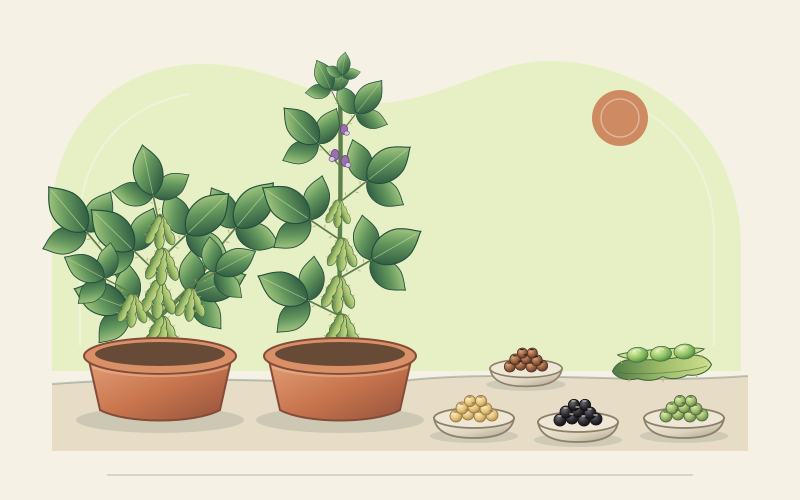
One species, two principal harvest goals
All cultivated soybeans belong to Glycine max. “Edamame” refers to the green vegetable harvest and to cultivars selected for that use; it is not a separate botanical species. “Dry soybean” describes seed harvested mature and dried for storage. A cultivar can sometimes be used at both stages, but breeding priorities differ and eating quality at one stage does not guarantee quality at the other.
Edamame types are commonly selected for large seeds, tender texture, agreeable flavour, bright green pods and a high proportion of well-filled pods. Their harvest is timed while the seeds are still succulent. Dry types are judged by mature seed characteristics, reliable dry-down and resistance to local production problems. Yellow, buff, brown or black mature seed coats can occur across cultivars; colour does not by itself identify a cultivar as edamame or field soybean.
| Trait | Edamame selection | Dry-bean selection |
|---|---|---|
| Harvest stage | Full seeds in bright green pods | Hard mature seeds in dry brown pods |
| Broad timing | Often about 70–100 days from direct sowing | Often about 90–150 days from direct sowing |
| Useful pod traits | Bright colour, good filling, manageable plant-height pod set | Mature dry-down and resistance to shattering or weather damage |
| Kitchen priority | Green-seed flavour, size and texture after cooking | Mature-seed cooking quality and storage |
| Postharvest | Prompt chilling; cook soon or blanch and freeze | Thresh, dry thoroughly, inspect and store airtight |
| Shared requirement | A locally suitable maturity and warm frost-free growing season | |
Photoperiod makes “days to maturity” local
Soybean development responds to both temperature and photoperiod. Many cultivars flower in response to sufficiently long nights, so moving a cultivar to another latitude or sowing date can change its vegetative period and final maturity. Temperature modifies that response. The result is that a packet’s day count is most meaningful under conditions similar to those where it was measured.
North American cultivars are classified into maturity groups ranging from very early 000, 00 and 0 through later numbered and Roman-numeral groups, sometimes with decimal subdivisions. Lower groups are generally used farther north, but the system is comparative rather than a universal calendar. Washington State University’s edamame guide illustrates the point clearly: varieties catalogued at 70–90 days took 100–120 days in its Pacific Northwest conditions. Regional systems elsewhere may use different names or ratings.
Read local evidence before a group number
Start with cultivars recommended by local extension, seed growers or gardeners at a similar latitude and elevation. Ask whether the stated maturity refers to green edamame or physiological maturity for dry seed. Those dates are not interchangeable. For dry beans, allow enough margin before expected frost and persistent autumn rain; for edamame, check whether succession sowing has actually been tested locally.
Do not assume “early” means short in every climate or “late” means higher yielding in a garden. A later cultivar beyond its adaptation zone may remain vegetative until frost. An extremely early cultivar in a much warmer or lower-latitude site may flower before building much canopy. Use the group as one clue, then look for a named cultivar’s trial results at your intended sowing date.
Plant habit and pod traits refine the choice
Soybean cultivars can be determinate, with the main stem ending in a reproductive structure and vegetative growth slowing around flowering, or indeterminate, with continuing vegetative growth after flowering begins. Semi-determinate forms also occur. Habit influences plant shape and the distribution of flowering and pods; it does not directly tell you the maturity group or whether the seed is best for edamame.
Most garden soybeans form bushes rather than climbing vines. Height and branchiness still differ, so read mature dimensions and leave enough room to weed and harvest. Flower colour is commonly white or purple, pod hairs can be grey or tawny, and pods often hold two or three seeds. These are identification traits, not measures of flavour or nutrient value.
For an edamame planting
Look for locally proven green-pod eating quality, uniform pod filling and a harvest window that fits your schedule. Large light-coloured green beans and pods with several seeds may be preferred in particular markets, but pod-hair colour and the exact number of seeds do not determine eating quality. If fresh use is the goal, avoid buying an unnamed field soybean merely because the dry seed is inexpensive.
For a storage crop
Prioritise reliable maturity in local conditions, intact pods until harvest and mature seed suitable for your recipes. Wet harvest weather can stain or damage even a well-filled crop. No seed-coat colour guarantees dry-down, storage life or a shorter cooking time. Select healthy food-grade seed and retain the cultivar name rather than storing everything as generic “soy”.
Read seed colour without overreading it
Yellow soybeans are familiar in many dry-bean and processing markets, while black, brown, green and other seeded cultivars have distinct culinary traditions. Immature edamame seeds are green because of their harvest stage, not because every cultivar will produce a green mature coat. Conversely, a pale dry seed does not reveal how its green pods tasted.
Seed appearance also changes with maturity, drying and storage. Immature seed is plump and moist; mature seed becomes firm and its coat develops the cultivar’s characteristic colour. Staining, mould or insect damage is a quality problem, not a variety trait. Compare clean mature samples for dry-seed identity and freshly cooked samples at equivalent green maturity for edamame quality.
Make a small, recorded comparison
When local information is limited, trial two suitable named cultivars side by side in the same warm, well-drained bed. Keep the intended harvest consistent, and do not compare an early edamame pick on one plant with mature dry seed on another. Record emergence, flowering, plant size, first well-filled green pods, mature dry pods, weather setbacks and eating quality after proper cooking.
| Check | Question to answer |
|---|---|
| Identity | Is it a named Glycine max cultivar from a reputable supplier? |
| Purpose | Was it selected for edamame, mature dry beans, or another agricultural use? |
| Adaptation | Is there evidence from a similar latitude, elevation and sowing season? |
| Maturity | Do the stated days refer to green harvest or mature seed? |
| Plant and pod | Do height, habit and pod characteristics fit the bed and harvest plan? |
| Food status | Is the harvested crop intended for food and free from unsuitable seed treatment? |
Our growing guide covers warm-soil sowing and the two harvest finishes. Whichever cultivar you choose, green pods must be chilled promptly and mature beans must be dried before airtight storage.
Save seed with identity and food safety in view
Soybean is predominantly self-pollinating, but saved seed is not automatically uniform, correctly labelled or free from disease. Begin with a named cultivar and observe any supplier restrictions. Select healthy plants that represent the desired type, keep lots separate and label them through harvest, threshing, drying and storage. Do not save seed from diseased plants or mouldy pods.
Let planting seed mature fully and dry it thoroughly before cool, dry, airtight storage. Keep it separate from the cooking jar and from any chemically treated planting stock. Seed saving does not change the food rule: mature dry soybeans still require proper preparation and thorough cooking before eating.